On adoration

I have only a moment before I’m supposed to step onto the treadmill of this day.

But I found myself engrossed in each member of my family as we hurried them into shoes and jackets and car seats, and as I waved them down the road and turned back into the living room, I found I leapt — actually physically leapt — toward the computer to write.  The treadmill can wait.  This moment, pregnant with human beauty and the fullness of falling rain, asks for something else.

It’s been a rough two weeks of no daycare and much family time, so much, in fact, that it has become easier to lose patience and harder to find it again.  There has been a mappable increase in hollering and sarcasm as we’ve worked our way through to today.  But here we are, and the boys are off to daycare.  It feels like total freedom, though I’m entirely booked already, and therefore it feels like heavy relief to finally be able to dig into what needs work.  But these are the images I carry with me into this day:

1. Malachi, at breakfast, carefully feeding me each of his enormous blueberries with his soft, carroty, fumbling fingers.

2. Ezra, after finding his moose rain jack ALL BY HIMSELF, informing me that it has a hood, and insisting I look as he solemnly puts it up to frame his smooth elfin face and glowing hazel almond eyes.

3. Len’s pants and jacket soaked in the downpour as he brings each child in his turn to the car, hurrying against the inevitable drenching but gentle in his haste and hugeness.

It feels strange to be so thrilled at their departure and yet so reluctant to let them go.  Malachi in particular, at this sweet stage of last-babyhood, feels like a precious gift I cannot release; I want to keep him home with me alone, snuggled under the covers, nursing and playing and gazing and singing and watching his world unfold.

It seems, sometimes, this is what it all boils down to, on its best days: the whole world condenses into a mother and a child, a father and an infant, any pair of people who open themselves up to light, to rain, to each other, to adoration.

On unswerving support

As I may have mentioned, we’ve been having a hard time lately.  Some of that is related to the course I’m teaching (new institution; new course; new online-ness); some of that is related to giving up all my baby-free time to teaching said course; some of that is the persistent rain or the groundhog in my garden.  Some of it is entirely self-imposed, like our goofy decision to try and spruce up the kitchen, which has necessitated hours and hours of research, inquiry, decision-making.  Now I’m trying to make bigger decisions about whether and what to teach in the fall and what it would mean for my life to keep doing this adjunct thing (which, let’s face it, is not only grossly underpaid but also kind of demoralizing for the minimal engagement it offers with students and the institution).  Basically, I’m running around a headless bird.  It’s not pretty.

So here’s an email exchange I had with my beloved partner today.  I feel it illustrates some of why I’m the luckiest person in the world.

-----Original Message----- 
Sent: Tuesday, July 02, 2013 1:58 PM
To: Len Bartel
Subject: more kitchen questions

Backsplash: skip indepth backsplash and just tile all the way 
down to the counter?  By stove as well as sink wall?  will that 
show the window-height-differential less?  If we do backsplash, 
should we include sides on sink wall and stove and microwave 
wall?
These are some of today's questions.
Also: what should I do with my life?
And: why does Blackboard suck so very much?
And perhaps: will you still love me despite my having eaten 
ALL the garlic in the house for lunch?
Love,
me
PS Yes, Jessica [the countertop salesperson] has come and gone.

He replies: 

"Where to start...

I think tile down to the counter, but only on the sink 
wall (not the others, I think it might look a bit odd) - 
carrying the same line from flush with the cabinet above 
the toaster oven across to under the chicken.  It's hard 
to get a sense of what it would look like with the indepth 
backsplash in addition to the tile.  

What should you do with your life?  Write.  Blog.  Maybe 
consult. Be the fabulous mama that you are.  You're a 
fabulous writer, and schedule hasn't allowed you to give 
it the appropriate focus.  Of late, when you are most [you] 
[I had to remove a pet-name-adjective] it's when you write 
and have the mental space to be creative with the boys 
when you have them...  

I have no idea why Blackboard sucks so very much, but I'll 
support you in the accusation.

Yes, I will still love you despite eating all the garlic.

Presents [this is where he really goes bananas, since I 
forgot to even ASK what we were giving the family members 
who need birthday gifts this week]:  iTunes for AJ ($15).  
Big Allagash (need to procure - can do tomorrow before we 
go over), and maybe a small e-card to Amazon (need to procure 
will do so tonight) for BB.  Done.  And done.

You're my love"

And since I'm in an email-quoting kind of mood, here's more 
unswerving support from that quarter.

My dad writes: 
"Yes, quite right adjunct professor sucks...
only slightly better than being out on the street."  

To which I can only reply: 
"Well, there are huge variations in adjunct experiences, 
and for some of us, at some institutions, it may be much 
worse than being out on the street.  That's what I'm 
working to ascertain right now.  Seth Godin 
(marketing/strategy author I like) had a good blog post 
recently on money, reminding us that not spending is the 
same as earning, and not earning is the same as spending.  
There are many things I could do to build ways to earn 
more (but they take time) and a few things I could still 
do to spend less (those, also, take time).  The bottom line
discovery here is that teaching used to feed me, so it was 
worth various aggravations.  But the ways I'm able to do 
it these days, it's feeding me a lot less.  And that's 
worth listening to, I think."

Support in complexity.  That's about as good as it gets, folks.

On (not) seeing ourselves

A friend of mine who is six months pregnant just posted on Facebook that after days of running around in sweats and not showering, she kind of forgot she was pregnant.  But once she got glammed up again, and into regular maternity clothes, she was reminded.  (I know, I know; she’s CLEARLY in the blissful second-trimester-so-not-everything-hurts-yet stage.  We honor her by not pointing this out in reply.)

And I was just thinking today, while strolling down the lawn with a son’s hand in each of mine, that my favorite thing about having kids (at least my kids, at least on a happy sunny afternoon) is how totally ME they make me feel.  With them, I am funny; I am loved; I am wanted — regardless of how I might actually look. In fact, I am often surprised to emerge from some enjoyable interaction with my family, where I’m feeling smart and engaging and magnetic, and wander past a mirror.  Good heavens — who is that wrinkled frump with the atrocious bedhead?

I suppose there’s a pretty obvious down-side to this phenomenon, but mostly I just love it.  I mean, as an American woman, I’ve spent most of my life a little unhappy about how I look.  (I say “a little” because I’m one of the lucky ones — my genes tend toward slimness, in what I hope is a decent tradeoff for the cancer and alcoholism that they also seem eager to share.)  Forgetting how we look to others is one of the great pleasures of life AND one of the great signs we’re living well.

The all-girls summer camp I went to and worked at had very few mirrors, and I remember being startled, sometimes, that I HAD a face and a body.  My time was spent making friends, making things, learning skills; my body was always running and swimming, canoeing and hiking, singing and dancing.  I was an energy, a personality embedded in a physical competence that was always stretching; I relied on that body for what it could DO for me, not for what it looked like.  I still love watching women athletes at their sport, because it’s one of the only times we get to see female bodies in peak form, carried with a sense of expertise and comfort rather than self-consciousness.

And of course all this shifts somewhat once we have babies (IF we have babies; the same argument applies to the general process of living on the planet, too) — the sags and the bags, the wrinkles, the stretch marks.  But it’s like that meme I saw one time: these aren’t stretch marks.  You’re a tiger, baby, and you’ve earned your stripes.  (Yes, I’d copy the meme here except I’m unclear about meme copyright AND the belly pictured doesn’t look quite like mine…)  There are myriad reasons our bodies are even more amazing now that they’ve grown and nourished little lives.  But what’s even cooler to me is this: forget about how our bodies look.  Just forget about it.  They do the hard and constant work of feeding, cleaning, sharing, amusing, and teaching our people.  They are where we need to be, and let’s hope it’s comfortable there.  We do what we can to take care of our bodies, but our focus is on our intelligence, our compassion, our creativity, our patience.  The joy of building.  The sacredness of what we’ve built.  And it’s absolutely delightful that we are often invisible to ourselves precisely because we’re too busy living all that beauty.

On meeting chaos with joy

I started writing this post seven minutes ago, only to be interrupted by a phone call from a job prospect, wondering if we can talk via skype rather than conventional phone. So now I’m downloading skype for my new computer and trying to remember if I have a login and whatnot (it’s been a while since I used skype, since facetime works better around here and most of my peeps have macs or iPhones). And it will complicate life later, because now I have to consider how I look and how my background looks…sigh. This strikes me as a typical moment in a typical “me” day.

Okay, and as I am downloading skype and creating a new account (because it’s faster than trying to track down my old one), I get an email from a student who will be taking my summer class at the University of Southern Maine. I reply, carefully, and with the consideration her thoughtful questions demand. Twenty-three minutes after I started writing, I continue.

See? See? I want to shout to Life. THIS is what I’m up against. I can’t do a darned thing for myself without the whole WORLD rushing in. But here’s the thing (even after the hyperbole): I love all this multiplicity. Sure, it makes me crazy sometimes, but I love knowing that tomorrow I get to play with my boys again, and it’ll be warmer, so maybe we’ll head back to the playground near our house and I’ll watch Chi learn to climb higher and farther (which stops my heart but is wicked good for my reflexes). Maybe we’ll pick more flowers, or just look at the deepening maroon of the emerging hyacinths. (Ezra told me yesterday: “Sometimes I just like to say the word hyacinths. Hyacinths.” He’s so my boy.) Maybe there will be swinging; maybe there will be falling down; almost certainly there will be some shouting and also lots of hugs. And I won’t get a damn thing done except support two very small people in the process of becoming bigger people. And here’s the best part: the day after THAT I get to spend prepping my summer course, which is a senior thesis seminar on sustainability. How lucky am I? And how nuts, that these are only the two largest and most urgent of my many different tasks and responsibilities? This goes for all of us, I know.

It occurs to me that the absence of pattern, or maybe the prevalence of interruption, is a hard thing for all human creatures, small and big, and also that our efforts to construct regular patterns can keep us focused on the wrong things, or looking through the wrong lenses. It’s one of the prime lessons of parenting, right? That attention to the random, spontaneous declaration is rewarding; that saying yes instead of no can take us all further, together; that getting messy is okay when we have nowhere to go and we live in the company of a great blessing called the washing machine. The hardest days of all are the days we have to get stuff done, when, as my mother-in-law once famously put it, “We don’t have TIME for joy!”

We always have time for joy. It is the root of our humor and lord knows we need that ALL the time. It is the base of our compassion, without which we aren’t even human. It is, at best, the quiet breath that’s always waiting inside us, the one we are physiologically incapable of actually fully exhaling. The trick is remembering it, befriending it, and, quite frankly, expecting it to be around as much as it is. It’s a beautiful surprise, constantly available, and ultimately life-altering.

On tension

Surface tension.  Also known as total serenity.

Surface tension. Also known as total serenity.

I used to be a singer, a habit which has served me well as a parent (and not just for singing pretty songs).  Four nights a week when I was in college, my women’s acapella group would rehearse for two hours, and we’d usually perform at least one other night.  It was a lot of singing and it came from a place of extraordinary joy.  Plus, my abs were things of beauty: firm, sculpted, and in perfect support of my breath, voice, posture.

Shortly after that, I started taking yoga for the first time.  I listened enthusiastically to the suggestions on breathing: “Let the air fill you up!”  I can do that!  “The fullness of your breath grounds you, connecting you to the world around you.”  Yes!  But then: “Let your belly be soft.”  WHAT?  Obviously, I said to myself, these yogi people know nothing about breathing.

Now, nearly twenty years later, I find that I have lived, mostly, in a constant state of suspension between these two ideals: tension (albeit supportive) and softness (albeit chosen, and therefore disciplined).  I suspect this has something to do with the human condition: that we are given certain circumstances and we need both to accept them (softness) and to make something of them (tension).

This is the essence of Saul Alinsky’s principle, that we have to live in the world as it is and work toward the world as it should be.  It is also the essence of productivity: understand where you are that you might move forward (and the kind of non-acceptance that manifests as self-flagellation doesn’t help).  It’s the essence of teaching: start where the students are and go on from there.  And of course it’s the essence of parenting, of love, and creativity: compassion, for ourselves, our kids, our world, must undergird every disciplined effort to build and teach and grow.

All the love is making this dog tense.

All the love is making this dog tense.

We can all agree that breath (and for “breath,” from here on out, read “love,” “openness,” “curiosity,” or “spirit”) fills us up, that it simultaneously grounds us and lets us fly.  The musculature and intentionality that produce such breathing are real and profound: such breathing is our natural state (as in sleep), but in the world of our realities, pretty much everything gets in the way and messes it up.  So between nightmares and day jobs, childcare and health care, commuting and computing, we end up – most days – tangled beyond recognition.  For most of us, it takes a walk in the woods (which we don’t take) or a round of meditation (which we don’t get) to rediscover our core.  When we do, we can begin to parse our lives with a little more clarity.  Without clarity and rest, we tend to experience stress (which might be considered tension with an attitude problem).

But here’s the thing: tension itself is not bad.  Tension is a kind of discipline or structure, and its manifest in both.  There are many ways to good posture, or effective work habits, or appropriate human interaction, and tension is a part of them.  I am reminded of the persistent knee and hip pain I experienced in graduate school that stopped my running habit, and of the excruciating SI joint issues that developed in my first pregnancy and didn’t resolve long after the second.  I had worked out and stretched diligently through the first but learned in the second that rest was the only solution, so by the time I sought expert help I was not the strongest person you know.  I was, however one of the more flexible.  And that turned out to be the problem.  I didn’t have enough tension!

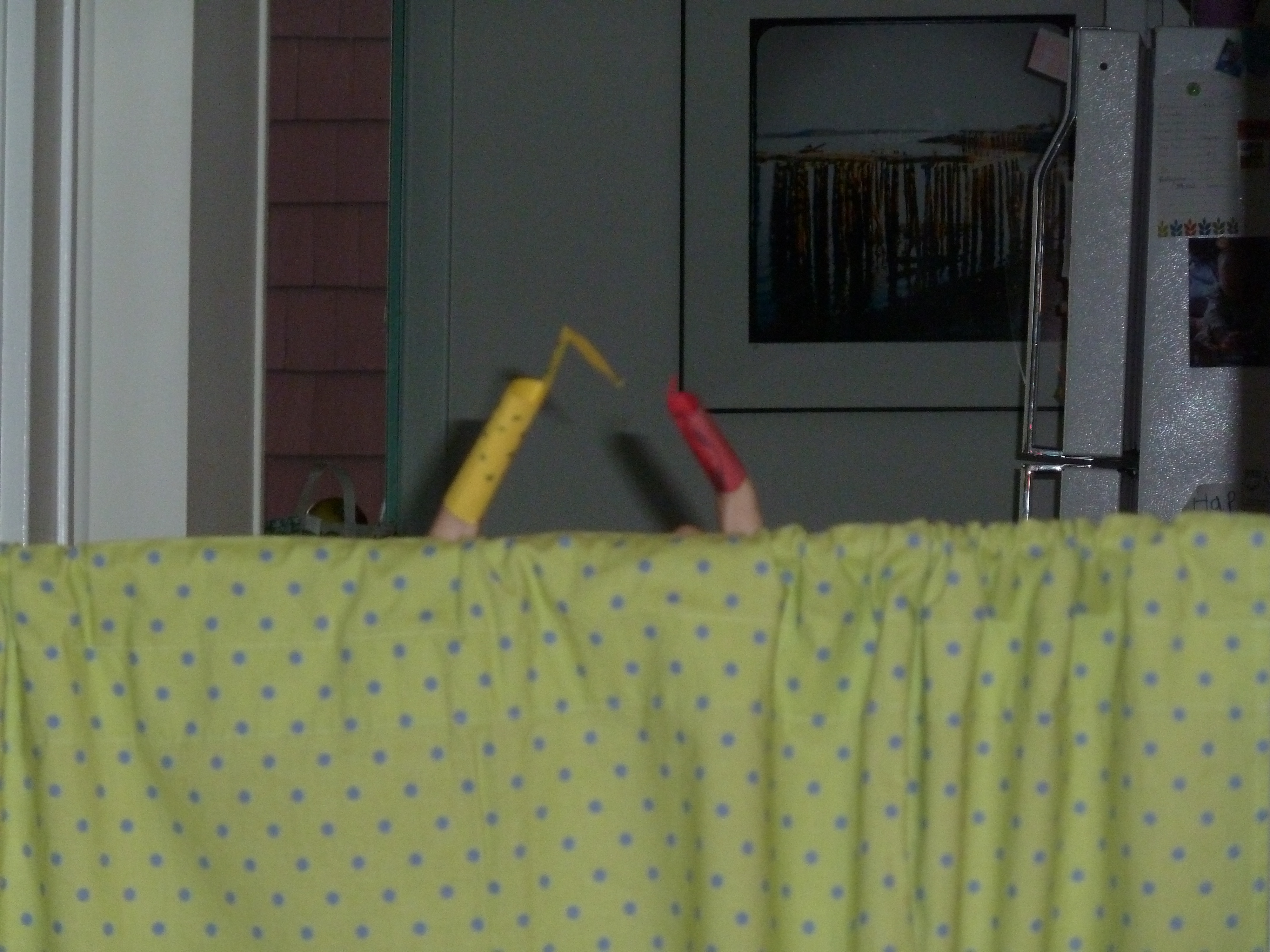
You maybe can't tell, but this is a tension rod holding up our puppet theater.  Tension promotes play.

You maybe can’t tell, but this is a tension rod holding up our puppet theater. Tension promotes play.

Hahahaha, she laughs, only slightly hysterical – two babies under three years old and mounting fiscal pressure that made it important to get more work and find more daycare…but it’s true.  That kind of emotional tension was keeping me from the strength-training that my body needed in order to create the muscular tension that would hold my bones in the right places.  Roughly.  Part of the pain was from too much tension; part of it was from too little.  Sound familiar?

It’s the same logic with our lives: an absence of tension doesn’t mean smooth sailing: it means we aren’t learning or pushing or changing or MAKING change.  Of course it’s delightful when in the midst of complications something goes smoothly (I still remember, as do all women who have delivered a baby vaginally while conscious, that moment of exquisite, whooshing relief when at long last that tiny body fully squeezes out of your own).  The trick to managing tension in the rest of our lives, I’m finding, is that damned balancing act.  We need some tension, but not too much; we need resilience and self-care for when we are overwhelmed by too much tension anyway; we need the right kinds of tension, at the right times and places, to keep us alert and accountable; we need counterbalancing forms of relaxation to remind us of our natural state and to help us recalibrate.  This is to say, we need the sturdy muscles of our singer’s core to give us voice, to help us run.  And we need to know how to release that posture to assume a gentler one for the yoga mat.  We need to relieve that tension through twisting core stretches and maintain it with vigorous exercise.  But what we can’t do, it seems, is sidestep the question entirely.  Which I’ll admit makes me a little grumpy.  Because I like the idea of smooth sailing.  I’ll let you know how that works out for me.

And another thing I’m learning from the kids

I’m greatly impressed, lately, by the power of silence.  And not just the kind you think I mean, where the noise finally subsides and we can hear the ringing in our ears and take a deep breath before it all starts up again.  No, I mean the kind of silence that is intentionally made and kept as a conscious choice.  My older son, Ezra, likes to ask for silence in the car on the way home from daycare.  And tonight, as I lay next to him at bedtime and asked if he wanted a song, he said, “Not yet, Mama.”  And he lay quietly for a good long while.  I used to listen, in the silence, for the things I wasn’t hearing: the music, the conversations, the stories.  I used to plan for what would come next or imagine what might have been.  But lately I’m just trying to do what he does: to hear the world as it is and his own presence in it, without comment or contribution.  Just listening to all that comes in on the breath and noticing all that goes out with it.  The world is a full place indeed, and those places of quiet are one of my son’s many gifts.

Our home bread revolution

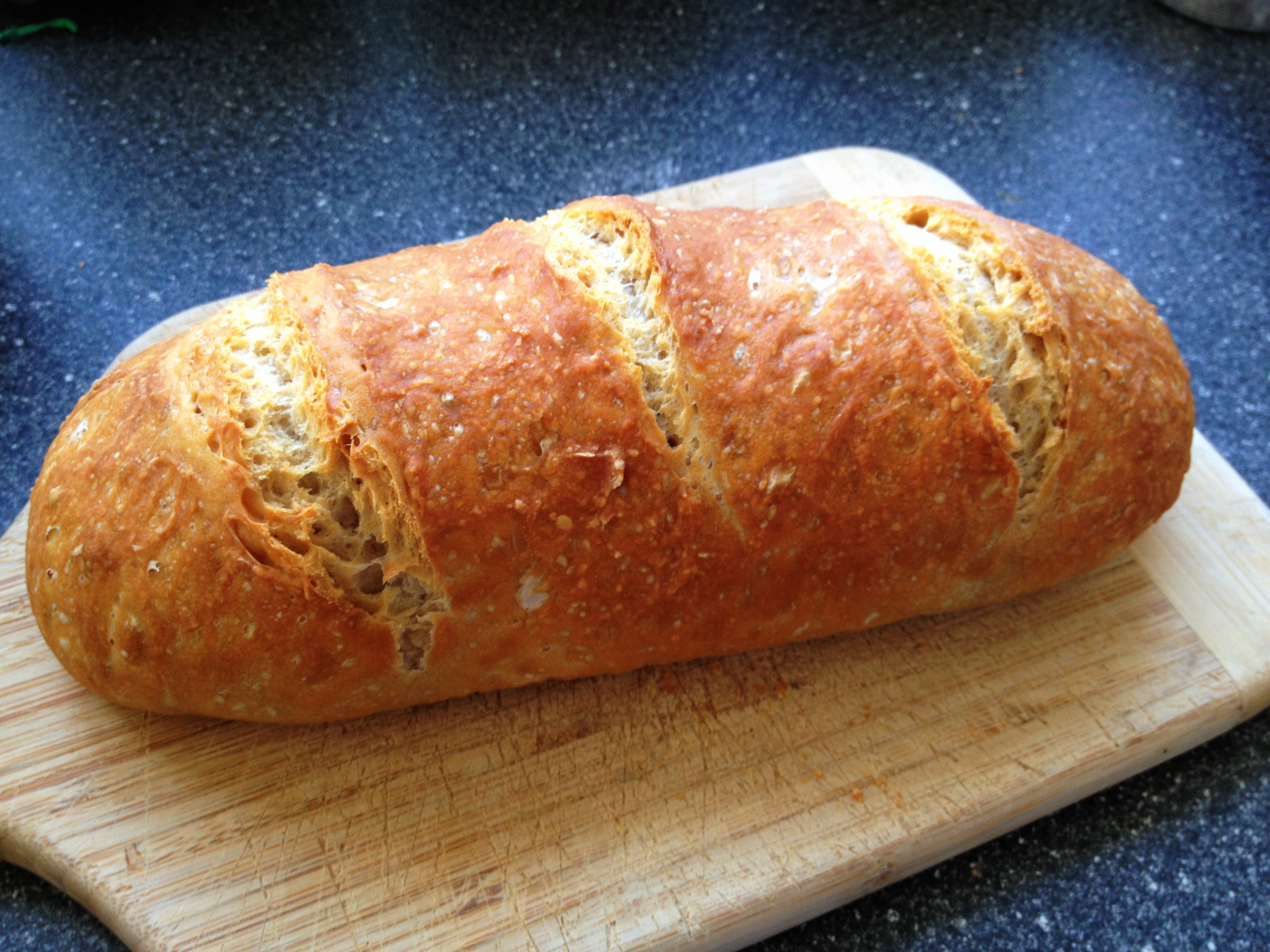
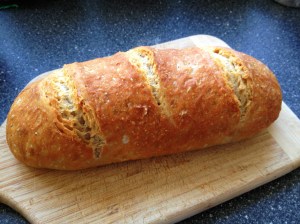
IMG_1245I am someone who lives in the perpetual struggle between wanting to live frugally and wanting to eat well.  There are certain non-negotiables: organic dairy products; decent wine/beer; and until recently, good bread.  There are two fabulous local bakeries that we like to support (don’t you love it when a good cause is also the best food around?), but we are also bread-hogs, and our little habit was costing us maybe $50 a month.  I’d tried baking bread off and on for the last few decades, but the best I could do was a very good (but highly specific) polenta bread and a decent sandwich loaf.  All other attempts were met with varying degrees of disappointment and rage.  By me, I hasten to add.  Len loves whatever I cook and is uniformly supportive (which I don’t understand but revel in).

So imagine my skepticism when I read about these “no-knead” bread strategies that cost less than a buck a loaf.  But imagine my experimental enthusiasm as well!  A few weeks ago, I tried it.  This is the recipe that, I believe, started with Mark Bittman’s thing on no-knead bread, but I found it here at the Italian Dish Blog.  It seems like an awful lot of flour (and I changed it some, as detailed below), but then, it makes three loaves of bread!  And the most incredible thing is that it is really really easy AND really really delicious.  Raise your skeptical eyebrows all you want, people.  Try it and see.

So several times a week, now, our house is filled with the glorious aroma of baking bread; our lives are enriched by those first warm slices slathered in melting butter; our ordinary toast — with jam, with melted cheddar, with slices of creamy avocado — is now a thing of transcendent beauty.  Once a week I mix a new batch and let it sit.  Honestly, the worst thing about this whole undertaking is that the bowl I use takes up too much room in the fridge.  Poor poor me.

So here’s the recipe:

  • 3 cups warm water
  • 1 1/2 Tablespoons (or 4 1/2 teaspoons or 2 packets) granulated fast-acting yeast
  • 1 1/2 Tablespoons (ditto) coarse salt
  • 3 1/2 cups bread flour
  • 1 1/2 cups all-purpose flour
  • 1 1/2 cups white whole wheat flour

You mix the yeast and salt into the warm water — I use a fork to make sure it’s all dissolved.

Mix the flours together and then add them to the yeasty water all at once.  Mix until moist.

Cover and allow to rise (not airtight) for about two hours — longer is fine.  We understand the vagaries of life, and so does this dough.  (And in case you feel like there’s some professional fancy dough-covering device needed — nah.  I use a recycled plastic grocery bag with the handles tied in front.  Sue me.)

Refrigerate at least 3 hours (this dough is really sticky and wet, and refrigeration makes it easier to handle).  I leave the bowl in the fridge for up to a week, taking off what I need as I go.  Though you will be tempted to rest other foodstuffs on TOP of the dough bowl, it’s probably not a great idea.

To bake: put a sheet of parchment paper on a lipless cookie sheet or pizza peel.  When it curls up repeatedly, curse under your breath and place the parchment paper box lengthwise across it to hold it down while you prepare the dough.

Cut off, with a serrated knife, about a third of the dough.  If it’s sticking to your hands, you can dust them with flour, but I rarely need to do that, and it’s much faster if you don’t have to get things OUT for this.  Shape the dough into a sausagey-french-loaf-kind-of-shape as quickly as you can, pulling the top under to the bottom and hanging it to lengthen it .  The surface should be taut and smooth.  This should all take maybe 30 seconds.  Set dough on parchment paper-covered cookie sheet.  Let rise 30-40 minutes (and don’t worry if it doesn’t do much.  Mine rarely does).

20 minutes before baking, put a pizza stone in the center rack of the oven and a shallowish pan on a lower rack (I find it best if the pan is not directly beneath the stone).  Preheat your oven to 450.

Immediately before baking, slash the top of the bread three times with a sharp knife.  Slide the dough, paper and all, onto the hot pizza stone.  Then quickly pour one cup of water into the pan and close the oven door.  Bake 30 minutes, turning the paper once if your oven is crappy and uneven like mine.

When bread is almost finished, use a clean towel to lift the loaf briefly, peel off the paper, and return the bread to the stone (ideally to a new, hotter spot on said stone).  Crisp for five more minutes to brown the bottom crust.

Enjoy your absolute wizardry; brag to all your friends.  Regret it when they demand taste-tests.  A few days (or hours) later, when your loaf is gone, just grab more dough from the bowl and fire it all up again.

A last note: when you go to make a new batch, you don’t have to wash out the bowl.  According to the authors at The Italian Dish Blog, the leftover yeasty doughy goodness just adds to the flavor.  And indeed it does, my friends.  Indeed it does.  Divine.

If all this sounds a little much, rest assured that it’s quicker than reading these instructions.  It’s quicker than BUYING bread.  It’s a simple habit to develop and you’ll be glad you did. (Heavens, you’d think I was investing in your bread success.  I don’t know how to do that.)  Anyway, enjoy.

On writing as an act of generosity

I am a big fan of generosity.  I love the notion of giving, of gift as interaction and interaction as gift.  And I’m a big fan of writing.  But it has only recently occurred to me that those might be the same thing.

Naturally, there are many writers whose work felt like a gift to me — Barbara Kingsolver, Wendell Berry, Billy Collins, and many more — but it felt private.  It was the emotional counterpart to my teenage habit of hugging a book to my chest as I snuck off somewhere to read (since I was not supposed to be reading but rather doing something “productive” like washing dishes).  I cherished the words and the stories and I felt wildly privileged that they spoke to me.  To ME!  But as I got healthier and wholer, I came to see that the larger political significance I’d always attributed to stories was perhaps the same thing as this deeply personal conversation, just on a broader scale.  As these and other writers opened my eyes and my soul to the wider world, and as I learned (ironically, well AFTER my PhD in Comparative Literature) how many other eyes and souls were out there, doors ajar, because of their writing, I came to see that this is their gift to the world.  Barbara Kingsolver, in fact, talks about this in a video she did way back when Animal Dreams was first published (which I can’t seem to find today); she says, essentially, that the most important thing she can do for this broken world is to put her butt in chair and write.  It’s true, she tends to work on the macro level, I think: witness this excerpt from a conversation with David Gergen about how stories structure and define our world, our nation, our communities:

“DAVID GERGEN: –but through your own novels to invent a new set of stories for us, is that what you’re about?

BARBARA KINGSOLVER: It is in my own little corner. That’s what I’m trying to do. I love what Joseph Campbell said about mythology. He said that our stories are what holds us together as a culture, and as long as they’re true for us, and as long as they work for us, they–we thrive. And when they cease to become true, we fall apart, and we have to reconstruct them or revitalize them. We have to come up with new myths.”

And of course that’s what she does: her stories enable us to connect to the land and the people who work it; to understand the histories of human movements and failures; to imagine ourselves into a capacity for managing heart-wrenching, world-churning change that right now seems certainly fatal.  But what’s brilliant about Kingsolver is that she works on the micro level as well.  Her characters and her language are so compelling, so utterly moving and hilarious and desperate and comforting, that we can’t help but be drawn in.  As a reader, I’m in awe of that.

But now I find myself thinking, for the first times in my life, as a WRITER too.  It feels like hubris, and perhaps it is. But I’m slowly, slowly catching up to the notion that when we have a gift to give and we believe in generosity, then we have to give it.  Even if it is our writing.  Even if it is a painful exposure or a risk or an embarrassment, or whatever it turns out to be.  Maybe we have to do it.  (I’ve had little angels tell me this before — angels in the sense of folks who show up to say wise things or be there when you need them — the most memorable of which was a guy at a conference in San Francisco years ago who came up to me after I’d spoken in a seminar to ask what my book was called.  I said I hadn’t written one, and he asked why not, and then he held my eyes while I squirmed.  “This isn’t about ego,” he said.  “The world needs to hear what you have to say.  You have to get out of the way.”)

So here I am, trying to get out of the way, though a little confused by the whole thing and unsure of what comes next.  I am grateful for the readers I have and hopeful for more; I am grateful for the extraordinary writers (novelists, bloggers, poets, and authors of all stripes) who inspire me every day with their bravery and their brilliance.  I am grateful, I suppose, for the gift I’m perceiving and for those of you who are out there to give it right back by receiving.

On dancing and seeds and grace

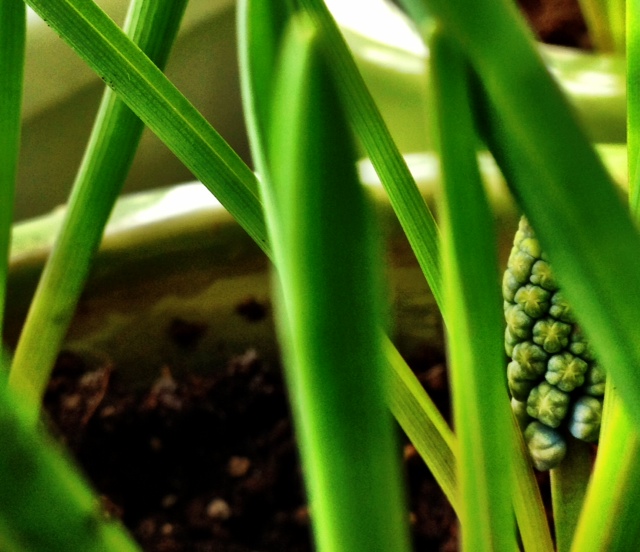
grape hyacinth budHere’s my afternoon: starting seeds with Ezra in the basement; coming upstairs to find Len and Chi home from the grocery store and provisioned with a tasty new beer (well, Len, anyway); dancing with both babies to The Miseducation of Lauryn Hill.  Her song “Bonus 2,” which is essentially First Corinthians brought to extraordinary life, always reaches out to me — but today, as I held my small fevered Ezra in my arms and danced, it was transcendent.  To sing those ancient words of love to my son, through Lauryn’s music, to feel the rhythm move through the bones of this old white Colonial, well, I was shaken.  I was lifted up.

I don’t often write about spirituality, or at least not as such.  It’s partly because I feel those are kind of private issues, and also because I’m uncomfortable with the ways articulations of our own faith can end up looking or feeling like advocacy or pushiness to others.  I confess, I’m also tired of the self-congratulatory tone of lots of the writing out there on religion.  And also, let’s face it: I’m a seeker who was raised Quaker (more in the secular humanist end of that spectrum) in a kind of do-as-I-say-not-as-I-do sort of way.  So I have no sense of authority, only a heart full of questions and gratitude.  I tend, then to use the language of mindfulness or grace, since the former is more of a practice and the latter more of an acceptance of what seems an obvious and widely accepted truth.  For me, there are lots of interchangeable words that describe what I have faith in: love, beauty, the sacred, harmony, nature, the universe, grace, providence, serendipity, the Way, the Light, truth, hope, and of course the many permutations of god.  It is clear to me that music is sacred, as are the gifts of all artists and growers and makers and seekers — all creatures, and especially those who offer up something of beauty, who uncover or create or otherwise act with generosity in this sad and broken world.

I’ve been trying to read Margaret Wheatley’s So Far From Home, though it’s hard, because its premise is that we cannot change the world; we can only accept our powerlessness and do our best to live whole and beautiful lives by doing the right work because it is work that needs to be done.  That living, that standing in contrast to the crazy and the broken, is itself transformative.  I buy this, mostly, because it seems smart and truer than anything else I know, but I’m not wise enough or whole enough to live within it.  I’m trying.   Most days, I’m still seeking, perhaps too anxiously, for that “right work,” unable to accept that where I am is enough.  But on a day like today, that truth rings out: of course it’s enough.  Perhaps not forever, but I don’t live in forever.  I live right here, right now, right in the middle of all this beauty, surrounded on all sides by grace.

Making MORE, not less, of ourselves

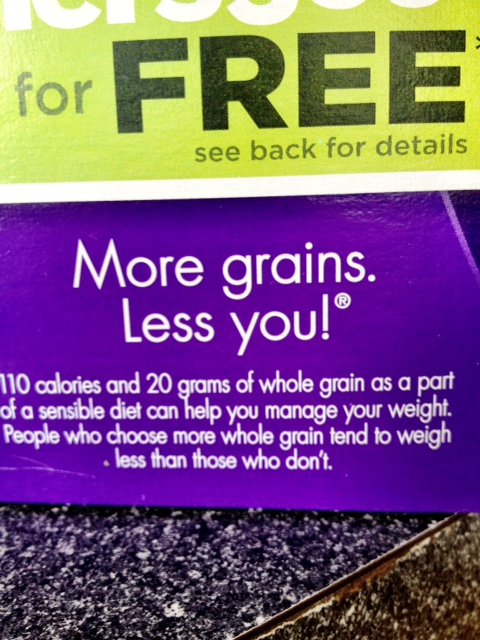
But, but, but...here I've been working so hard to make MORE of me!

But, but, but…here I’ve been working so hard to make MORE of me!

I know I’m not always in the best mood in the morning, but it was still a shock to see this on the cereal box.  And to realize that this is what my (mercifully pre-literate and mercifully male) kids have been staring at.  And to realize that this kind of message is everywhere.  How broken is that?

I know they mean well, that it’s a weight-loss message, but still.  Come ON, Cheerios.  Surely you’ve noticed the whole self-actualization agenda that is at least trying to keep pace with our nation’s long-term self-hatred protocol?  Maybe this is another reason why I shouldn’t eat Cheerios.

In all seriousness, though, this has started me thinking about the range of ways our culture invites us to be less than we are, and not just physically (though that encompasses not only weight issues but the whole range of gender-normative behaviors and style).  Jobs are stultifying enough that most of us have to compromise most of our selves in order to earn the paycheck and the benefits we need; educational programs force us into outdated molds of specialization; even cocktail-party conversations (I think; I can barely remember that far back) expect a short answer to the standard question: What do you do?

Here’s what I’d like to say to that, today: I raise two pretty awesome little boys in ways I hope are feminist and respectful and empowering.  I read whenever I can.  I write (academic work, poetry, this blog, articles, children’s stories) and seek to write a lot more.  I hope and plan to get paid for writing.  I serve on the board of a major community action agency and chair its committee on community impact.  I used to teach college and build community-partnership and community-based learning programs.  I have a PhD and often wonder if and how I can put that to appropriate use again.  I consider teaching options.  I lead discussion groups for our state humanities council and my local public library.  I crochet and I sew, and I especially like working with upcycled and repurposed materials.  I work on recovering from a childhood that bizarrely merged great privilege with great difficulty.  I fix things that need fixing, when I can.  I talk to my neighbors and pitch in where I can.  I hope to build a community of moms where I live.  I discovered recently that I can kind of draw.  I struggle with how to balance my type-A-ness, which I need but instinctively dislike, with my husband’s more relaxed approach to life (type L?  L for Love?), which I admire but which doesn’t privilege order as much as I need.  I like getting older.  I like lifting weights and am kind of glad that my family’s propensity for osteoporosis makes it kind of non-optional.  I chastise myself a lot for not lifting often enough, though, and I’m working on that.  There’s more, but there’s always more, and that’s the POINT.

You see my resistance to the language of “less”?

Patti Digh has a great bit in her totally fabulous book “Life is a Verb,” in which she mentions a study where a guy asks kindergartners to raise their hands if they are painters.  All the hands shoot up.  Dancers? Ditto.  Singers?  Yes.  Then he asks college students the same thing, and hardly any hands go up.  “What happens in those years,” she asks, “between five and eighteen to our sense of joy and possibility and personal command of the universe?”

Personal command of the universe might be a bit much to ask, but the SENSE of it is glorious.  It’s the sense of our largeness, our infinite capacity, our minds and hearts as generous and accepting and brilliant as they were born to be.  Mindfulness practitioners often say that when we try to meditate, it’s like sitting inside a closet crammed with the detritus of our lives.  And as we practice more, the disappointment is that the same crap never really goes away.  But the closet gets bigger and bigger, becoming a room, a cathedral, an airplane hangar, and soon the wide blue sky.  A few old pairs of cleats and some back tax files don’t bother us nearly as much under those circumstances.

I find it’s the same thing with our general sense of self.  Bad hair, bad skin, an achy shoulder, a snide remark — all these things can fester if we keep ourselves small (ironically, often the same thing as keeping ourselves “secure”).  But if we admit our largeness, our GREATNESS — in the sense of our participation in the grand drama of human events, not some weird ego trip — then who really cares?  We are who we are, and we deserve to surround ourselves with people who love us and things that give us joy.  We deserve to celebrate exactly who and where we are.  More grains, Cheerios, by all means.  But please don’t try to make less of us.