On Nemo, of course

Image

It’s not like we can write about anything else today.  At least, not those of us who live in the 3-foot zone.  But it does help to remember a few things:

1. This is one of the few winters where a storm like this wouldn’t make it impossible to see out our driveway.  Some years, it’s been like a cavern, with snow banks eight feet high on either side.  This, all things considered, is not all that severe.

2. We haven’t lost power!  Hurrah!  Celebrations!  Naturally, I kept expecting us to, so we had the woodstove on all night (including a 2:30 am run to reboot).  And then we had to do some emergency baking — Mimi’s German Apple Cake, from Rustic Fruit Desserts (the best such cookbook I’ve found).  These are not awful things.

3. Kind neighbors are glorious: one such just snowblowed (snowblew?) out the worst of our four- and five-foot drifts.  I heap blessings upon him and his family.

4. There were brownies.  From the day before.  All chewy.  And Len was too sick to really compete for them (yes, I will make this up to him, but for Nemo, well, it was what it was).

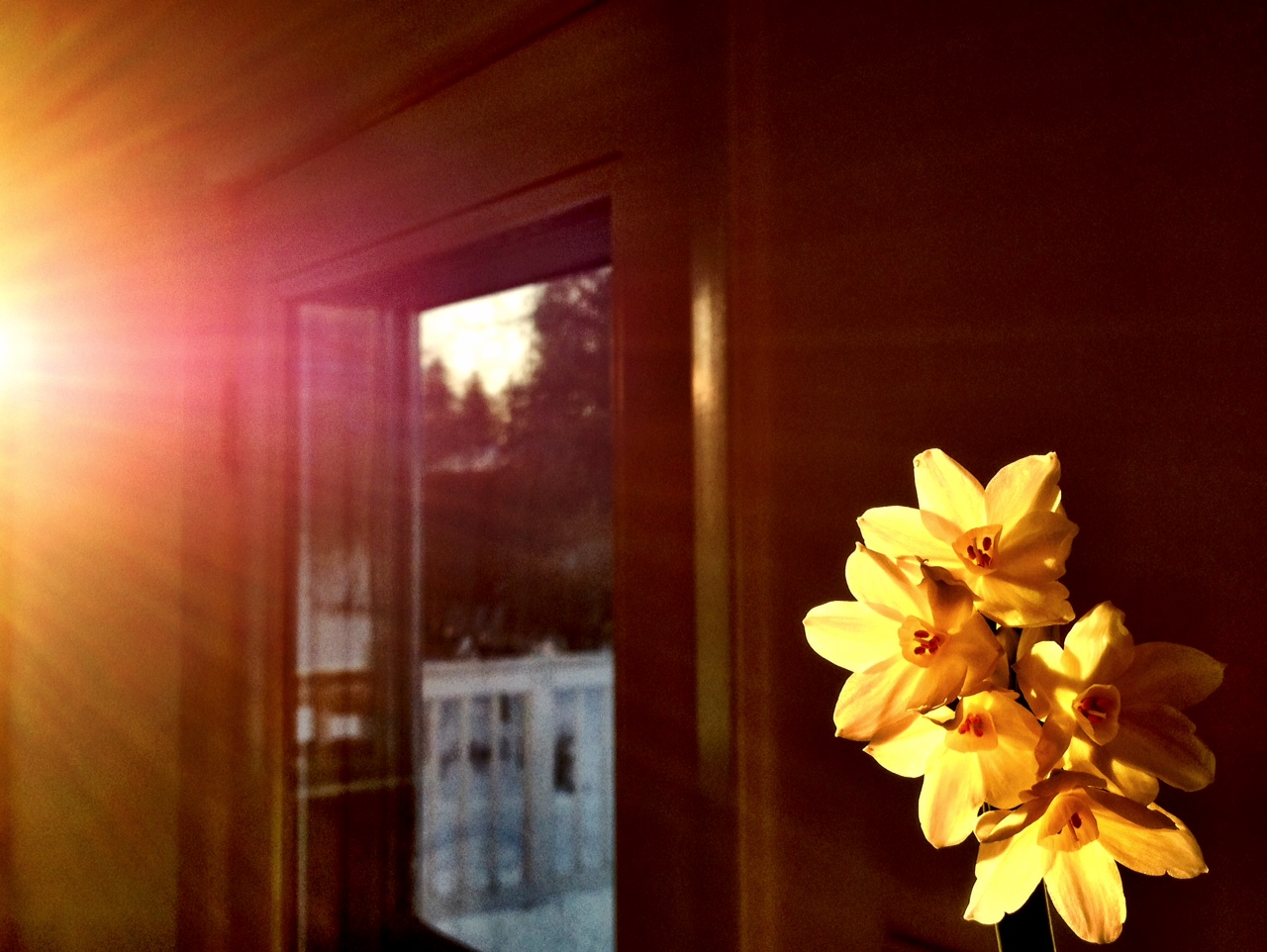
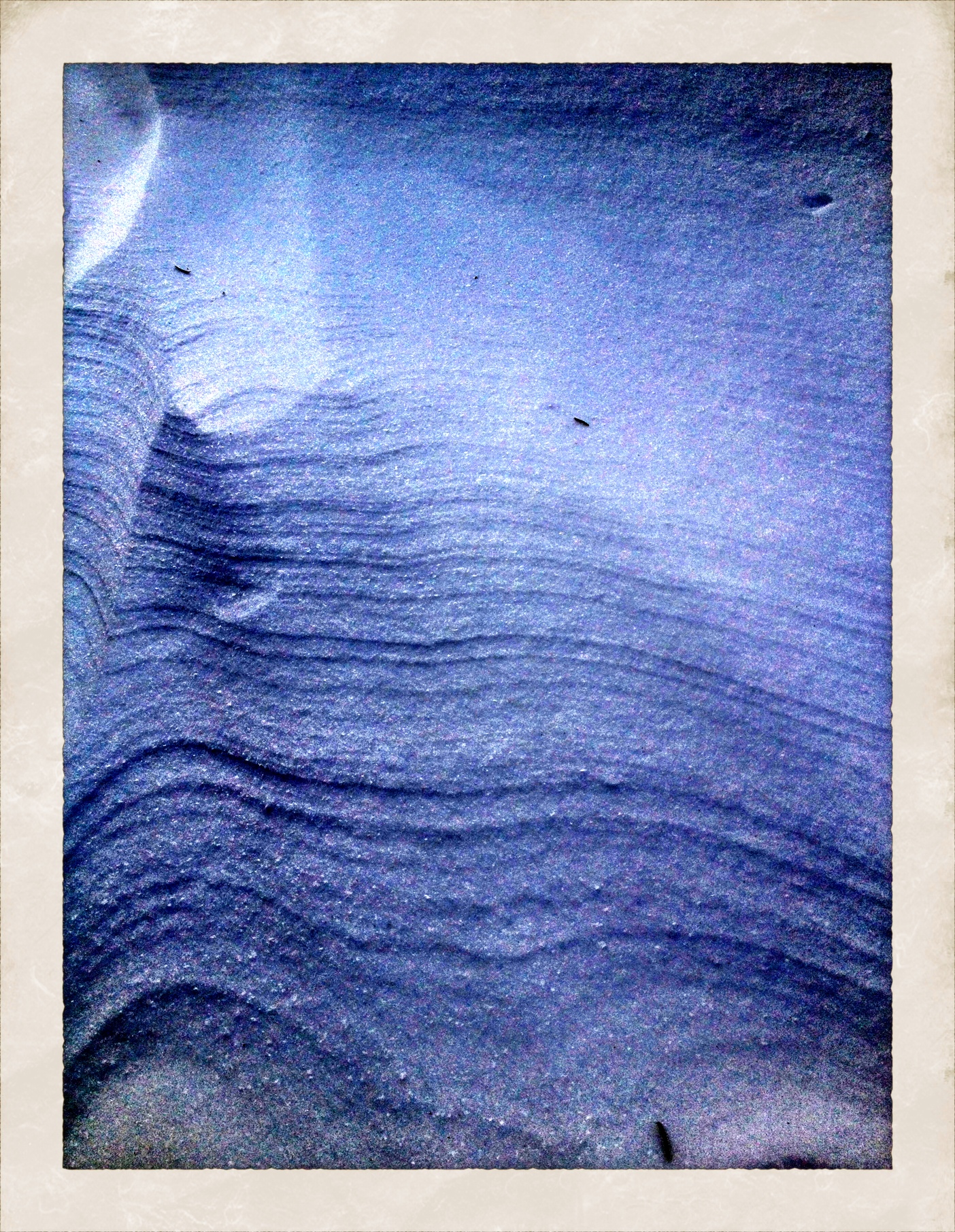
5. The beauty of all this snow is astonishing, and if you catch me at the right moment, I am even capable of seeing that.  Witness.

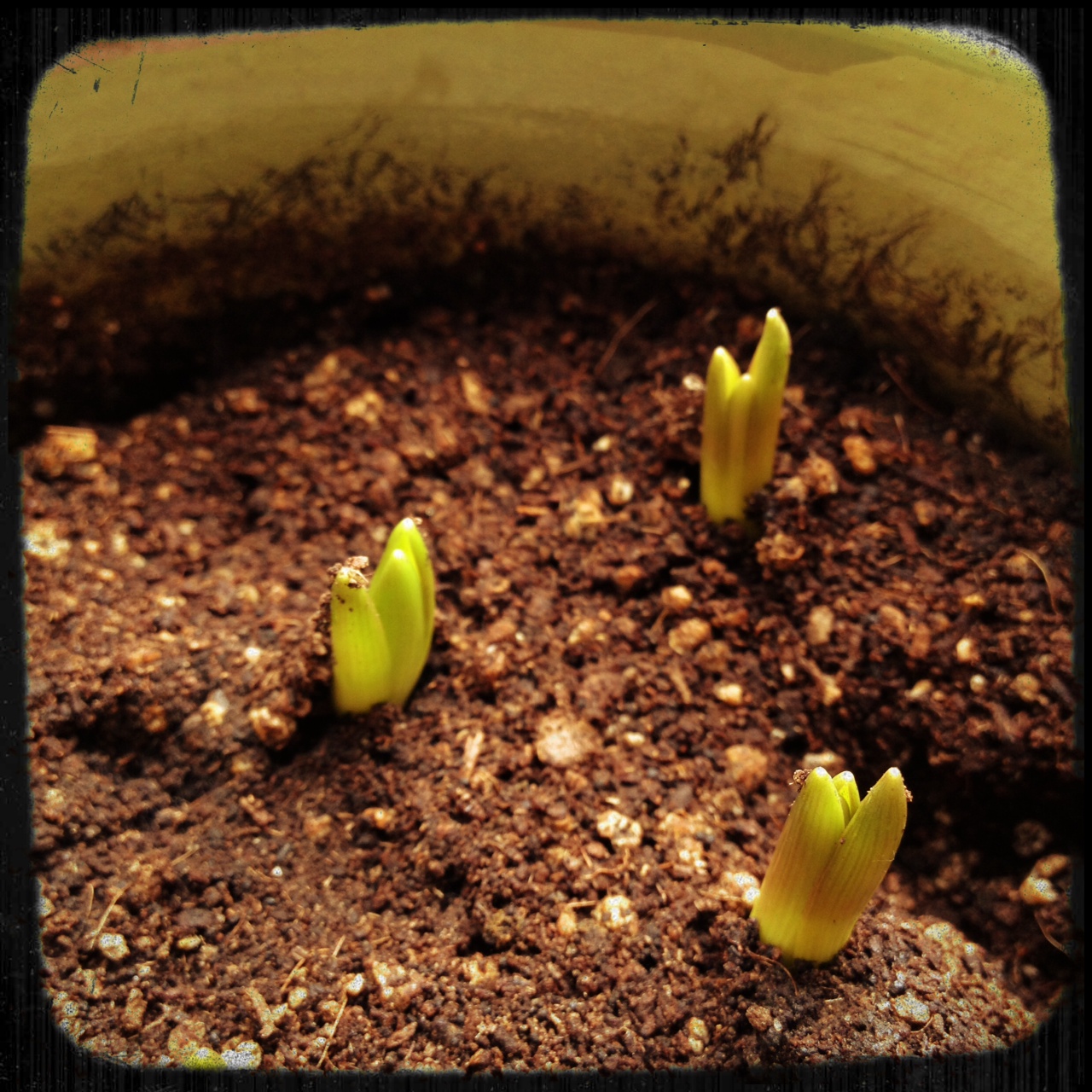
6. And we are, after all, heading inexorably toward spring.  See?

Bulbs in pot

Heard this afternoon

Me, to the boys: “You know what’s amazing? You will never in your whole lives not be loved by your mama.”
Ezra (three, in case you couldn’t tell): “I’m going to skip your love.”
Me: “That’s not super nice, dude.” Then, as he starts to eat the curtains, I add: “Do not eat the curtains. Do NOT eat the curtains.”

Hard to believe this is the same kid who did this last night:
I was nursing Chi while Ezra finished his tub and I heard Len talking with Ezra, helping him get out, dry off, brush teeth. Then I hear whispers outside Chi’s door. And the crack widens. A small toweled head appears around the door, and much higher up another, larger head follows. “Can Ezra say night night to Chi?” Len asks. “Sure,” I say. Ezra tiptoes into the room, then turns to look up at Len again. His face is illumined, either with love or with the hallway light, I’m not clear. “Papa, can I give Malachi and Mama night night kisses?”. My heart reaches all the way to the door. He tiptoes over, his hooded towel in its superhero cape position, and climbs carefully up on the nursing stool. A gentle kiss on his brother’s “sweet soft head” –their two small faces turned briefly toward the glow — and another on my lips, and like that, he’s gone. Precious beautiful wondrous heroic love.


Friends: to have and to hold

I recently read Pam Houston’s latest book, “Contents May Have Shifted.”  Like most of her work, it’s a fascinating inside look at globetrotting, wilderness survival (usually both of those, together), relationships with men, and some measure of recovery from an abusive childhood.  And all of them lean heavily on her friendships with women — rich, whole, complicated, open, hilarious, and intimate. Most of the time, these friendships seem like backstory, or like the tide that moves her life, enabling her to cope with everything else.  But for the first time in this novel, it hit me: these friendships are her LIFE.  For real.

So of course it got me thinking about my own friendships, the handful of extraordinary women I treasure around the globe, and how the first thing I got when I had a baby was a bluetooth so I could talk while nursing.  Well, eventually my bluetooth died and I had another baby and then it just came to pass that most of my conversations with my friends were in my head.  And since that’s the kind of people these women are, it was okay just to touch base every six (or eighteen) months.  But here’s the thing: I MISS them.  I miss the sound of their voices, the stories of their cooking, their kids, their bosses, their wardrobes, their reading, their vacations, their partners, their home improvement projects, their yoga mishaps, their favorite new wine, their afternoon tea habits.  I miss the gestures that you can’t get over the phone anyway, but at least the turns of phrase will help.  It occurs to me that handwriting is an excellent substitute, so I’m digging up my stash of cards and trying to locate some stamps.  (STAMPS?)

How do we end up here, more connected than ever and yet so busy and distracted that we forget to even WANT the kind of deep connection that used to be the whole point?  And more significantly, how do we get back?  Or how do we move forward into each other’s lives in ways that honor what all we’ve got going on AND our need for each other?  How do we construct a village when we live so scattered?  I realize this is largely what the blogosphere has done for many of us, and I am powerfully grateful.  But there’s more to it than that, and I want to live in it.  So I’m trying harder to live like Pam (or her characters; that’s always a little fuzzy): to let people in, even right from the beginning.  To recognize the connection that’s there rather than play it down.  To issue invitations and keep issuing invitations; to go when and where you are invited.  To bring things with you, however small.  To realize that thank-you notes are not always about formality but are often actually about real gratitude that doesn’t NEED to be expressed but that WANTS to be.

I called a dear friend yesterday to see how her boys were recovering from the flu, and we had a hilarious hour of conversation, punctuated by the games and needs and uproar of our collective male offspring.  At one point, her four-year-old, who now has a suspected stomach bug, dragged his exhausted body across the floor to her, every fiber of his being working toward, it appeared, resisting the need to vomit.  She’s offering me a cautious “hang on a minute…” when I hear her boy ask in a sprightly way: “Who ya talkin to?”  Surprise!  He’s fine.  Just enjoying the drama of mama home — again — with all their illnesses.  She sighed, appropriately pleased to be still clean and dry, and told me in a thoughtful way: “You know, I’m really glad you called.  I don’t think I could have made it through another one of these days.  I may call you again this afternoon.”  You see?  We are lifelines, and laughter, and succor, and sanity.  We are, it often seems, all we’ve really got.  Which is absurd, in many ways, but you know what I mean: we are the only ones who get us completely, who ARE us, in a certain way.  So if our job is to be present to ourselves, surely that means in part being present to our better selves, wherever and in whomever those selves are located.
On the challenges of showing up

When I was in graduate school, I worked at a really good restaurant that some friends of mine were opening.  It was a small place, and serious about their food, drink, and service.  To support that, they made every staffer go through an intensive and prolonged training where you tasted every single thing on the menu (oh, hardship) and learned about how it’s made and how to describe it.  The wine part turned out to be especially interesting to me, because we were given the proper schooling on how to “taste” wine, and I found that I resisted mightily.  I could taste all the same things everyone else was talking about, and the descriptions all made sense and I enjoyed having a new vocabulary, especially one with such cultural cache (how the eff do you write a French accent in here?).  But I could not, and cannot, let wine roll all the way off the edges of my tongue.  It is way too intense for me.  It’s almost physically painful.  Our teacher, the wife of the team (who has since completed sommelier school at Windows on the World and opened her own wine shop) was amused — apparently there are people who are considered “super-tasters” who have these issues.  That seems too fancy a title for me, but the fact remains that I cannot abide the intensity of wine that way.  Some folks can’t drink hard liquor for the same reason; others hate spicy food.  Sometimes experience is just too much and we want to calm the stimulus or avoid it altogether.

I tend to think about mindful living in the same way, especially parenting.  I’ve realized lately that I spent much of the fall in kind of a daze, dealing with one familial health issue after another, and so rarely actually attending to the people rather than the problems.  I’m becoming aware of this as I see how much my kids have grown, how the shapes of their faces are changing, the growth of downy hair on their arms and cheeks.  We walked at the pond today and Ezra stomped puddles the whole way there, rather than riding in the stroller; Malachi wanted to get out and walk, holding onto my hands, up and back, up and back one particular stretch.  I’m trying not to avoid the anguish of their growing up anymore.  I’m trying to think of the truth I heard of a child’s first day of school: how terrified you are for them, and for you, and how thrilled you are as well.  That the two not defeat each other, or cancel each other out, seems like a major goal, or perhaps a small miracle.  So that’s how I’m trying to live these days: to see and relish the absurdity of softness and roundness that is still, for a while, Chi’s little body, and not to worry about what comes next.  Many days, that seems too tall an order, because how else do we prepare ourselves for the angst and chaos ahead?  But maybe all this mindful stuff is right after all, and the only reality is now, and the only truly great thing we can do is show up.

Small achievements, small regrets

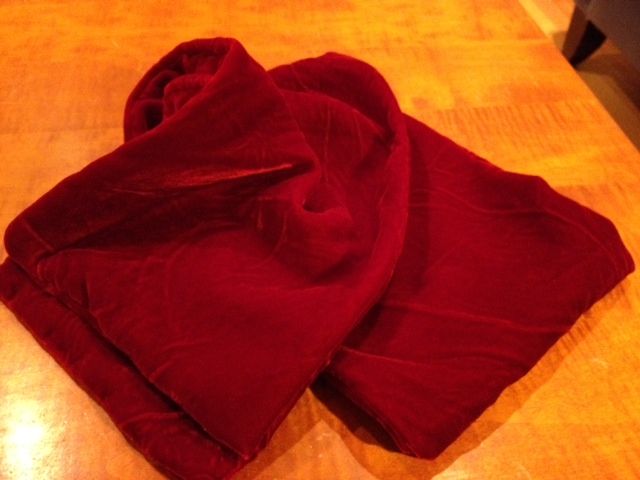
I’m trying to keep things small these days.  So those ambitious and beautiful patchwork velvet scarves recycled from old clothes — well, those haven’t been happening, except in my head.  The PLANS have been laid for a month now.  But apparently the downside of the otherwise-totally-awesome upcycling process is that you have to first “make” your “fabric.”  Which means cutting into something with many possible uses and which may or may not be replicable.  (I realize this is how you tell the newbies from the old hands in this work — the old hands know there’s always something else awesome out there.  I don’t, yet.)  So I agonize over the cutting and spend lots of time trying to decide whether to rip out seams or cut them out (old velvet: the answer is cut them out, because once the ripping is over, your fabric is likely to rip along the stitch line anyway).  Today, instead of beating myself up for not making the scarves, I decided to just make rectangles.  It took me much of the morning, since I was working with tailored garments, one of which even seemed to be bias-cut AND was heading toward its at-least-third life in my hands.

But now I have gorgeous, sumptuous rectangles that both babies want to get their hands all over.  Thank goodness for scraps.  (Or, according to the scared voice in my head who always promotes the logic of scarcity, I have now ruined the potential of several neat old garments.  Good thing I didn’t yet cut up that sweet little coat I’ve been considering.)

The other big achievement of the morning was finding Malachi in a still moment and snipping off his curly little mullet.  I did this with the relish (and, apparently, thoughtlessness) of someone who has been casually watching for just such a chance.  Once it came, I didn’t really ponder why I was taking it.  But take it I did, and the smallest among us now has more respectably short hair.  As I took the curls and the baby into the kitchen, replete with a strange sense of swollen, senseless grief, Len cheerfully announced: “No more first haircuts!”  and the tears spilled over.  Since then, I’ve also realized that winter in Maine is not necessarily the time to cut off a baby’s neck-warmer.  But I think I’m mostly just a loving mama who is hardwired for regret, and so this seems like a big one that I didn’t properly anticipate.

It’s like the life-management metaphor of juggling various balls: just know which are made of glass and which of rubber.  Cutting up fabric is really only ever cutting up fabric.  And basically, you could say the same thing about your child’s hair.  But when you realize that you just altered a particular way of being when you’d give your soul not to alter it, well, that’s a little painful.  And silly, of course.  I’m working on letting go of my attachment to his hair.  But I will say this: I’m looking forward to it growing back.

One of the ways you know you’re living with the right people

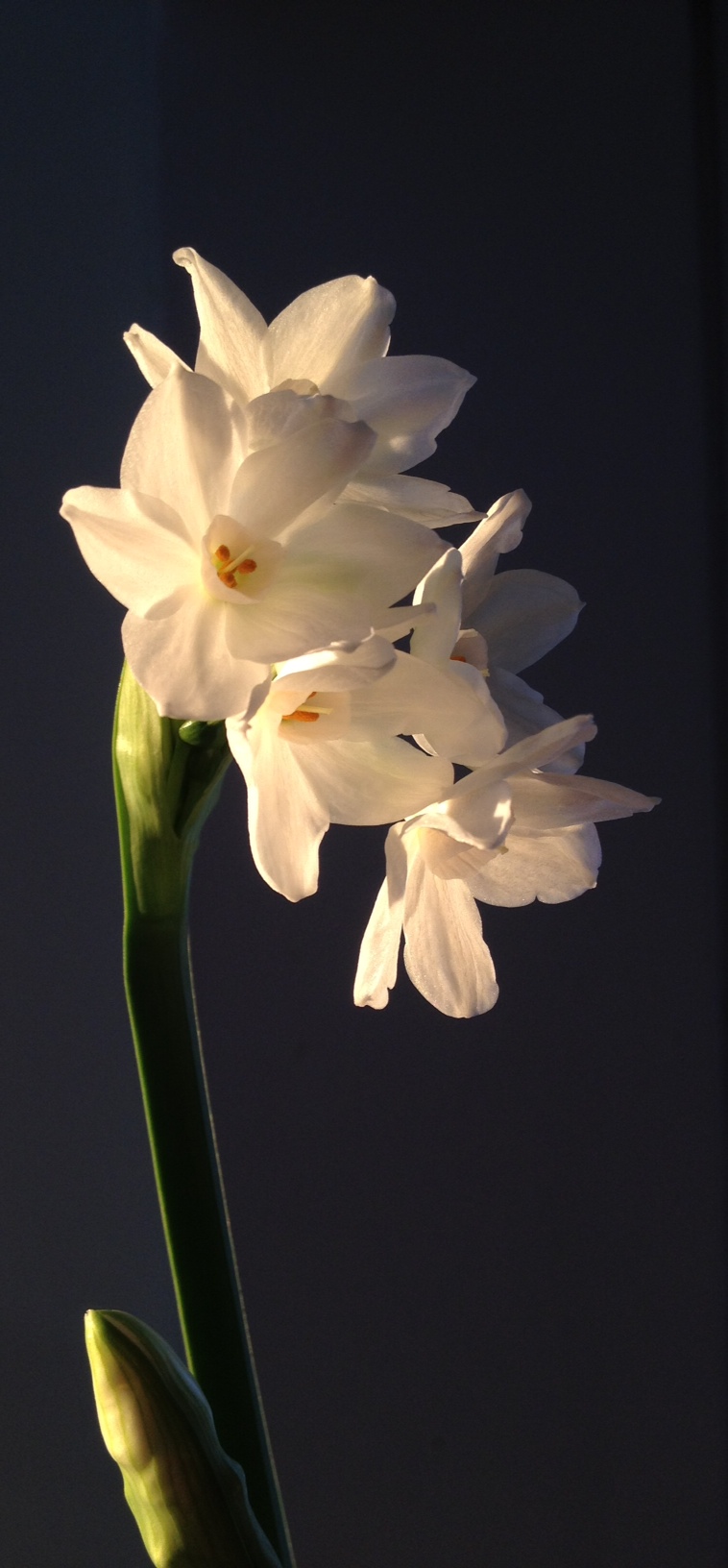
backlit paperwhite

This morning was a hurried morning, as they usually are.  Potty training isn’t making life any easier yet.

Malachi surprised all of us by sleeping tall paperwhitewell from midnight to 6, so he awoke confused and starvacious. Ezra announced he did not sleep enough, which was why he was sad and grumpy and unable to use his big-boy voice.  There were Cheerios everywhere and Sunbutter on my sleeve and coffee splatter on Len’s work tie.  In the midst of all this noise and hustle, the sun rises above the neighbor’s trees and beams directly in the eastern window, backlighting the newly-unfurled  paperwhite so that it glows, transformed, a fierce beacon on a fragile stalk.  Ezra and Len and I stare amazed for a moment before I grab my phone/camera; then Len grabs his and Ezra starts grabbing at our waists for us to lift him up to see. Malachi, strapped into his high chair, spends some time trying to owl his neck all the way around and then gives it up, content to eat and watch us watching.  Where else, I ask you, would I find people so willing to let their lives be altered by such a brief moment of beauty?  Who else would see this and drop everything to stand in its light, breathing more quietly while we wait for the sun to shift?

On letting go of the story line

Pema Chodron, in various of her works, talks about “letting go of the story line” as one of the crucial skills that enables us to stick with the practice of living, of being present to our lives.  I had never even heard the concept until I went to a retreat she was running at Omega when I was 35 weeks pregnant.  The retreat was called “Smiling at Fear,” which seemed like a good idea, as I had just left not only a job but a whole career I’d spent 15 years building AND I was about to have my first child.  I was working and working at the concept of befriending my negative emotions and I just couldn’t see how you make friends with a runaway train and I was feeling the old desperation rise up in my throat.  But then she said that about the story line, and how we spend so much of our lives acting out particular stories that we feel define us, and all of a sudden I could see it.  Even THIS, the process of wanting to shift something and not being able to, was a story line I was committed to.  So what happens if we let go?  Well, it turned out that letting go of that one meant that I could just BE there — in a beautiful warm room with two extraordinary friends and several hundred other fascinating people.  With a wise and holy teacher before me and another one inside me: that joyful acrobat in my belly has never since stopped teaching me.  I was able to breathe, to stretch, to sit in quiet and gratitude.

I think often of the challenge of setting down the story line, and less often I actually remember to do it.  But sometimes life surprises me.  Yesterday, for example, was full of surprises.  My 14-year-old car had been making some terrible noises, and I realized that I really didn’t want it on the road, much less carrying me and my two precious babes.  I had convinced myself that it was a clutch problem, or worse, and that now, here, finally was the repair job that would be the death of Hubert (yes, after the excellent bloodhound in Best in Show.  We generally name our cars after dogs).  So I prepared for the worst by doing what I do: managing for time and money.  We spent some time looking up used cars online, and I concluded that Tuesday’s lineup of meetings would give me only four hours for car repair, so we’d better the diagnostics done Monday.  I called the shop (Center Street Auto in Auburn, Maine — if ever you need anything, they ROCK), and they graciously agreed to take a quick look for diagnostics if I came in at 11.  So both boys and I “took Hubert to the car doctor.”  Twenty minutes later, they handed back the keys, having identified and fixed a loosening wheel (!!!).  No cost, no trouble, no major life shift.  Oh!  Look at that.  I had the story all wrong.  Which is reason number 2 for setting down the story line: first, it makes you crazy if you let it define your life, and second, you might not even have the right story.

When we get home, I gratefully remove all the winter accoutrements from our three persons and head to the kitchen to figure out lunch.  But there’s water in the disposal (which is the only drain in our kitchen sink and which, we know from past experience, has no main drain cleanout beneath it, so any serious problem in the pipe becomes a serious plumbing issue in the house).  AH, I think.  There it is.  Not the car but the plumbing.  THAT will be our major problem.  But before I despair completely, I figure I’ll do the recon I’d feel stupid to skip: and of course, the under-sink unit had merely become unplugged somehow.  Crisis averted.  Story line aborted.  Or perhaps there’s a different story line starting to form: maybe I am a resourceful protagonist who can sometimes solve her own problems and so doesn’t need to freak out about them.  Everything in its own time, eh?

It was a sunny day, and warm (upper 20’s), and we still had a nice foot of snow on the ground, so I hauled both boys outside after naptime.  The storyline there is about hassle pre- and post- and about crying over snow in the wrists while we’re out there.  But I announced we’d have outside time, and by golly we did.  Ezra helped me pull Malachi in the little red sled and went down the hill twice himself; he even made the lower half of a snow angel. Twenty minutes of enjoyment outside and we went in for warm snacks.  The sun slanted glowingly into the kitchen; the neighbors’ trees were all bronzed and rosy at their tips; the startlingly clear sky showed not one but three jet trails, brighter than light, converging slowly toward Portland. Of course there’s going to be whining, I thought.  Of course the snow gets in at our wrists, right where our skin is most fragile and thin.  But this does not mean we stay inside.  We try to remember that we will warm up again; we zip up and tuck in and open our eyes to the sky.

On actual crafting (as opposed to planning to craft)

You’ve all seen it: “Stop pinning; start making things.”  It’s good advice.  And many of you probably do handmade holidays like we do.  So there’s a persistent sense of always needing to be making things, and therefore always resisting making things, right up until the holiday is over.  Then it’s time for self-recrimination about the lame little thing you ended up making instead of the bastion of glory you INTENDED to make, and then onward and upward to the stout promises for better work next year.  Somewhere after that, a beautiful thing happens: you relax. And with relaxation comes clear vision, for the first time in months.  You love crafting!  You made some beautiful things!  And you have some nice ideas for a few more that you’re looking forward to making in these cold, dark months.  (If you’re like me, you may have even invested recently in decent lighting and perhaps been inspired to move things around and clear out space for easier access and better child-management during the work.)

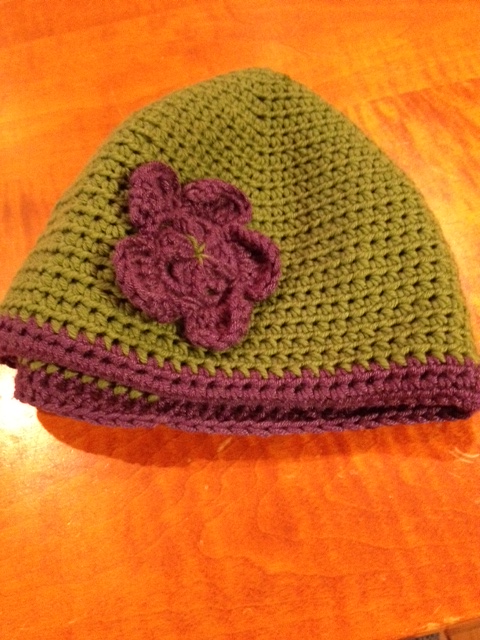
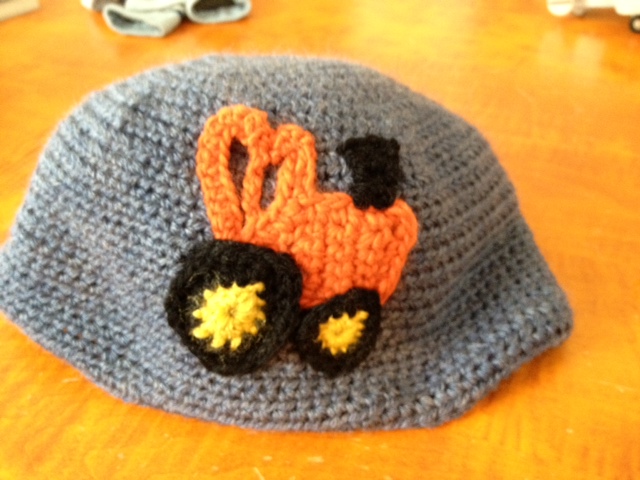
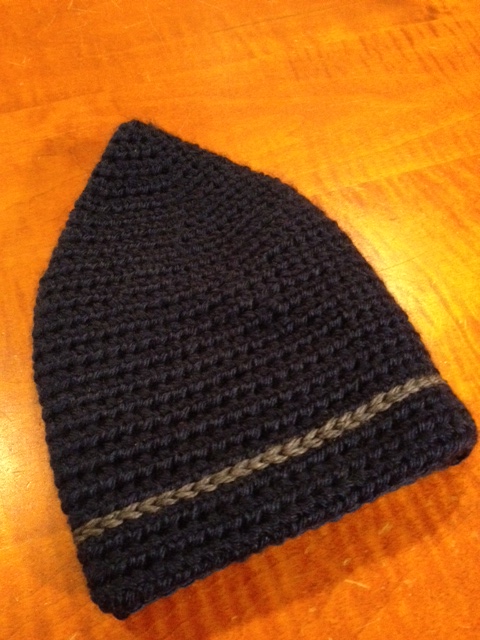
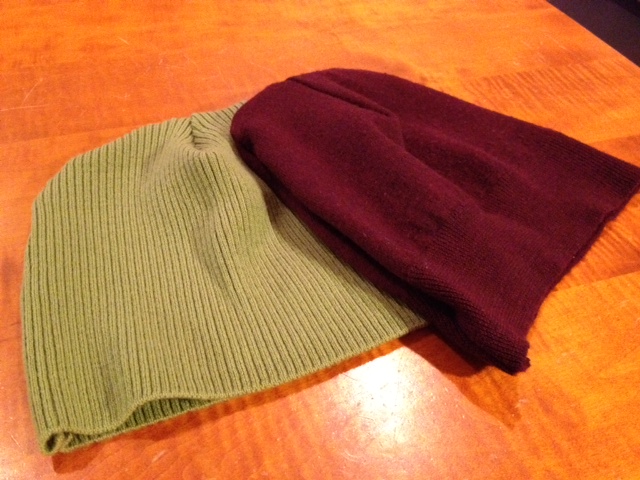
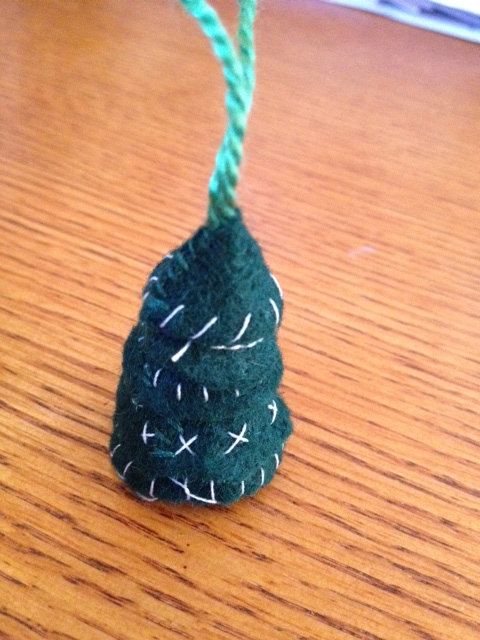
So in this spirit of clarity and kindness toward myself, I thought I’d share some of the things I made.  Details are available upon request.

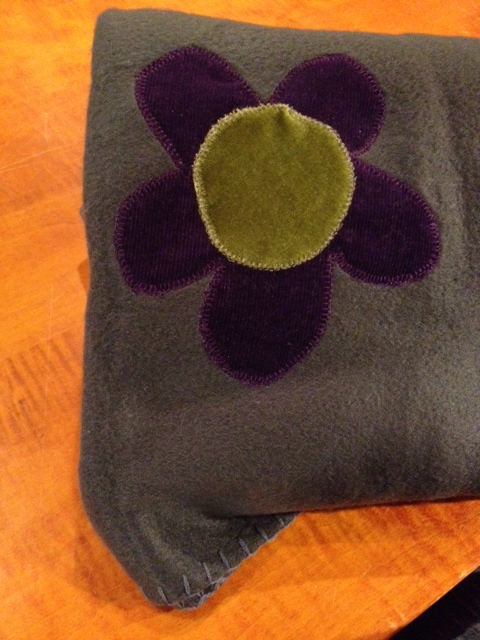
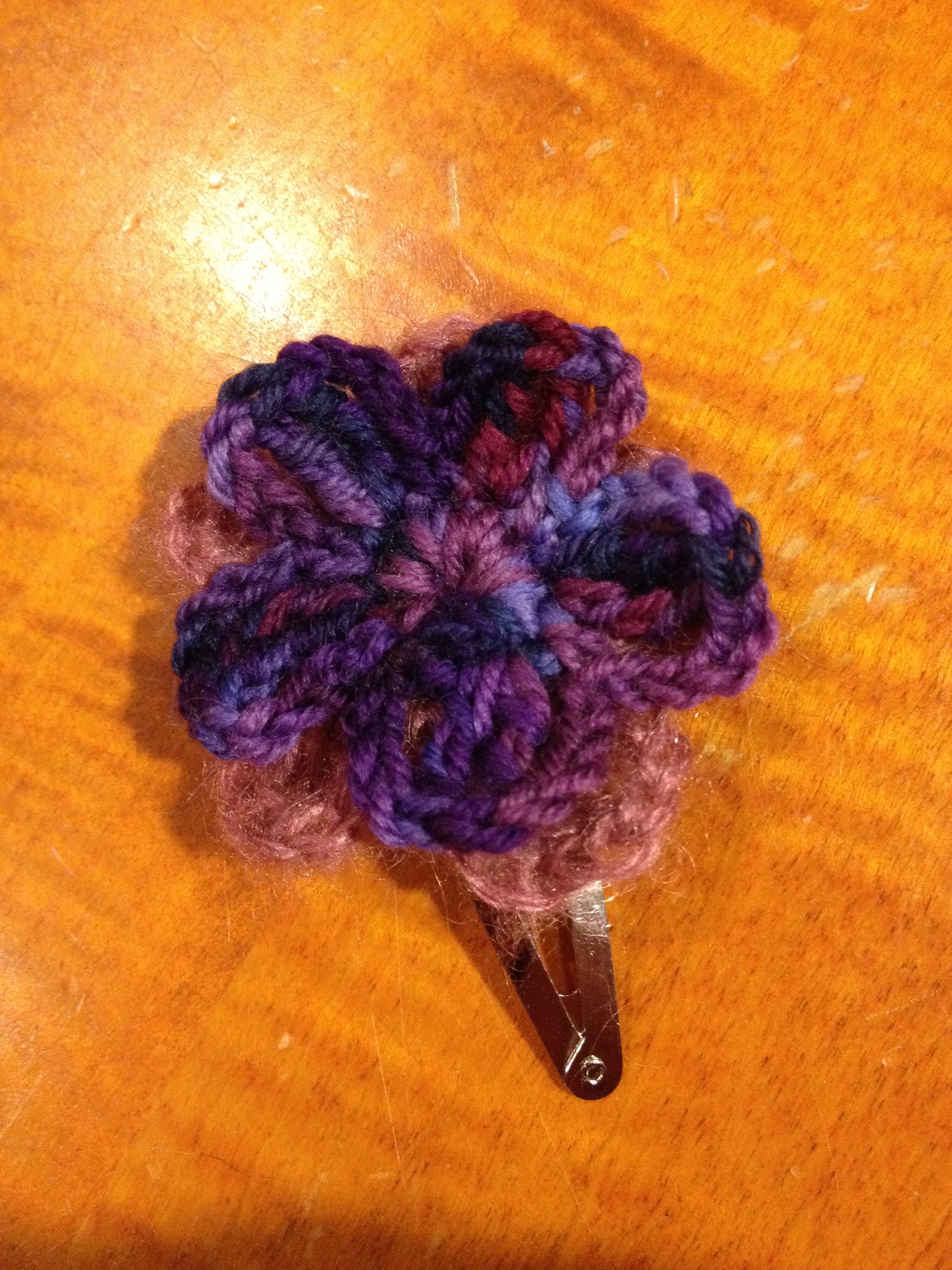
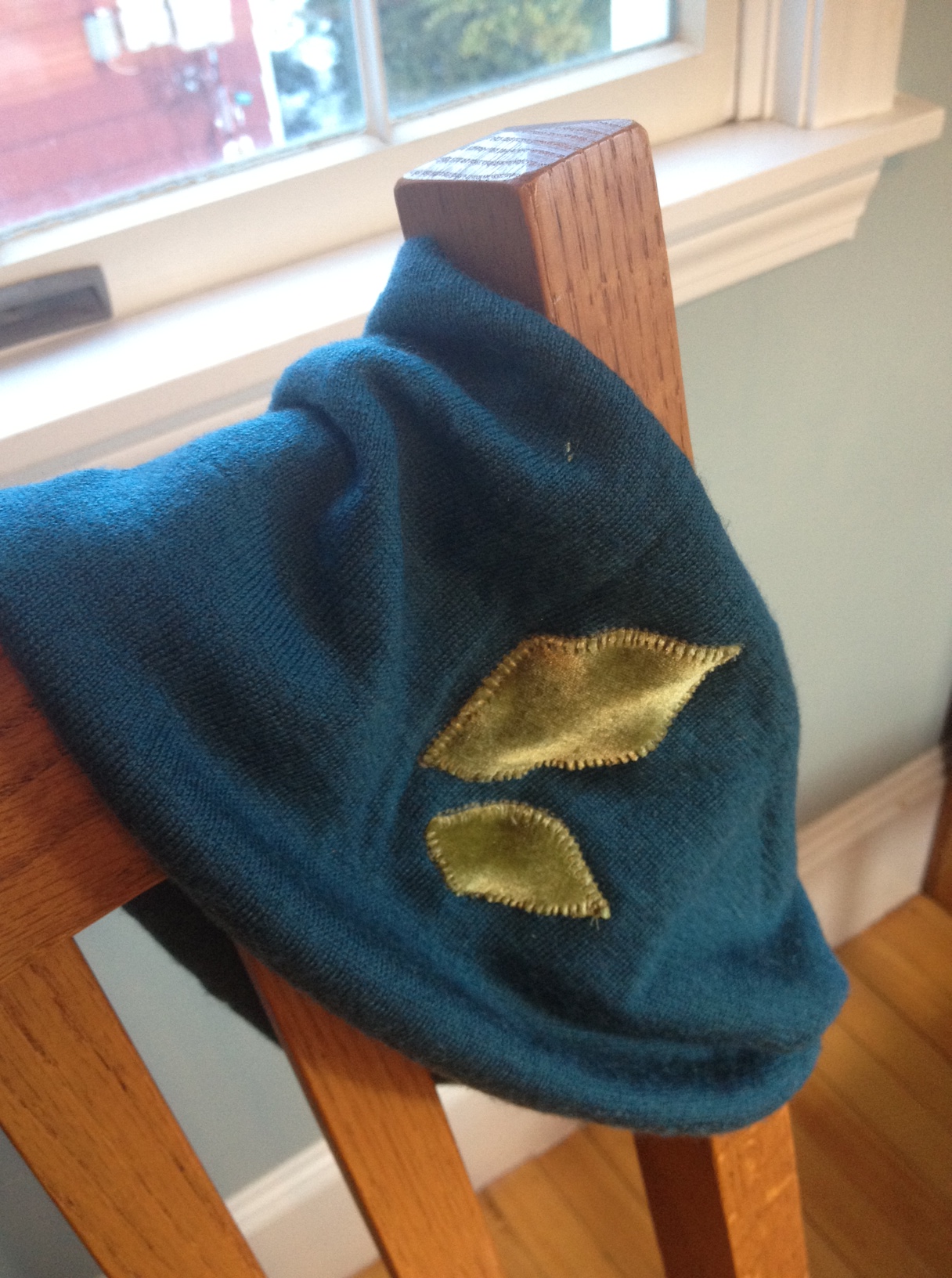
Brooke's hatConnor's tractor hat flower appliqued throw IMG_0020 Julia's red velvet scarf Kim's cowl Parker's hat sweater hats tree ornament

On intentions and resolutions and out with the old and all that

One of my more delightful projects, since leaving full-time work, has been facilitating some discussion series for the Maine Humanities Council at our local public library.  The second of those, just completed, was on the contemporary detective novel as social novel — we read Laurie King, Tony Hillerman, Eliot Pattison, and Katherine V. Forrest.  In each of these, there’s the age-old tension between the-way-things-have-always-been and the forces of modernity; scholars of postcolonial theory will recognize all the makings of hybridity, of a world that is many things, combined, and that therefore is more complex and less easily boxed up than we might like.  Hillerman says it best, in “Dance Hall of the Dead,” when a character mentions the motto over the entryway of an Indian reservation school: “Tradition is the enemy of progress.”  Under these auspices, kids were pulled from their families, beaten for speaking their native languages, and turned from their cultural heritage.

What the heck does this have to do with New Year’s?  I’ve been thinking about the innate violence of resolutions, the way many of us feel encouraged now to excise the warts of our being and stitch up the wounds ourselves.  Lose weight (you fat slob); lay off the booze (though you’ll be dead boring if you do); stop cursing (what the #*&^! for?); get a damn job (unless you’re actually as worthless as you seem).  It’s a tough time of year anyway, and when you add in all that stock-taking and all those toggle-switch models of change (flip UP for good behavior, DOWN for bad), well, it gets plain painful.  I am, however, a big fan of the “intention” — a gentler, kinder version of a resolution that seems to start from the premise of oneself as a decent, rational, perhaps even lovable being, with a desire to commit to certain shifts.  Intentions seem to make room for human foibles; they seem less apt to end up as “successes” or “failures.”  Perhaps this is because of the kinds of traditions they stem from — Buddhist, yogic, mindful, generous.  These are traditions that accept us unconditionally, that insist, in fact, upon us being always and only who we are, warts and all.   In my book, these kinds of traditions are the only possibility for progress, largely because they don’t make room for the concept of “enemy.”  There’s you, there’s me, there’s the world, and we’re all just trying to get along without mauling ourselves or each other too badly.  I intend, then, to be kinder and more accepting of myself and others; I intend to honor the old as well as the new, in others and in myself.  I intend to seek transformation and positive change in myself and others (like, for example, potty-training); I intend to love us all as hard as is humanly possible in the process.

On birthdays

I have a friend named April who is my birthday idol.  She, like me, grew up in circumstances where it being your birthday only meant that you EXPECTED to have fun and be showered with love, not that you WOULD.  She, unlike me, became someone who designed her own birthdays to meet her expectations.  I, on the other hand, tend to struggle with Great Birthday Ambivalence, not wanting to have to plan it all myself but also wanting something I want.  You see the challenge? Chi's feet

This little struggle is one of many I hope to avoid passing on to my sons, and so I’m concentrating on thinking about their births, about their presence in my life, about their marvelous, miraculous specificity.  Above all, I’m realizing that their birthdays (especially the first one) are as much about me as about them.  All day, it’s: “at this time last year, we had just met you for the first time!”  “At this time last year, you were having your first mama-milk!”  Standing up from the table after lunch, I stretched tall and felt the usual tug of deep c-section scar tissue…and, of course, thought of how much my body has put up with for the sake of these beloved creatures.  Their birthdays are, really, a celebration of capacity, of generosity, of animal instinct and tenderness.  A rejoicing in who they are and what they love; an exploration of how the everyday makes room for the exceptional.  Best of all is seeing the older boy tend to the younger, leading not one but TWO rousing choruses of “Happy Birthday,” and actually honoring his new status as Owner-in-Chief of some pretty interesting new toys.

These are times we want to snapshot, to cordon off, as if it would help us get our hands on this slippery, uncontainable life.  But like the children themselves, they move too fast for clarity, and we’re left with a joyous blur of someone crawling at high speed toward the door.