On the sense(s) of love

Ezra, in the throes of recovery from several simultaneous dread diseases, ate something close to an actual dinner tonight. This led to a significant increase in chattiness at bedtime. In the dark, as he’s supposed to be falling asleep snuggled next to me, he offers in an enthusiastic whisper: “Mama? Red-eyed tree frogs have red toes. And they’re sticky so they can climb every something they want to climb. And they can jump every jump they want to jump.” As Kingsolver once said: “It is senseless to love anything this much.”

Here’s the thing about love: it shows up in more ways than you thought were possible.  It’s in the color of your kid’s hair and eyes; the tiny muscles of his chest; the sweet rancid smell of his morning breath; the blurred speed of his words as he tells a very important story very fast; the giggle as his baby brother pats his back for the first time.  It’s in his hearty rendering of ABC’s (both “his” version and Alpha-Pig’s version) in the back seat of the car; his intense concentration on linking up his wooden train set; his fierce insistence that the LYING DOWN tiger sticker is more important than the WALKING AROUND tiger sticker.  The stone-amber of his eyes; the quick intelligence of his mind; the unselfconsciousness of his dancing.

When he was a baby, Ezra had a tendency to touch, with one hand, a mole on my chest while he nursed.  Little did I know that that habit meant my cleavage would become his “lovey,” his touchstone, his ultimate source of comfort.  For days, now, during his illnesses, he’s been ritually grabbing for my chest, despite the fact that he hasn’t nursed in eighteen months.  And tonight, as we lay reading “The Library Lion,” he said, “Hey, Mama?  Is it okay if I take a break now?  I need to use this finger to count the children.”  In the library in the book, he meant.  I have new hope for tomorrow.

On gifts, especially hope

We travel to New Hampshire at most Christmases when we don’t have a brand-new baby (or the threat of one), to see my dad and stepmother.  They live in a beautiful house they designed and built, completely off-grid, on a mountaintop in the Monadnock region.  It is, I always say, a wonderful house from which to be in the world.  That sounds like an oxymoron, but it’s not: the house is full of windows, as its primary energy sources are active and passive solar, and out every window is a vista of striking beauty.  Just being here is restorative, but also inspiring, and the back-and-forth between the two sensations is little short of a miracle.

I’ve been thinking about inspiration a lot, lately, in all of its forms, and about miracles.  It’s hard to think of one, I suppose, without the other.  I mean the Thich Nhat Hahn version of miracles rather than the standard Christian varieties (the miracle, he says, is not to walk on the water; the miracle, he says, is to walk on the earth).  But at Christmas time, I am reminded that much of humanity heralds as a miracle the birth of an infant around this time, and his astonishing gifts of kindness, courage, generosity, and clear sight.  Having two small boys of my own is miraculous enough to me — their small hands (Chi’s fingers, I decided yesterday, measure nearly an inch now, from tip to dimple) — but that they occasionally also exhibit these larger gifts is staggering.  It gives me, in a phrase, hope for humanity.

Barbara Kingsolver’s character Codi in the unparalleled Animal Dreams struggles with hope, having learned early that loss hurts (here we remember The Princess Bride: “Life IS pain, highness.  Anyone who says otherwise is selling something).  But Codi has a sister, Hallie, who lives inside her hope: “What I want is so basic I’m almost embarrassed to say it.  Elementary kindness.  Enough to eat, enough to go around.  That kids might grow up one day to be neither the destroyers nor the destroyed.”  I’m paraphrasing, since I left the novel at home, but I’ve read enough times to be fairly sure I’m close.  Hallie says, “The very least you can do in your life is figure out what you hope for.  The very most you can do is live inside that hope.” It’s easier to live in what’s already around you, to try to welcome that or at least not fight it tooth and nail, and to try to make small differences where possible.  But this, I know, demands a shift in what Kingsolver dubs “ground orientation.”  As Codi says, “I’d spent a long time circling above the clouds, looking for signs of life.  Hallie was down there living it.”  Perhaps the hope, then, is not necessarily the abstract kind that sets lofty goals and five-year plans.  Or perhaps it might be, depending on the person.  For me, the hope seems smaller, more local, at least these days.

And as I write that, I realize that I’m fulfilling the prophecy of Loyd in that novel, whose brief disquisition on what animals dream about constructs the title of the novel.  “I think animals dream about whatever they do in real life…it’s the same with people…your life, what you do and all that, it’s not separate from your dreams, it grows up out of them.  So if you want sweet dreams, you’ve got to live a sweet life.”  (This section is horribly bastardized, a hybrid misquote from a longer conversation.  But you get the idea.)  So as my life has shrunk, and yet expanded in a L’Engle-esque miracle, my dreams have shrunk.  Perhaps I should say, focused. And I’m eager to see the bigger work return to center stage, because I still believe in the macro-levels of  hope that are realized from there.  And yet, at Christmas, it’s easy to be reminded as all mothers are, that in each child lie the seeds of transformation, of hope, for us and for the world.  It’s possible — I might even say it’s likely — that we are, each of us, the gift of hope, the possibility of honesty and beauty and love.
On hiding out

It’s the most exhausting time of the year.  Daylight is brief; daytime is crowded; people are hurried and harried and hard.  It’s not supposed to be like this, but it is.  Children who are otherwise fonts of light become stuff-oriented demons, and runny noses abound.  I grant you that I’m a little jaded, having been soaked in vomit (not my own) not once but twice today, but still, it’s a rough time for all of us.  Quite aside from the national trauma of Newtown, I have friends who are living their first holidays without a mother, a husband, an aunt.  And while I adore the notions of peace and joy and sugar cookies, I struggle to make room for these things in any meaningful way.  It’s as if the show takes over and the substance of our lives has to yield to the performance.

I recognize this is the opposite of what Christmas, or any holiday, or even any season, should be.  And I find myself longing for a quiet week at a little cabin in the woods, just us and a fireplace (with a nice protective barrier), some board games, and a well-stocked kitchen.  Maybe snowshoes, and the corollary snow.  THERE, I believe, I could properly celebrate the lives of those I love, the season of rest, and the birth of hope.  But out here?  I think not.  Instead, I let my three-year-old watch back-to-back episodes of “Go Diego, Go” and I bury my head in social media.  Organizing our lives seems too much for me right now, let alone enjoying them.

I figure this will stop, or at least abate, once we ease off on the doctor’s visits and get a few packages in the mail.  (Did I mention we make everyone’s gifts?  Crikey.  Photos below, if I can find my phone, which I am — accidentally? — losing a lot these days.)  But perhaps I fool myself.  Perhaps this is the test run of the general philosophy that we spend our lives how we spend our days; that peace is every step; that we can choose to live with grace and intention or we can choose to throw our hands in the air and give up.  I’m working on it, or at least I INTEND to work on it, and I hope that counts for something.

I should be grateful, and I am

For so many things.

I watched my rotund eleven-month-old fall asleep in my arms today, punch-drunk on applesauce, oatmeal, banana chunks and breastmilk, and I thought about mothers the world over who hold too-light children and too-heavy worries.

I keep picking at the irritating scab of a search committee that doesn’t respond…and then remember how good it feels to even HAVE interviews, in this climate, and to have warm, supportive ones at that.

I am frustrated to not have more time to write, and I am reminded of the years when writing was work.  This, then, is play.

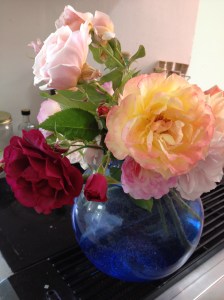
IMG_0519In one of my gardens I grow roses, all carefully chosen for cold-hardiness and disease resistance; it’s every plant for himself at our house.  When I think of the winterkill that mauled them last year and of my half-assed attempts to prune, heal, transplant, and protect them anew, I must also remember this: come June, whether I deserve it or not, there is usually grace.  Come to think of it, I depend on grace.  I build it into my strategy.  The flowers, though, are a glorious bonus.

I once had to write down, every day, ten things that were beautiful or inspiring or somehow positive, and by god it was a struggle.  But, as Thich Nhat Hahn says, “peace is every step” and compassion (with self, with world) is a habit.  In these dark days, it’s a habit worth cultivating.

The overwhelmingness of creativity

Every year I start thinking about Christmas gifts in June. Every year I SWEAR that I will start making them in June. And this year I did! I did. I made one small scarf. But summer is just so, well, summery, so perfectly designed for other things, like helping a very naked young man make a river habitat for his wild animals on the edge of the driveway. Crocheting fuzzy things just seems so pointless under those circumstances. And thus we arrive here, in early December, at a state suspended halfway between panic and bliss: the crafting imperative.

And so I spent my Sunday afternoon: felting old wool sweaters; upsizing a hat pattern I like; making experimental fleece hats (one of which my sweet partner has been wearing ever since). I am one of those crafters who takes such pleasure in the planning and anticipation that I spend very little time actually MAKING things. But now it’s all about the making, and that brings a whole new kind of satisfaction. Put differently, it actually brings satisfaction rather than its promise. Pam Houston: “In graduate school you learned that men desire the satisfaction of their desire. Women desire the condition of desiring” (from Cowboys Are My Weakness, probably “How to Talk to a Hunter). I hate to be so gender-conformist, but hell, I’m a stay-at-home mom making Christmas presents. I’ll just own that.

Back to the Making of Things and the Overwhelmingness of Creative Energy: I’ve got plans. They are good plans. The trick now is to get enough done fast enough that it still feels like generous gifting rather than crazed production. It’s a bear trying to live this whole mindful approach. But it has been beautiful to look back at the last few years and realize that most or all of our gifting is now either a) donation (Heifer, Kiva, local home energy assistance, or recipient’s favorite charity); b) handmade; and/or c) purchased from local crafters. That feels good on all levels — an appropriate way to honor a holiday I tend to think of as the birth of hope. And boy do we need it. In these dark months we need all the warmth, fellowship, and generosity we can get.

And hey — if you are interested in details of what I’m making, check out my Pinterest boards or just leave a comment here. I want to use the pages for that kind of info, but I’m not quite there yet. Prompt as needed.

That whole holiday thing

We had a few friends over to decorate the tree this evening, and conversation turned, as it will, to the kinds of traditions we create, now that we’re grownups. Tree-trimming is the big one, for us; we’ve been doing it since back in the day when we had lots of friends, lots of energy, and the funds to throw an actual party. Times do change. We’re not sure how the rest of it will turn out, now that we have kids — there’s the whole Santa fiasco, the hiding of gifts, the efforts to secure the tree from small grasping hands. There are things we’d like from the season, but those seem elusive at best: music. Time with friends and loved ones. A sense of peace, perhaps even of joy. But where the hell are we supposed to find all that in the chaos we’re swimming in? We seem to end up instead with a short occasional visit, a panicked rush on making gifts that we’ve been planning since June, and a general sense of seasonal affective disorder. This is no real surprise, but it is a disappointment. I suspect my real problem is not the holidays at all, though there’s obviously enough trouble there. I suspect my real problem is the looming prospect of February. I may need to seriously consider moving to where there’s more light.