On wading in: Day 1

Rabbit rabbit, or whatever you say to herald the new month.

It’s September.

Everyone’s going back to school, cleaning up, settling down.

Except for me. I’m jumping off a cliff.

Well, that’s what it feels like anyway. I’m wading into a vast unknown ocean of freedom to choose my projects and commitments, and I’m equal parts thrilled and horrified. So to avoid checking out entirely and spending the next month with my head in the sand, I’ll be starting a little group instead. The September group, I’d like to call it. Join us by following and commenting here, and by checking in on Facebook (The September Group: On Crafting a Life).

What’s funniest is that sticking my head in the sand is only half of my usual response to freedom and opportunity. The other half is manic activity, and what’s kind of worrying is that we never quite know how long these cycles will take. And when it’s, say, six months in the sand, well, that’s not really something we can afford. So like all efforts toward health, we’re not trying to eliminate the pendulum swings, but rather to bring them back to center a little more quickly. And that seems mostly like a process of mindfulness.

So here I am: Day 1 of a 30-day adventure in checking in, writing down, reaching out. I’m looking forward to hearing what all of you have to say about your lives and projects. Here’s mine, today:

My baby boy got his first haircut today — I couldn’t bear to cut it too short, which was fine because he kept wanting to hold the comb. He loved how it sounded when he ran it against the edge of the water glass. (And how fascinating that his big brother could always sit perfectly still and watch a show, but Chi is all in love with how everything works and sounds and feels…)

We spent some excellent time in the garden, earning Chi his new nickname: Tomato Joe. He CANNOT leave them alone. Seeds everywhere. It’s gorgeous. And if any of you have ever considered growing haricot vert (bush green beans that don’t get huge): try Masai. From Fedco Seeds. I’ve never seen a more prolific bean — and so delicious! And patient with a late harvest! Also, I have to note the asclepias (butterfly weed) in its orange profusion of gorgeousness. It’s self-sowing and I’m letting it, because I’ve seen zero butterflies this year. Total. And not one in my garden. I am gravely worried for our world.

I finished Ruth Ozeki’s All Over Creation last night, and I can’t recommend it enough. Silly, beautiful, profound, painful, awe-inspiring, concerning, and consciousness-raising. It’s a fun trip and one you’re glad you took.

My best work today (usually, in fact, I’m seeing) is happening when I don’t quite mean to Work. I fall into it because it’s fascinating. I’m trying now to let that falling happen. (Years ago, my insightful and loving mother-in-law gave me a card that said “Books fall open and we fall in…” and I’m realizing that books aren’t the only things the universe holds open for us.)

What else? This is clearly a strange and disjointed practice, like mind-dumps, like photo-editing at the end of a trip. But day by day, I imagine this one way we find courage and continuity and compassion and creativity. I hope so, anyway. We’ll try it for a while and see.


On parenting and patience

A dear friend and I talked today about the alarming uptick in irritation with our kids lately.  Naturally, we were unable to really HAVE the conversation because of the galloping and hollering of said kids.  (Climb the tree, climb the tractor, run barefoot into the barn; I want to SWIM but I won’t put my head under; Mama milk!  Mama milk!  You get the idea.)  So I sat down this evening to write out the rest of what I wanted to say, and it is this:

Dear Kate,
I’ve been sitting with your concerns about parenting and patience, not least because they are also mine.  I feel like maybe I hit this particular wall (at least, most notably, most recently) earlier this summer, so by now I’m both more cynical and blessedly more tolerant.  Of my own failings, that is.  I don’t like them, but I accept them and continue to work on trying to change them.

What’s trickiest for me is this: the circumstances that lead to shortness and eruptions are partly about me (have I scheduled the time I need for myself; am I using that time to best advantage; am I taking proper care of myself in all the textbook ways; am I feeding my creative energies; am I nurturing the relationships that I crave…) and partly about the world as I see it (am I using my gifts productively in the world; am I addressing problems I can see and help with; am I contributing to my kids’ lives in the ways I’d like to; am I speaking my truths to the powers that I humbly submit need to hear them).  It makes me crazy to have this bifurcated diagnosis.  I’d like to imagine that a renewed commitment to mindfulness as a practice would solve everything.  Truth is, it would help, but not solve.  I’d like to believe that finding meaningful paid work would fix things.  Truth is, it would help, but not solve.  In fact, it would create a host of other issues by draining away some of that vital attention that I now try to direct to my boys (which is, all by itself, getting harder as I get more interested in more and different things).  I suspect this is in part the curse of the smart, dedicated, socially-conscious parent: we engage with our kids and are fascinated by them, but there’s so much else that also engages and fascinates us that it’s hard to keep focus.  I feel like the theory of part-time work is beautiful, and sometimes it works out that way in real life as well.  But other times, we spend our days checking the clock or checking our email or jotting lists of things we’d rather be doing.  Of course we don’t hear everything the kids say.  They aren’t the only ones we’re listening to anymore.  And that’s hard for all of us.

Sometimes I wonder if shifting to full-time work would be a better plan.  Sometimes I wonder if giving up on work altogether and pouring myself into the kids, including home-schooling of a sort, would be a better plan.  Often I think that one or the other is an absolute necessity.  Now.  Today.  But my reality is that while I am not skilled at tacking back and forth between critical, engaging priorities, I seem to NEED it.  So I try to imagine that THIS is my work: this daily, excruciating, exquisite practice of loving everyone and everything I love according to their needs and my capacities.  That means it doesn’t always look the same, and some days feature a lot more cursing than others.  But I figure my kids must be learning some key lessons about the preciousness and precariousness of our lives, and they sure as heckfire are learning how to read and work with the moods of others.  I need to believe there’s value in that, too.

Most days, I think a little more structure would help; I turn to Pinterest for more ideas about creative play and how to get a handle on our lives.  Every day, I think a little more mindfulness would help; even a tiny practice like a three-minute meditation while the coffee brews has helped me enormously in the past.  It gives me distance from my life, in a way, and lets me see myself and my struggles in the vast context of the universe — and that, of course, lends me a little more humility and tolerance than I might otherwise be able to find.  I’ll take what I can get.  Mostly, these days, I’m working hardest on letting myself off the hook.  It feels a little like defeat, but hey.  Defeat and acceptance are siblings, I hear, and I’m trying not to ruin my life for the sake of some macho Western illusion.

Anyway.  This is all to say: I feel your pain.  Holy SMOKES, I feel your pain.  And for what it’s worth, I think you are an extraordinary parent: creative, loving, attentive, compassionate, smart, nurturing, supportive, concerned.  Your soft voice and obvious enthusiasm for your kids are models to me, as is your willingness to say yes, to follow them where they need to go, to give them the room to be themselves (within safe limits).  If I could cultivate your patience, I’d imagine myself a ten times better mother.  But I know how you feel, and that’s part of the point: the feeling is not necessarily well-calibrated to reality, and when it is, it just makes us cringe.  So we try to keep our eyes clear and our heads (and hearts) in the game and put one foot in front of the other.  And as we do it, we try to sing a little song, or pat a little cheek, or generally hold our whole selves open for the ridiculous beauty that just keeps showing up.

On adoration

I have only a moment before I’m supposed to step onto the treadmill of this day.

But I found myself engrossed in each member of my family as we hurried them into shoes and jackets and car seats, and as I waved them down the road and turned back into the living room, I found I leapt — actually physically leapt — toward the computer to write.  The treadmill can wait.  This moment, pregnant with human beauty and the fullness of falling rain, asks for something else.

It’s been a rough two weeks of no daycare and much family time, so much, in fact, that it has become easier to lose patience and harder to find it again.  There has been a mappable increase in hollering and sarcasm as we’ve worked our way through to today.  But here we are, and the boys are off to daycare.  It feels like total freedom, though I’m entirely booked already, and therefore it feels like heavy relief to finally be able to dig into what needs work.  But these are the images I carry with me into this day:

1. Malachi, at breakfast, carefully feeding me each of his enormous blueberries with his soft, carroty, fumbling fingers.

2. Ezra, after finding his moose rain jack ALL BY HIMSELF, informing me that it has a hood, and insisting I look as he solemnly puts it up to frame his smooth elfin face and glowing hazel almond eyes.

3. Len’s pants and jacket soaked in the downpour as he brings each child in his turn to the car, hurrying against the inevitable drenching but gentle in his haste and hugeness.

It feels strange to be so thrilled at their departure and yet so reluctant to let them go.  Malachi in particular, at this sweet stage of last-babyhood, feels like a precious gift I cannot release; I want to keep him home with me alone, snuggled under the covers, nursing and playing and gazing and singing and watching his world unfold.

It seems, sometimes, this is what it all boils down to, on its best days: the whole world condenses into a mother and a child, a father and an infant, any pair of people who open themselves up to light, to rain, to each other, to adoration.

On the challenge of being yourself

If you’ve never watched the movie “Center Stage,” you should.  It’s cheesy and beautiful and uplifting and all the right people get what they deserve.  It’s a dance movie that functions perfectly as a metaphor for life: dance the dance you have inside you, with all the effort and discipline you can muster.  And recognize when you’re trying to dance a dance that’s not your own.  And of course, roses and standing ovations follow immediately when you have the wisdom to be yourself.

But here’s where I’d add a few things: it’s not just about wisdom.  It’s just as much about opportunity, and foresight, and connections, and plain old good luck.  It’s about having sufficient freedom from constraints that you can actually DO the kinds of movement your own self demands.  And for most of us, absent full-time child-care and a perennially healthy bank balance, we just don’t get that freedom.  So what do we do?

I hate that all the best answers seem to revolve around “patience” and “self-love” and being “mindful.”  We need an Action Plan.  A Career-Planning Mom action figure.  She’d be a myth, like all the other super-heroes, but she’d have her s*#t together.  Perhaps I need a costume.

On (not) seeing ourselves

A friend of mine who is six months pregnant just posted on Facebook that after days of running around in sweats and not showering, she kind of forgot she was pregnant.  But once she got glammed up again, and into regular maternity clothes, she was reminded.  (I know, I know; she’s CLEARLY in the blissful second-trimester-so-not-everything-hurts-yet stage.  We honor her by not pointing this out in reply.)

And I was just thinking today, while strolling down the lawn with a son’s hand in each of mine, that my favorite thing about having kids (at least my kids, at least on a happy sunny afternoon) is how totally ME they make me feel.  With them, I am funny; I am loved; I am wanted — regardless of how I might actually look. In fact, I am often surprised to emerge from some enjoyable interaction with my family, where I’m feeling smart and engaging and magnetic, and wander past a mirror.  Good heavens — who is that wrinkled frump with the atrocious bedhead?

I suppose there’s a pretty obvious down-side to this phenomenon, but mostly I just love it.  I mean, as an American woman, I’ve spent most of my life a little unhappy about how I look.  (I say “a little” because I’m one of the lucky ones — my genes tend toward slimness, in what I hope is a decent tradeoff for the cancer and alcoholism that they also seem eager to share.)  Forgetting how we look to others is one of the great pleasures of life AND one of the great signs we’re living well.

The all-girls summer camp I went to and worked at had very few mirrors, and I remember being startled, sometimes, that I HAD a face and a body.  My time was spent making friends, making things, learning skills; my body was always running and swimming, canoeing and hiking, singing and dancing.  I was an energy, a personality embedded in a physical competence that was always stretching; I relied on that body for what it could DO for me, not for what it looked like.  I still love watching women athletes at their sport, because it’s one of the only times we get to see female bodies in peak form, carried with a sense of expertise and comfort rather than self-consciousness.

And of course all this shifts somewhat once we have babies (IF we have babies; the same argument applies to the general process of living on the planet, too) — the sags and the bags, the wrinkles, the stretch marks.  But it’s like that meme I saw one time: these aren’t stretch marks.  You’re a tiger, baby, and you’ve earned your stripes.  (Yes, I’d copy the meme here except I’m unclear about meme copyright AND the belly pictured doesn’t look quite like mine…)  There are myriad reasons our bodies are even more amazing now that they’ve grown and nourished little lives.  But what’s even cooler to me is this: forget about how our bodies look.  Just forget about it.  They do the hard and constant work of feeding, cleaning, sharing, amusing, and teaching our people.  They are where we need to be, and let’s hope it’s comfortable there.  We do what we can to take care of our bodies, but our focus is on our intelligence, our compassion, our creativity, our patience.  The joy of building.  The sacredness of what we’ve built.  And it’s absolutely delightful that we are often invisible to ourselves precisely because we’re too busy living all that beauty.

On various forms of training

It’s always strange when things that are supposed to line up don’t: when the brilliant, highly verbal, well-adapted child refuses to potty-train until three-and-a-half; when the ten weeks of gradual and successful getting-back-into-running suddenly collapse in a new and constant bilateral knee pain; when remarkable patience and empathy in the face of all kinds of difficulty suddenly vanishes, leaving you astonished you ever behaved reasonably at all.  But that seems to be the bear of this thing called life: nothing is linear.  “Progress” is only ever incremental and more or less impossible to chart.  We can’t move forward efficiently unless we pause at every point where someone needs a hug or an ice pack or a listening ear.  It makes sense that we are this way; the part that doesn’t make sense is that we keep imagining our world works differently.  We maintain hopes and expectations that have nothing to do with reality, and, still worse, that we KNOW have nothing to do with reality.

And so, we are advised, we try to let those go.  We try to be here and now, accepting whatever is going on.  And I love that approach, I really do.  It opens me to all kinds of possibilities that I wouldn’t even NOTICE, otherwise.  But somewhere deep inside me is always that other set of voices, asking “really?  You’ve pooped on the potty before: you can do it again, no?”  I hear those voices, I try to nod to them and thank them for their good intentions in supporting our boy’s efforts, and then I ask them to please keep it down for a little while.  There’s someone else I need to listen to right now.  And I wrap him up tight in my arms and try to hear.

The grand irony here, of course, is that many of these myths of progress find their homes in various kinds of training: to use the potty; to follow a physical therapy regimen; to keep a household manageable; to build a career.  But those training arenas, those places of learning, are precisely where the myth of linear progress is most powerful and most damaging.  What we need is training in mindfulness, training in training, if you will: the kind of training that will enable us to see where we fall down and give ourselves a gentle hand back up.  We need to be reminded that we are always practicing and never perfect, that we all have accidents and make mistakes and that the trick is learning to accept it with grace.  So as much as supporting a potty-learner can be a hassle (yes, I was the recipient of a full stream of urine down the center of my back today), it’s also a good chance to say out loud to someone else these most vital lessons: we listen to our selves and then try to do what seems best.  We have courage if we are afraid.  We understand that everyone tries new things, that this is a big part of what life is about.  Sometimes we succeed and sometimes we don’t.  But we keep on trying and that is what makes us who we are.  Like the lambeosaurus in Jane Yolen’s “How do Dinosaurs Eat Their Food” — we try things. Like the deal I make with my students in every class I teach: you trust me enough to give the work your all and I will trust you enough to really hear what you desire and are capable of.  This kind of testing, this exploration of trust, is one way we live out our faith in the world and in each other.

What are you taking care of?

Ezra, in the midst of pulling books off his shelf the other morning, turned to me and announced: “When I grow up, I am going to take care of giraffes.”  Then he turned to his brother, who was standing on Ezra’s bed with his tiny face pressed to the window: “Malachi, what are you going to take care of when you grow up?”

We are invited to think about our work in a lot of ways – what we do, how much money we make, what industry we are part of, what sector we contribute to.  But maybe this should be our core question: what, or who, do we take care of?

I used to teach a senior seminar on work as service; all the students were doing a non-profit internship of some kind as a way of exploring a field they might consider for the future.  And we all came together one evening a week to talk over readings on vocation, sustainability, meaning-making, community, and the sociology of work.  It was one of my gladdest times, one of the truest moments of vocation for me personally, because it brought together my best and favorite tools: teaching, critical reading, group discussion, exploratory writing, program-management, community partnership, administration in the original sense of caring for or ministering to.  And the seminar asked essentially Ezra’s question, though never so bluntly.  I wish it had.

As I write this, Jack Johnson’s “lullaby” version of “With My Own Two Hands” is on the stereo, and I realize that it names our common desire: to make the world a more beautiful place, a safer place, with our own two hands.  And open beside me on the scuffed blue kitchen table is Wendell Berry’s incomparable Hannah Coulter, and she is telling us of how in times of grief we stand by one another, we stand with one another: “He came to offer himself…to love us without hope or help” (55).  And eventually, she says “the comfort somehow gets passed around: a few words that are never forgotten, a note in the mail, a look, a touch, a pat, a hug, a kind of waiting with, a kind of standing by, to the end” (62).  What we build and what we hold up only exist by virtue of love, of ad-ministration; what would it look like if we named that truth?  If we thought of our work in the world as always a taking care?

William Sullivan wrote a brilliant book called Work and Integrity: the Perils and Promise of Civic Professionalism.  In it, he traces the civic roots of the professions – business began because people needed goods; lawyers happened because people needed a system to manage disputes and to institutionalize fairness; doctors, well obviously, doctors have always existed in one form or another, though only in recent history do we carve out with such diligence the many forms and ranks of physical care-giving.  He suggests, boldly and reasonably (in fact, it’s bold to be so plainly reasonable) that we might all benefit from a return to these foundational commitments.  Yes.  Of course.  The absence of them is what makes us all so outraged, astonished, and generally speechless: when a drug company hides evidence that its medication does harm; when a financial corporation allows the loss of lifetime-savings entrusted to its care; when food crops are sprayed with poisons so someone can make a bigger or faster profit.  These are betrayals of the basic human contract and certainly violations of the unwritten code of professions.  Who, we might ask, are those decision-makers taking care of?

I know there is room for disagreement.  There always is, and there always should be.  But can we begin with better questions?  Can we learn to question ourselves and our colleagues?  Can we keep a clearer sense of what’s at stake?  Because it’s pretty big and there’s kind of a lot of it: our whole selves, our communities, our nation, our earth.  The air we breathe and the water we drink.  And, Ezra would add, “oceans and jungles and fish and gorillas and babies.”  Right.

So: what are you taking care of?

On meeting chaos with joy

I started writing this post seven minutes ago, only to be interrupted by a phone call from a job prospect, wondering if we can talk via skype rather than conventional phone. So now I’m downloading skype for my new computer and trying to remember if I have a login and whatnot (it’s been a while since I used skype, since facetime works better around here and most of my peeps have macs or iPhones). And it will complicate life later, because now I have to consider how I look and how my background looks…sigh. This strikes me as a typical moment in a typical “me” day.

Okay, and as I am downloading skype and creating a new account (because it’s faster than trying to track down my old one), I get an email from a student who will be taking my summer class at the University of Southern Maine. I reply, carefully, and with the consideration her thoughtful questions demand. Twenty-three minutes after I started writing, I continue.

See? See? I want to shout to Life. THIS is what I’m up against. I can’t do a darned thing for myself without the whole WORLD rushing in. But here’s the thing (even after the hyperbole): I love all this multiplicity. Sure, it makes me crazy sometimes, but I love knowing that tomorrow I get to play with my boys again, and it’ll be warmer, so maybe we’ll head back to the playground near our house and I’ll watch Chi learn to climb higher and farther (which stops my heart but is wicked good for my reflexes). Maybe we’ll pick more flowers, or just look at the deepening maroon of the emerging hyacinths. (Ezra told me yesterday: “Sometimes I just like to say the word hyacinths. Hyacinths.” He’s so my boy.) Maybe there will be swinging; maybe there will be falling down; almost certainly there will be some shouting and also lots of hugs. And I won’t get a damn thing done except support two very small people in the process of becoming bigger people. And here’s the best part: the day after THAT I get to spend prepping my summer course, which is a senior thesis seminar on sustainability. How lucky am I? And how nuts, that these are only the two largest and most urgent of my many different tasks and responsibilities? This goes for all of us, I know.

It occurs to me that the absence of pattern, or maybe the prevalence of interruption, is a hard thing for all human creatures, small and big, and also that our efforts to construct regular patterns can keep us focused on the wrong things, or looking through the wrong lenses. It’s one of the prime lessons of parenting, right? That attention to the random, spontaneous declaration is rewarding; that saying yes instead of no can take us all further, together; that getting messy is okay when we have nowhere to go and we live in the company of a great blessing called the washing machine. The hardest days of all are the days we have to get stuff done, when, as my mother-in-law once famously put it, “We don’t have TIME for joy!”

We always have time for joy. It is the root of our humor and lord knows we need that ALL the time. It is the base of our compassion, without which we aren’t even human. It is, at best, the quiet breath that’s always waiting inside us, the one we are physiologically incapable of actually fully exhaling. The trick is remembering it, befriending it, and, quite frankly, expecting it to be around as much as it is. It’s a beautiful surprise, constantly available, and ultimately life-altering.

On tension

Surface tension.  Also known as total serenity.

Surface tension. Also known as total serenity.

I used to be a singer, a habit which has served me well as a parent (and not just for singing pretty songs).  Four nights a week when I was in college, my women’s acapella group would rehearse for two hours, and we’d usually perform at least one other night.  It was a lot of singing and it came from a place of extraordinary joy.  Plus, my abs were things of beauty: firm, sculpted, and in perfect support of my breath, voice, posture.

Shortly after that, I started taking yoga for the first time.  I listened enthusiastically to the suggestions on breathing: “Let the air fill you up!”  I can do that!  “The fullness of your breath grounds you, connecting you to the world around you.”  Yes!  But then: “Let your belly be soft.”  WHAT?  Obviously, I said to myself, these yogi people know nothing about breathing.

Now, nearly twenty years later, I find that I have lived, mostly, in a constant state of suspension between these two ideals: tension (albeit supportive) and softness (albeit chosen, and therefore disciplined).  I suspect this has something to do with the human condition: that we are given certain circumstances and we need both to accept them (softness) and to make something of them (tension).

This is the essence of Saul Alinsky’s principle, that we have to live in the world as it is and work toward the world as it should be.  It is also the essence of productivity: understand where you are that you might move forward (and the kind of non-acceptance that manifests as self-flagellation doesn’t help).  It’s the essence of teaching: start where the students are and go on from there.  And of course it’s the essence of parenting, of love, and creativity: compassion, for ourselves, our kids, our world, must undergird every disciplined effort to build and teach and grow.

All the love is making this dog tense.

All the love is making this dog tense.

We can all agree that breath (and for “breath,” from here on out, read “love,” “openness,” “curiosity,” or “spirit”) fills us up, that it simultaneously grounds us and lets us fly.  The musculature and intentionality that produce such breathing are real and profound: such breathing is our natural state (as in sleep), but in the world of our realities, pretty much everything gets in the way and messes it up.  So between nightmares and day jobs, childcare and health care, commuting and computing, we end up – most days – tangled beyond recognition.  For most of us, it takes a walk in the woods (which we don’t take) or a round of meditation (which we don’t get) to rediscover our core.  When we do, we can begin to parse our lives with a little more clarity.  Without clarity and rest, we tend to experience stress (which might be considered tension with an attitude problem).

But here’s the thing: tension itself is not bad.  Tension is a kind of discipline or structure, and its manifest in both.  There are many ways to good posture, or effective work habits, or appropriate human interaction, and tension is a part of them.  I am reminded of the persistent knee and hip pain I experienced in graduate school that stopped my running habit, and of the excruciating SI joint issues that developed in my first pregnancy and didn’t resolve long after the second.  I had worked out and stretched diligently through the first but learned in the second that rest was the only solution, so by the time I sought expert help I was not the strongest person you know.  I was, however one of the more flexible.  And that turned out to be the problem.  I didn’t have enough tension!

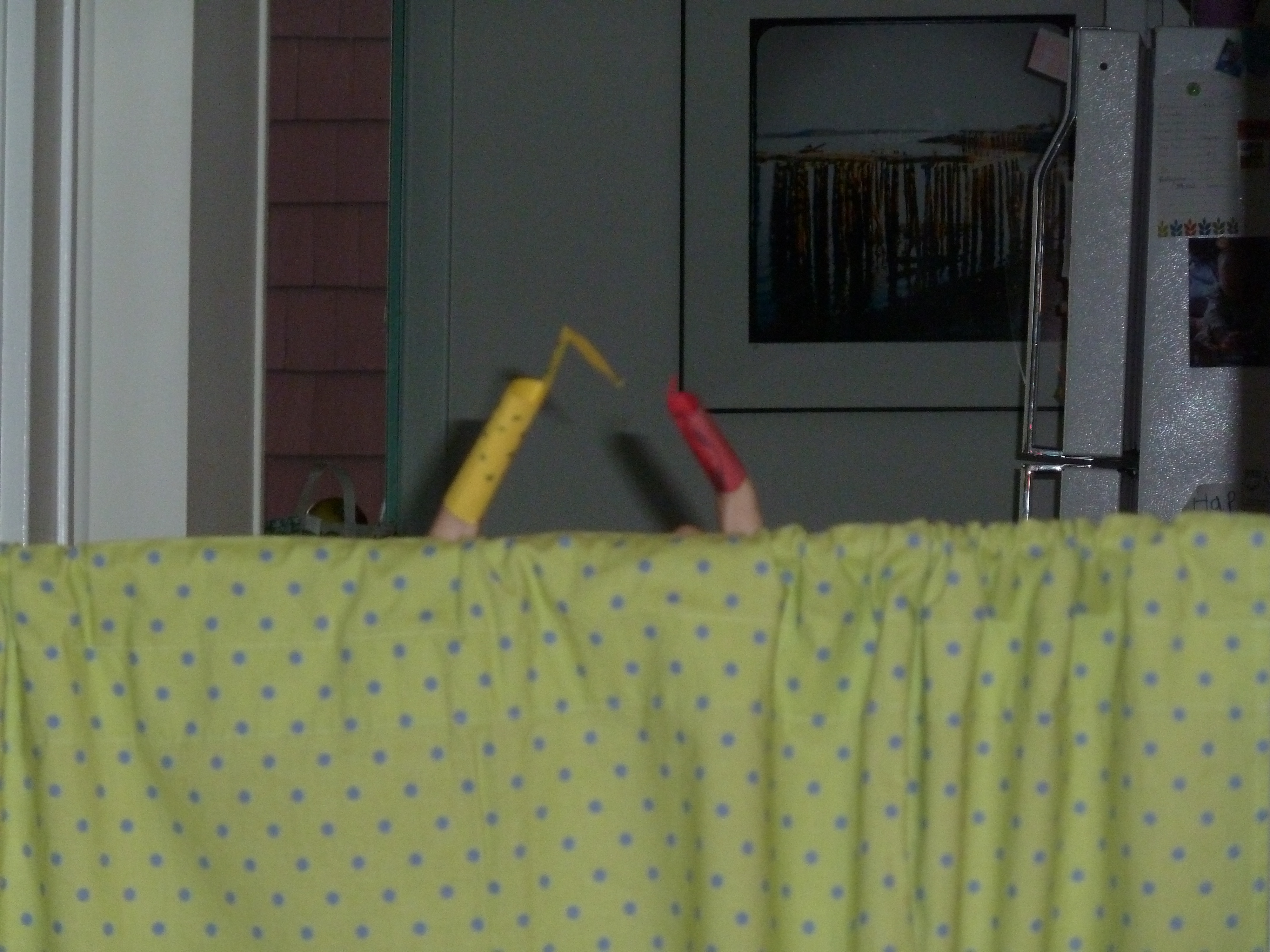
You maybe can't tell, but this is a tension rod holding up our puppet theater.  Tension promotes play.

You maybe can’t tell, but this is a tension rod holding up our puppet theater. Tension promotes play.

Hahahaha, she laughs, only slightly hysterical – two babies under three years old and mounting fiscal pressure that made it important to get more work and find more daycare…but it’s true.  That kind of emotional tension was keeping me from the strength-training that my body needed in order to create the muscular tension that would hold my bones in the right places.  Roughly.  Part of the pain was from too much tension; part of it was from too little.  Sound familiar?

It’s the same logic with our lives: an absence of tension doesn’t mean smooth sailing: it means we aren’t learning or pushing or changing or MAKING change.  Of course it’s delightful when in the midst of complications something goes smoothly (I still remember, as do all women who have delivered a baby vaginally while conscious, that moment of exquisite, whooshing relief when at long last that tiny body fully squeezes out of your own).  The trick to managing tension in the rest of our lives, I’m finding, is that damned balancing act.  We need some tension, but not too much; we need resilience and self-care for when we are overwhelmed by too much tension anyway; we need the right kinds of tension, at the right times and places, to keep us alert and accountable; we need counterbalancing forms of relaxation to remind us of our natural state and to help us recalibrate.  This is to say, we need the sturdy muscles of our singer’s core to give us voice, to help us run.  And we need to know how to release that posture to assume a gentler one for the yoga mat.  We need to relieve that tension through twisting core stretches and maintain it with vigorous exercise.  But what we can’t do, it seems, is sidestep the question entirely.  Which I’ll admit makes me a little grumpy.  Because I like the idea of smooth sailing.  I’ll let you know how that works out for me.

And another thing I’m learning from the kids

I’m greatly impressed, lately, by the power of silence.  And not just the kind you think I mean, where the noise finally subsides and we can hear the ringing in our ears and take a deep breath before it all starts up again.  No, I mean the kind of silence that is intentionally made and kept as a conscious choice.  My older son, Ezra, likes to ask for silence in the car on the way home from daycare.  And tonight, as I lay next to him at bedtime and asked if he wanted a song, he said, “Not yet, Mama.”  And he lay quietly for a good long while.  I used to listen, in the silence, for the things I wasn’t hearing: the music, the conversations, the stories.  I used to plan for what would come next or imagine what might have been.  But lately I’m just trying to do what he does: to hear the world as it is and his own presence in it, without comment or contribution.  Just listening to all that comes in on the breath and noticing all that goes out with it.  The world is a full place indeed, and those places of quiet are one of my son’s many gifts.