Pinterest as spiritual practice

The Pinterest craze has provided many of us with new ways to kill time.  And I mean, kill it dead.  The unbelievable depth and breadth of resources available present an enormous challenge to those of us with a passion for, well, anything.  Because it’s all on there – the whole world of hobbies, ideas, design, innovation, crafts, houses, book ideas, every possible manifestation of human interest.  It’s easy to start, hard to put down, and even harder to catch up on sleep after your first week.  Which is why all kinds of folks are including Pinterest in their media fasts, their unplugging, their general efforts to return to sane and local living.  (Patti Digh has a great little piece on that here.)

The real challenge, I think, is in moderation, in judicious use of the resources with a discerning eye, so that you a) aren’t constantly on there, and b) you only pin what you want to use, for feeding you in some important way.  (Here, my pastor mother-in-law would smile and say: “As it so often is in our spiritual lives.”)  Indeed, one friend asked (on facebook, amusingly): “does Pinterest provide beauty or value, or does it just give us more information? Because I have enough information.”  I answered yes, beauty and value indeed, because of how it enables us to keep contact (distanced, sorted, organized contact) with information, with good ideas and beautiful, inspirational images.

I am one of those people who struggles to live in the present because I am always trying to bear (“to carry”) in mind too many kinds of information: the location of that recipe I want to cook for dinner; the directions for that fun activity I want to try with my kids tomorrow; the pattern for the hat I will crochet my niece for Christmas; the paint color I saw in someone’s bathroom that I want to try in ours.  And that’s just the domestic sphere!  What of the brilliant “slow money” article I keep losing track of? The book on radical homemaking that offers new ways of imagining barter? The website that’s a useful model for my consulting practice? My head is constantly moving on several levels at once, which is an advantage in terms of getting things done but a distinct disadvantage in the peace-of-mind category.  It took me until a few months into my Pinterest love-affair to realize the enormous gift it offered me: to be here and now without ceding my hold on the future.  It offers us what is essentially a spiritual opportunity, previously available (perhaps) only to those writers and contemplatives who kept and used tiny portable notebooks.  By pinning (in our portable phones, even?) the next great family activity or the last painting that made us gasp, we can store our cherished visions without giving them up; we can live our lives AND remember where and how those visions are; we can revisit them in all their detail and promise, erasing what no longer fits or reorganizing to accommodate new dreams; we can share these visions, when we choose to, with friends; and most of all we can do all this without fear of spending our lives away from center, from the here and now.  We can set down the dream, or pin it up, and not have to live in its shadow for fear of failure or forgetting.  That way we can be here, now, with our lived realities, and still honor the hopes we have for other, better, fuller lives.  Because we do have those hopes, and yet we only fulfill them through living, here and now, rather than dreaming in the ether.

On gardening, or planning to garden

Most awesome seed source ever.

Most awesome seed source ever.

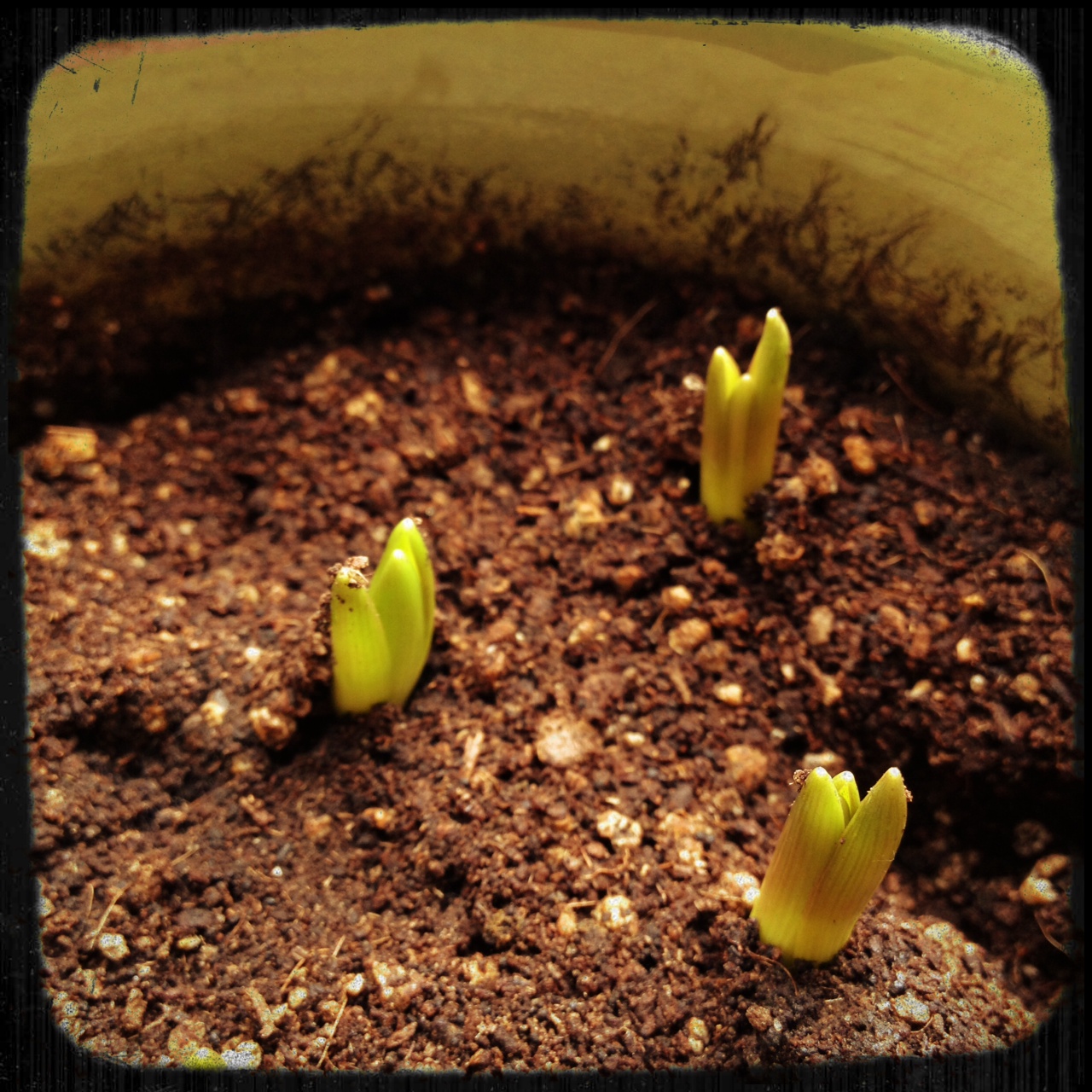
Is this what happens when we grow up?  Do we finally get clear about what matters and just root down?  I just sent my seed order in (only to discover the empty packet of my favorite lettuce: Winter Density…argh!).  It feels late, as it always does, and a few things are on back-order.  But mostly this year I feel a seismic change in the whole process.  Every year I pull together all my zip-lock bags of seeds and corral them into one huge basket, and then I go through and inventory what I have.  It’s a process I’ve loved over the years, as it fills me with a sense of abundance (look at all these gorgeous seeds!  Think of all the gorgeous PLANTS!) and with that delicious anticipation of ordering more.  Plus, when you feel like you’ve really gone overboard, ordering like 25 packets, you realize you’re only out $35.  Which is a lot of shopping bliss for your buck.  The big change this year, though, is in me rather than in the process: for the first time in history, I’m not all that interested in growing lots of different kinds of each vegetable.  (Flowers, yes.  Still.  Always.)  But I used to want six kinds of carrots, for example, to see which were best. I wanted to compare all the kinds of peas so I could know what I preferred and have some good variety in type and time to harvest.  Now, I’m realizing, I’m becoming a much more grounded gardener.  I want delicious; I want easy; I want staggered harvests and enough variety to keep cooking and eating interesting.  But I am more than happy to stick with tried-and-true, and my appreciation of new discoveries seems happy to stay in the realm of the theoretical.  I do not need to buy new varietals.  (There, Len, it’s in writing.  To your massive surprise, I know.  Mine too.)

I suspect this change is not really about the garden.  I suspect it’s about my life.  You see, gardening used to be a hobby – and now it’s one feature of my busy life with my family.  It has always saved us money, but now we count on that.  It has always kept us healthy, but now it teaches my children a lifelong love of healthy food.  It has always been a way for me to get grounded, to come back to my most basic self, and now it does that for two much smaller souls as well.  Nine kinds of peppers seems beside the point – though I am quick to defend the obvious point that there are roasters and jalapenos and Hungarian paprikas and bells, and there’s nothing wrong with a few of each.  But will I spend time reading about the fifty other kinds I don’t have?  Not this year.  No time, and my energy and curiosity are turned elsewhere: to people, large and small; to fiber and fabric; to writing and ideas and hope.

The next step, of course, in the process is cleaning off the seed-starting mats and shelves, checking the grow-lights and the soilless mix supply, investing in more wooden plant labels and a new, sharp Sharpie.  I’ve always loved these midwinter pilgrimages, but now they seem even more special, now that they are prompted by Ezra’s impatience.  Can we start seeds, Mama?  Yes, my son.  Yes, we can.  And all throughout the summer and fall, we can point to those plants and remember the smallness of their seeds in his palm, his chubby carrot fingers working to grasp and maneuver their tiny promise.

On patience, or, er, its absence

As we walk into Ezra’s school building this morning, he gleefully announces to the receptionist, the nearby teachers, and one or two families in the adjacent waiting room: “My mama just got really angry!”  Given that he delivered it with a smile, I suppose it might have been worse, but judging by the comments and snickers from the assorted onlookers, I’m guessing folks were feeling my pain.  Mercifully, I HAD BEEN angry but was no longer, or that little episode would have slid right past humorous and down into enraging.

You understand, I’m sure, how mornings can produce anger: the running around, the running late, things running down small faces that had been, just moments ago, ready to go.  Ezra decided to practice spitting by himself, which involved dribbling water all over his carefully-chosen (by him, at great length and with much turmoil) shirt.  Malachi decided to practice tooth-brushing on his own, which I’m all too happy to encourage, until I caught him scrubbing the fireplace bricks with his toothbrush.  The sidewalk is icy; the sippy cup is empty; the baby is halfway up the stairs.  Not a soul is listening to what I have to say.  It’s all a little much.  So of course I got angry.  And I yelled.  A door may or may not have been slammed.

In the car on the way to school, Ezra seemed unusually quiet, and then unusually chipper and cheerful.  As a child who often put on a happy face to bring my own family back to equilibrium (or at least civility), I was suddenly visited by the specter of all those burdens I never want him to carry.  Immediately, the anger was gone, and in its place was the sensible, loving, compassionate mama I like to think I usually am.  “Gosh,” I said to Ezra.  “Mama was really angry there for a little bit, huh.”

“Yeah.”

“I’m sorry I was so angry.  I’m sorry I yelled.  I know you and Malachi were doing things that weren’t ideal, but you’re kids.”

“Yeah.”

I know you’re working on how to be a better listener, and I’m going to work on not yelling and slamming things.  Next time Mama gets that angry, she’s going to take a deep breath and say: ‘Wow!  I’m really really angry.  I’m going to give myself a time out to calm down.’  Does that sound like a good idea?”

“Yeah.”  Then, a moment later, “Hey, Mama, I want to see the purple finch at my feeder.”  Okay, buddy, we’ll keep an eye out after school.

Anne Lamott says we have a chance to start a new 24 hours any time we choose.  Pema Chodron says: “This is our choice in every moment.  Do we relate to our circumstances with bitterness or with openness?”  Yes and yes.  And yes.  That small window, that tiny glimpse of reality in the middle of all the chaos — that can help us be open to what is rather than what we wish were.  And what IS might be infuriating in small ways, but it’s also pretty darn amazing in all the biggest ways: my kids so focused on their activities that they tune out the world; my kids learning the skills that will support them long after they’re out of my grasp.  (Plus, hey — my fireplace bricks got a little scrubbing for the first time in their lives.  Just so long as they don’t expect it to happen again.)  We breathe in.  We breathe out.

On kindness

On Sunday morning, we woke up to a 58-degree house.  Which is not much colder than we USED TO keep it, but since having babies, it’s been warmer.  Indeed, the discovery that the furnace had broken helped alleviate our concern about the youngest, who had been crying on and off since 3 am.  Turns out he was cold.

The good news was that the high that day was predicted to be ABOVE zero — 16 degrees above zero, in fact!  But since it would drop to zero that night, and since it was a Sunday and since our furnace is old enough that the one place our heating guy could get the right part was closed and no one was returning his phone calls…well, we got that basement woodstove going and started opening cabinets.  We had some good passive solar going, and of course there was the requisite emergency baking (for the heat of the oven, you know), but it still seemed clear that we’d need a better strategy.

We considered turning off the water main and taking up a friend’s offer to stay with them that night, but that would have meant letting the woodstove go out, and that just seemed dangerous (my dad said to put antifreeze in every drain — yipes!).  But then we thought about the offer in a different way: here were friends we like but don’t get to see all that much, offering us not just a warm dinner (and cake!  CAKE!) but the whole necessary array of beds and cribs and tubs and whatnot.  Maybe, we thought, we should throw ourselves on this kindness, and see if there’s more out there, too.  So we called neighbors and ended up with two space heaters — enough to keep the pipes on each floor in good shape.  And we knew that if all else failed, we could pack up and go in the middle of the night: not one but TWO sets of friends offered to leave a door open so we could just barrel in and find our way to a bed, no matter what the time.  My favorite line from the whole experience was from our excellent neighbor Bruce said: “Whatever you need, the answer is yes.”  I breathe easier just WRITING it.  It felt like we were taken in and held by all this caring.

As I was telling my dad how all this went, he mentioned his stepson had a similar experience recently — his car broke down in front of a stranger’s house in the woods of New Hampshire, and they invited him and his five-year-old daughter in for warmth and cocoa.  As they waited for AAA and assorted paternal types to deal with the car, these kind folks chatted with Jon and Amelia, learning a) that they live near a little lake, and b) that while Amelia has snow shoes, she does not have ice skates.  So what did they do?  Went and found an outgrown pair in the closet that will fit her small feet, and gave her them, asking her merely to pass them along to another little girl when she outgrows them.

We always hear about the shootings, the disease, the fistfights, the disruptions.  We hear about the agony and the ecstasy, but we rarely hear about the simple kindness, the interconnection.  Margaret Wheatley is right, in So Far From Home, when she says “most people don’t want to know they’re interconnected…[it] is too much of a burden.  It requires that we take responsibility for noticing how we affect other people…” (p.55).  And that is monstrously hard.  But still, my theory is that there’s more basic goodness out there than we know. I believe that most humans want the opportunity to be kind, to be treated with kindness and to receive it with grace.  Our innate generosity gets papered over with cynicism, defensiveness, and fear; our natural openness gets shut off and buried like some kind of dangerous supply line that might spurt everywhere if uncontained.  And you know what?  It DOES spurt everywhere. The whole world gets wet.  Kindness begets kindness and our very vision begins to shift, peering as we do now through the soft rain of basic human goodness, visibility low so that we have to look at who and what are here right now.  But what else can we do?  Of course we look a little goofy, with our wet hair and our smiles, treating people as if they have a right to be loved. We wring ourselves out, have a laugh, and lay down in the sun to warm.

On competence

Those of you who had careers you loved and excelled at and left to raise kids, you’ll know what I mean when I say that I CRAVE a sense of competence.  I used to zip around my world, well-dressed, well-informed, good at what I did.  It gave me (an unduly large) sense of purpose and it helped me feel at home, useful, valued.  Then, well, I had babies.

Now, of course, I’m not well-dressed and I rarely zip anywhere (unless there’s the sound of choking involved, or tiny feet on forbidden stairs).  But more importantly, I’m way outside of my zones of expertise.  Over the months and years, of course, you get good at some things — you learn the tricks to making the baby eat more applesauce, fall asleep faster, laugh more often.  You learn how to wash their hair without getting water in their eyes.  You learn how to draw a little bit, put on puppet shows, and dance with two small people at once.  But mysteries abound, and the failure to solve them is both constitutive of our tasks as parents and, more simply, a persistent pain in the ass.  How best to assist night-weaning?  How to promote potty-training? When to shift naptime?  There are days — like today — where the pre-5-am wake-up is not good for anyone, and breakfast time is generally a whine-fest.

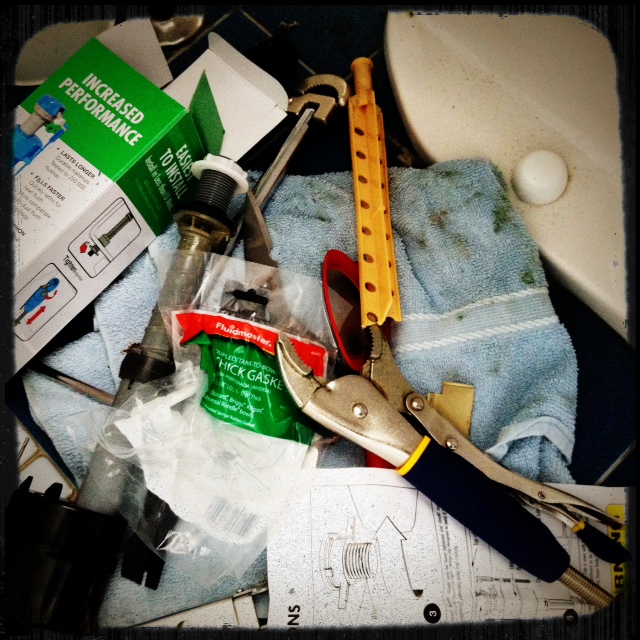
toilet repair detritusFortunately for all of us, today is also a DAY CARE DAY!!  Hah HAH!  I can get something DONE!  Unfortunately, the prime task at hand is fixing the broken toilet.  I realize that kind of sounds like a punch line, and it kind of IS, but here’s the thing: I love this kind of work.  I love it when you can actually see your accomplishment.  (Of course, I hate hate hate the three trips to Home Depot involved, especially because I planned ahead, but who knew the little pre-packaged nut-and-bolt set contains not the necessary THREE, but a useless TWO bolts?)  But there are so many things in our world and our lives that involved delayed gratification, or none at all, that something this concrete is, well, pretty awesome.  Plus, it uses ingenuity (that’s right, I thought to use the pliers as a sort of block to hammer lose the big central nut that would not come loose and was too big for our biggest wrench) AND WD40, and that’s a winning combination.  And I have to admit: I’ve always loved hardware stores.  They fill me with a sense of possibility, as if I might be doing more than just fixing a toilet, as if I might be building a beautiful, sunlit studio right between the asparagus patch and the apple tree.  Hmmmm.

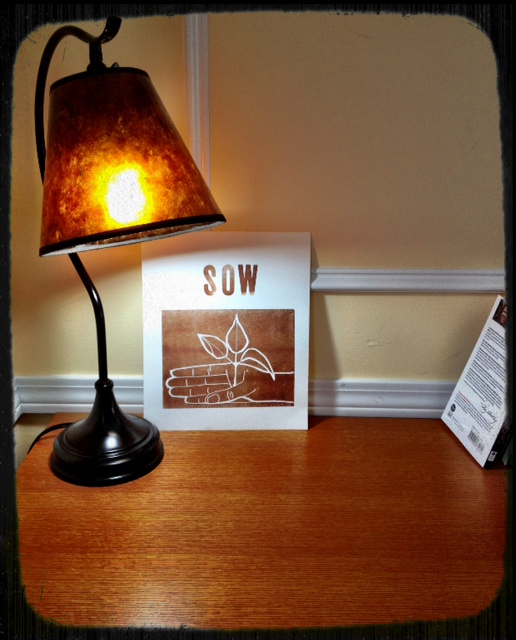
Competence and achievement, or the promise of them, have the power to pull me through another tired day, but more than that, they help me look at the usual crap fromclean desk a different position.  Today, for example, I didn’t just sort and file papers (again!): I cleaned my desk!  It’s beautiful, with a new lamp and an inspiring new print from my artist friend Kim Crichton (check her stuff out here!).  I didn’t just manage the ongoing saga of familial healthcare: I was an effective advocate for my son in a meaningful conversation with a doctor that settled some important points.  The energy to do things today, and the capacity to see them as whole and important, come from the toilet’s reminder that I am competent, that I can achieve things…and now the desk will remind me of the same thing.  (Right up until it’s covered in clutter again, I suppose…hey, we’re all a work in progress.)  My environment usually conspires against me, rife as it is with the needs and detritus of people’s lives.  But sometimes it’s useful to remember that the spaces we live in can also show us our best selves, if we’re willing to work to let them.

On the sweetness of children

We’ve developed something of a Goodwill habit at our house: I hunt down old sweaters and velvet to upcycle (and, of course, the occasional fabulous garment to wear), and the boys find books and toys.  We’ve had amazingly good luck lately, and the visits are fun for all of us.

On our trip yesterday, several people commented on how sweet my boys are.  One lady in particular did it at length and with the kind of pointed remarks and sidelong glances that made me look around for the other, less-than-sweet boys who were being implicitly criticized.  But it seemed she was entirely genuine.  I was pleased and gratified, of course, and I agreed with her: I DO have sweet boys.  Much of the time.  And, I explained, when they aren’t being sweet, well then, we aren’t out.  For long.

I realized as I said it that I may have finally cracked the code of all the “Love and Logic” and “Aha! Parenting” approaches.  If you can let go of your own agenda and your own attitude for long enough (which I find really really hard), you can really BE with your kids and hear how THEY are doing.  Which gives you either a vast array of emotional responses (anger, resentment, frustration, grief…) or, much more simply, a clear choice: to keep grumpy kids at home or to take them out in the world, knowing full well what that may entail.  On days when I’m close to my best self, like yesterday, I can make that choice and then not be particularly put out if the trip causes more turmoil instead of less.  In fact, yesterday we even had some moments of near-meltdown in the toy section, which led to me calmly crouching down by Ezra and explaining that we could stay and browse if he could be quieter and a good listener, or we could go home.  I suspect it was my (I confess) unusual calmness and rationality in meeting his little outburst that caused it to settle so fast.  But it was not ten minutes later when the kind lady started saying such nice things about him.

I’m kind of thrilled that these lessons are slowly settling in, slowly coming to life in how I actually work rather than how I’d LIKE to work.  Just showing up without an agenda makes it weirdly possible to pursue my agenda.  Being present to all the humor and chaos of my boys helps them tune into ME, too, so that when I’m fed to the eyeteeth with toys underfoot, we can have a cleanup game, together.  With dancing.  I feel like we’re all trained to find peace by escaping upheaval — but sometimes our lives ARE the upheaval, and the only peace (of hope of accomplishment) is relaxing into it.  If you can’t get out of it, get into it.  Like swimming, I guess: it’s when we stop thrashing with fear and exhaustion that our bodies can finally teach us to float, eyes closed, belly-up to the sun.

The perfect pumpkin bread

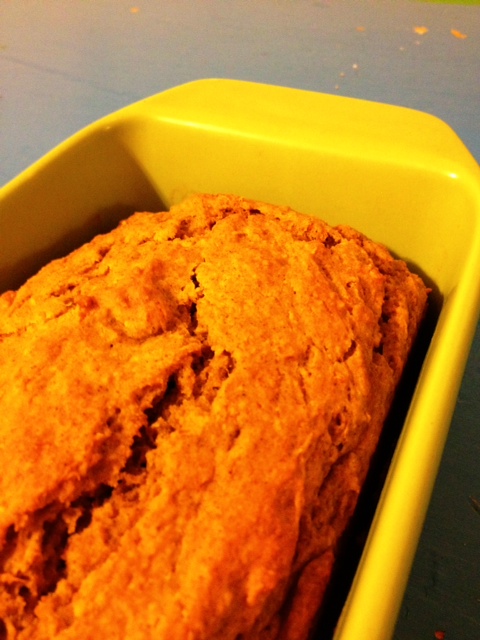
I know, I know, it’s an ambitious title.  But I’ve working on this for years, and I feel some confidence in the result.  wicked good pumpkin bread

My goals were these: pumpkin bread that is a) delicious and b) healthy.  It had to be tender and a little chewy and not harden up too much in the day or two following the bake.  I wanted to have some variability in spiciness and to be able to use either canned or real pumpkin.  Done.  Check.

Preheat oven to 350 F.  Makes two loaves.

Ingredients:

1.5 c all-purpose flour

1 c. whole wheat flour

1 c. oat flour (you can do what I did: buy the pricey stuff and THEN find out that you can grind oats in a blender to make it yourself, or you can just start the cheap way and feel all smug about it)

2 tsp baking powder

1 tsp allspice

1 tsp cinnamon

1 tsp nutmeg

1/2 tsp ginger

3/4 tsp salt

1/2 tsp baking soda

1 c. loosely or not-at-all packed brown sugar

3/4 c. milk (soy or cow’s, whatever)

1/3 c. vegetable oil

2 tsp vanilla

2 large eggs

1 15-oz can of pumpkin, or mashed roasted pumpkin (I used extra this time, maybe 15 oz, and loved the result)

Optional walnuts, chocolate chips, currants, whatever — though it’s pretty awesome plain.

Process:

Preheat oven to 350 F.

Mix dry ingredients together; make a well in the center.

Mix sugar through pumpkin in a separate bowl; add to the dries.

Add whatever extra stuff you feel you need.

Pour into two greased 8 or 8.5″ loaf pans and bake for 1 hour.

Notes:

You can also add 1/2 tsp of cloves and a pinch (or more) of cayenne if you want a spicier version.  Also, be glad this makes two loaves.  Strongly consider giving one away, but know that I will not judge you if you end up not.

Heard this afternoon

Me, to the boys: “You know what’s amazing? You will never in your whole lives not be loved by your mama.”
Ezra (three, in case you couldn’t tell): “I’m going to skip your love.”
Me: “That’s not super nice, dude.” Then, as he starts to eat the curtains, I add: “Do not eat the curtains. Do NOT eat the curtains.”

Hard to believe this is the same kid who did this last night:
I was nursing Chi while Ezra finished his tub and I heard Len talking with Ezra, helping him get out, dry off, brush teeth. Then I hear whispers outside Chi’s door. And the crack widens. A small toweled head appears around the door, and much higher up another, larger head follows. “Can Ezra say night night to Chi?” Len asks. “Sure,” I say. Ezra tiptoes into the room, then turns to look up at Len again. His face is illumined, either with love or with the hallway light, I’m not clear. “Papa, can I give Malachi and Mama night night kisses?”. My heart reaches all the way to the door. He tiptoes over, his hooded towel in its superhero cape position, and climbs carefully up on the nursing stool. A gentle kiss on his brother’s “sweet soft head” –their two small faces turned briefly toward the glow — and another on my lips, and like that, he’s gone. Precious beautiful wondrous heroic love.


Friends: to have and to hold

I recently read Pam Houston’s latest book, “Contents May Have Shifted.”  Like most of her work, it’s a fascinating inside look at globetrotting, wilderness survival (usually both of those, together), relationships with men, and some measure of recovery from an abusive childhood.  And all of them lean heavily on her friendships with women — rich, whole, complicated, open, hilarious, and intimate. Most of the time, these friendships seem like backstory, or like the tide that moves her life, enabling her to cope with everything else.  But for the first time in this novel, it hit me: these friendships are her LIFE.  For real.

So of course it got me thinking about my own friendships, the handful of extraordinary women I treasure around the globe, and how the first thing I got when I had a baby was a bluetooth so I could talk while nursing.  Well, eventually my bluetooth died and I had another baby and then it just came to pass that most of my conversations with my friends were in my head.  And since that’s the kind of people these women are, it was okay just to touch base every six (or eighteen) months.  But here’s the thing: I MISS them.  I miss the sound of their voices, the stories of their cooking, their kids, their bosses, their wardrobes, their reading, their vacations, their partners, their home improvement projects, their yoga mishaps, their favorite new wine, their afternoon tea habits.  I miss the gestures that you can’t get over the phone anyway, but at least the turns of phrase will help.  It occurs to me that handwriting is an excellent substitute, so I’m digging up my stash of cards and trying to locate some stamps.  (STAMPS?)

How do we end up here, more connected than ever and yet so busy and distracted that we forget to even WANT the kind of deep connection that used to be the whole point?  And more significantly, how do we get back?  Or how do we move forward into each other’s lives in ways that honor what all we’ve got going on AND our need for each other?  How do we construct a village when we live so scattered?  I realize this is largely what the blogosphere has done for many of us, and I am powerfully grateful.  But there’s more to it than that, and I want to live in it.  So I’m trying harder to live like Pam (or her characters; that’s always a little fuzzy): to let people in, even right from the beginning.  To recognize the connection that’s there rather than play it down.  To issue invitations and keep issuing invitations; to go when and where you are invited.  To bring things with you, however small.  To realize that thank-you notes are not always about formality but are often actually about real gratitude that doesn’t NEED to be expressed but that WANTS to be.

I called a dear friend yesterday to see how her boys were recovering from the flu, and we had a hilarious hour of conversation, punctuated by the games and needs and uproar of our collective male offspring.  At one point, her four-year-old, who now has a suspected stomach bug, dragged his exhausted body across the floor to her, every fiber of his being working toward, it appeared, resisting the need to vomit.  She’s offering me a cautious “hang on a minute…” when I hear her boy ask in a sprightly way: “Who ya talkin to?”  Surprise!  He’s fine.  Just enjoying the drama of mama home — again — with all their illnesses.  She sighed, appropriately pleased to be still clean and dry, and told me in a thoughtful way: “You know, I’m really glad you called.  I don’t think I could have made it through another one of these days.  I may call you again this afternoon.”  You see?  We are lifelines, and laughter, and succor, and sanity.  We are, it often seems, all we’ve really got.  Which is absurd, in many ways, but you know what I mean: we are the only ones who get us completely, who ARE us, in a certain way.  So if our job is to be present to ourselves, surely that means in part being present to our better selves, wherever and in whomever those selves are located.

On the challenges of showing up

When I was in graduate school, I worked at a really good restaurant that some friends of mine were opening.  It was a small place, and serious about their food, drink, and service.  To support that, they made every staffer go through an intensive and prolonged training where you tasted every single thing on the menu (oh, hardship) and learned about how it’s made and how to describe it.  The wine part turned out to be especially interesting to me, because we were given the proper schooling on how to “taste” wine, and I found that I resisted mightily.  I could taste all the same things everyone else was talking about, and the descriptions all made sense and I enjoyed having a new vocabulary, especially one with such cultural cache (how the eff do you write a French accent in here?).  But I could not, and cannot, let wine roll all the way off the edges of my tongue.  It is way too intense for me.  It’s almost physically painful.  Our teacher, the wife of the team (who has since completed sommelier school at Windows on the World and opened her own wine shop) was amused — apparently there are people who are considered “super-tasters” who have these issues.  That seems too fancy a title for me, but the fact remains that I cannot abide the intensity of wine that way.  Some folks can’t drink hard liquor for the same reason; others hate spicy food.  Sometimes experience is just too much and we want to calm the stimulus or avoid it altogether.

I tend to think about mindful living in the same way, especially parenting.  I’ve realized lately that I spent much of the fall in kind of a daze, dealing with one familial health issue after another, and so rarely actually attending to the people rather than the problems.  I’m becoming aware of this as I see how much my kids have grown, how the shapes of their faces are changing, the growth of downy hair on their arms and cheeks.  We walked at the pond today and Ezra stomped puddles the whole way there, rather than riding in the stroller; Malachi wanted to get out and walk, holding onto my hands, up and back, up and back one particular stretch.  I’m trying not to avoid the anguish of their growing up anymore.  I’m trying to think of the truth I heard of a child’s first day of school: how terrified you are for them, and for you, and how thrilled you are as well.  That the two not defeat each other, or cancel each other out, seems like a major goal, or perhaps a small miracle.  So that’s how I’m trying to live these days: to see and relish the absurdity of softness and roundness that is still, for a while, Chi’s little body, and not to worry about what comes next.  Many days, that seems too tall an order, because how else do we prepare ourselves for the angst and chaos ahead?  But maybe all this mindful stuff is right after all, and the only reality is now, and the only truly great thing we can do is show up.