I should be grateful, and I am

For so many things.

I watched my rotund eleven-month-old fall asleep in my arms today, punch-drunk on applesauce, oatmeal, banana chunks and breastmilk, and I thought about mothers the world over who hold too-light children and too-heavy worries.

I keep picking at the irritating scab of a search committee that doesn’t respond…and then remember how good it feels to even HAVE interviews, in this climate, and to have warm, supportive ones at that.

I am frustrated to not have more time to write, and I am reminded of the years when writing was work.  This, then, is play.

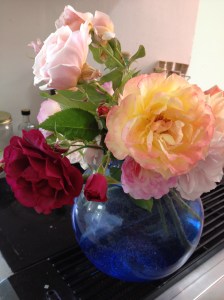
IMG_0519In one of my gardens I grow roses, all carefully chosen for cold-hardiness and disease resistance; it’s every plant for himself at our house.  When I think of the winterkill that mauled them last year and of my half-assed attempts to prune, heal, transplant, and protect them anew, I must also remember this: come June, whether I deserve it or not, there is usually grace.  Come to think of it, I depend on grace.  I build it into my strategy.  The flowers, though, are a glorious bonus.

I once had to write down, every day, ten things that were beautiful or inspiring or somehow positive, and by god it was a struggle.  But, as Thich Nhat Hahn says, “peace is every step” and compassion (with self, with world) is a habit.  In these dark days, it’s a habit worth cultivating.

With pick-axe and pitchfork…

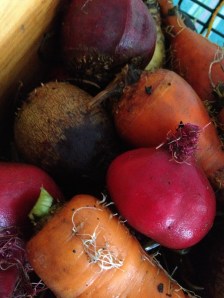
Six kinds of beets, three kinds of carrots...I feel rich.

Six kinds of beets, three kinds of carrots…I feel rich.

I’ve liberated the last of the root crops from the frozen ground.  They did not want to come.

It was a chilly endeavor, but a rewarding one.

Plus, I can’t think of the last time I was in the garden without someone “helping” and someone else crawling off into the shrubbery or gagging up leaves.  I just hope my little helper isn’t furiously pissed that I didn’t wait for him to uproot all those carrots.  He has a point: digging up brightly colored food from the earth is pretty well the awesomest.


IMG_0880

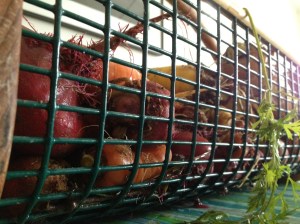
Witness the genius of the Maine Garden Hod…sturdy, affordable, and you can wash your produce right in it. Also useful for picnics in the yard and toting small animals.


Heard at our house this morning

As I’m trying to feed C, who slept too late and seems not hungry, Len is in the living room changing E’s diaper.
“I hate these wipes,” says Len. As do I: they are environmentally responsible, but the pouch they come in is persistently reluctant to give them up, leading to much shaking-of-pouch with one hand while you try to hold the boy’s bottom out of his poopy diaper with the other. And then when they do come free, they’re all stretched out like damp ribbons, which vastly increases the chance of cleaning said bottom with your bare hand.
“I know,” I say. “They are the worst wipes in the world.” Len accuses me of hyperbole, which is the most ridiculous thing I’ve ever heard. But at least we’re both amused by it.
“There is nothing worse, in the entire world, than these wipes,” he says.
After a pause, he adds, “Well, maybe the Republican party.”
“The situation in the Middle East,” I contribute.
We both chew on this.
“Slavery.”
Fine. But the wipes are really annoying.

The overwhelmingness of creativity

Every year I start thinking about Christmas gifts in June. Every year I SWEAR that I will start making them in June. And this year I did! I did. I made one small scarf. But summer is just so, well, summery, so perfectly designed for other things, like helping a very naked young man make a river habitat for his wild animals on the edge of the driveway. Crocheting fuzzy things just seems so pointless under those circumstances. And thus we arrive here, in early December, at a state suspended halfway between panic and bliss: the crafting imperative.

And so I spent my Sunday afternoon: felting old wool sweaters; upsizing a hat pattern I like; making experimental fleece hats (one of which my sweet partner has been wearing ever since). I am one of those crafters who takes such pleasure in the planning and anticipation that I spend very little time actually MAKING things. But now it’s all about the making, and that brings a whole new kind of satisfaction. Put differently, it actually brings satisfaction rather than its promise. Pam Houston: “In graduate school you learned that men desire the satisfaction of their desire. Women desire the condition of desiring” (from Cowboys Are My Weakness, probably “How to Talk to a Hunter). I hate to be so gender-conformist, but hell, I’m a stay-at-home mom making Christmas presents. I’ll just own that.

Back to the Making of Things and the Overwhelmingness of Creative Energy: I’ve got plans. They are good plans. The trick now is to get enough done fast enough that it still feels like generous gifting rather than crazed production. It’s a bear trying to live this whole mindful approach. But it has been beautiful to look back at the last few years and realize that most or all of our gifting is now either a) donation (Heifer, Kiva, local home energy assistance, or recipient’s favorite charity); b) handmade; and/or c) purchased from local crafters. That feels good on all levels — an appropriate way to honor a holiday I tend to think of as the birth of hope. And boy do we need it. In these dark months we need all the warmth, fellowship, and generosity we can get.

And hey — if you are interested in details of what I’m making, check out my Pinterest boards or just leave a comment here. I want to use the pages for that kind of info, but I’m not quite there yet. Prompt as needed.

That whole holiday thing

We had a few friends over to decorate the tree this evening, and conversation turned, as it will, to the kinds of traditions we create, now that we’re grownups. Tree-trimming is the big one, for us; we’ve been doing it since back in the day when we had lots of friends, lots of energy, and the funds to throw an actual party. Times do change. We’re not sure how the rest of it will turn out, now that we have kids — there’s the whole Santa fiasco, the hiding of gifts, the efforts to secure the tree from small grasping hands. There are things we’d like from the season, but those seem elusive at best: music. Time with friends and loved ones. A sense of peace, perhaps even of joy. But where the hell are we supposed to find all that in the chaos we’re swimming in? We seem to end up instead with a short occasional visit, a panicked rush on making gifts that we’ve been planning since June, and a general sense of seasonal affective disorder. This is no real surprise, but it is a disappointment. I suspect my real problem is not the holidays at all, though there’s obviously enough trouble there. I suspect my real problem is the looming prospect of February. I may need to seriously consider moving to where there’s more light.

“Going back to work?”

As if we stopped working in the interim.  As if carrying, growing, birthing, nursing, and raising a child are not work.  (Someone told me that the process of gestation and childbirth is equivalent, in terms of energy expended, to climbing Mount Everest.  Someone more reliable told me that the single most energy-intensive activity a mammal can undertake is gestation.  This seems obvious.)

But when you’ve had a professional career and you step away for a different kind of life, people always want to know if you’re going back to work.  By which they really mean one of two things: a) will you get paid again, or will you keep sponging off your husband (who must make a MINT)?, and/or b) will you do something that uses your vast experience and training or will you just keep changing diapers ad infinitum?  I’d be offended by these questions if I weren’t asking them myself.  (Except for the MINT part.  We wish.)  But I kind of want to know, too.  And I REALLY want to know if I’ll be able to go back to work in the ways that make best sense. Those are:

1. With limited hours so there is still time to spend with kids and so we don’t spend my whole paycheck on childcare.  You’d think in a tough economy and a social context where more parents want to parent more, that we’d see an increase in smart, flexible, responsible part-time positions.  No.  Instead, most organizations are forcing more on overworked, underpaid employees in the strange American all-or-nothing principle.  I don’t get it, nor do I like it.  The parents I know could change the world, and the lucky ones get to do it in both ways at once: through paid work AND raising the next generation of citizens and leaders.

2. With a passion for the field and an excellent match for my distinctive sets of skills and capacities.  Why aren’t there more (decently paying) jobs in the most creative and engaging fields of teaching and social change?  Don’t answer that.  I get it.  I just don’t like it.  Mostly, I can’t help thinking about how much positive change could happen if we actually embraced principles of prevention rather than treatment — if we made sure kids have what they need, and parents too.  If we got people interested in building things early, instead of teaching them to behave like a cog in a wheel or an arm in a factory.  The world is what we make it, friends.  Let’s make it something we want to inhabit.  That takes artists and engineers and organizers and teachers and doctors and environmentalists, and it takes cooperation and negotiation and the crafting of shared hope.

3. With a context and situation that permit and even encourage the recognition that all workers are human and deserving of dignity, flexibility, support, integrity, and engagement.  Being a parent has made me a better human and also, I believe, a better worker and supervisor.  And it has made me less patient with forms of interaction that are counterproductive.  Ask for people’s ideas.  Give them a chance to shine.  Be honest with them.  Encourage them to learn and grow.  Remind them that they’re not just laying brick upon brick, as the old story goes; they’re building a great cathedral.

This is all to say: I’m hopeful.  I’m hopeful that I can find ways to sustain us in the long haul, whether through writing or teaching or foundation work or crafting or consulting.  And for now, I’ve got a job I love with two tiny colleagues and one great big one and a shared vision of fun, love, and creativity.  Can’t beat that with a stick.

The garden at first snow

There have been years when our first snow surprised us, and we gleefully picked spinach and arugula from under a fluffy blanket.  There have been years when the first snow came overnight and was so gentle that it melted away from the small warmth of the plants, leaving them in shallow dark circles among the white.  There have even been years when I was so organized and the snow so conveniently late that my beds were harvested, composted, and covered over with a shredded-leaf duvet.  But this year is a tweener: the snow is late, and sparse, but we’ve had deep, consistent freezes that forced the chard and parsley into the house.  (I picture them lifting their mulchy skirts to hoist their skinny white knees above the soil line and then straggling like refugees up to the deck.)  All that’s out there now is the kale (which somehow ended up in four of our six beds…don’t look at me like that) and the remaining root crops: beets and carrots.  Those really need to come in soon, as our pitchfork can only do so much against rock-hard winter soil. 

It’s a frustration trying to garden with children, but also a lesson in wonder — not just that things grow from tiny seeds and produce beautiful, colorful food, but also that the soil and water and worms exist as they do.  We got Ezra to help us spread chopped leaves on the garden because we told him the worms need them for food through the winter.  He was beyond thrilled when, four weeks later, we lifted the leaf mulch to plant our garlic, and there were numbers of wrigglers dashing for cover.  Worms are for Ezra what writing is for me: alluring, entrancing, and more than a little terrifying.  Also good for the world, and something we want to nurture.

What. On. Earth.

Bear with me, because I’m just starting this up, and I’m a little starry-eyed.  It feels like one of those deep dark secrets we used to fondle, a little afraid of it and totally enticed.  And now I’m pulling it out of my pocket, covered in lint and crumpled, ready perhaps to show it to someone before it falls apart in the wash.

A blog like this seems the last hope of the desperate.  And a particular kind of desperation at that: a kind that demands that life have meaning and beauty and some sort of order.  A kind that insists we keep growing, even when it hurts or seems just plain stupid.  So here I am, typing away in my effort to keep living the questions I’ve been teaching about for years.  Yes, this blog’s title comes from a course I designed way back when: “Passion and Sustenance: On Crafting a Life.”  It was a study of community, vocation, sustainability, and work.  Ever since I left my paid work to raise my family, I’ve been trying to cleave to these questions, to remember the readings and to live with the ideas we bandied about so carelessly in the classroom.  And now the questions matter even more, because now they are wrapped around more of us.

So what will I do here?  Remains to be seen.  But at this moment, here are my topics:

Working (paid, free, idealized, crap, whatever)

Living (on earth; in the land; in community)

Growing (plants, people, whatever)

Making (food, art, words — craft is everywhere)

Hoping (what some might call faith, love, or imagination)

Nothing is neatly sorted or sortable, but as you’ll soon see, that’s just my speed.  It’s all connected, anyway, so we might as well take a deep breath. Keywords: patience, humility, generosity.  And hope.