On writing as an act of generosity

I am a big fan of generosity.  I love the notion of giving, of gift as interaction and interaction as gift.  And I’m a big fan of writing.  But it has only recently occurred to me that those might be the same thing.

Naturally, there are many writers whose work felt like a gift to me — Barbara Kingsolver, Wendell Berry, Billy Collins, and many more — but it felt private.  It was the emotional counterpart to my teenage habit of hugging a book to my chest as I snuck off somewhere to read (since I was not supposed to be reading but rather doing something “productive” like washing dishes).  I cherished the words and the stories and I felt wildly privileged that they spoke to me.  To ME!  But as I got healthier and wholer, I came to see that the larger political significance I’d always attributed to stories was perhaps the same thing as this deeply personal conversation, just on a broader scale.  As these and other writers opened my eyes and my soul to the wider world, and as I learned (ironically, well AFTER my PhD in Comparative Literature) how many other eyes and souls were out there, doors ajar, because of their writing, I came to see that this is their gift to the world.  Barbara Kingsolver, in fact, talks about this in a video she did way back when Animal Dreams was first published (which I can’t seem to find today); she says, essentially, that the most important thing she can do for this broken world is to put her butt in chair and write.  It’s true, she tends to work on the macro level, I think: witness this excerpt from a conversation with David Gergen about how stories structure and define our world, our nation, our communities:

“DAVID GERGEN: –but through your own novels to invent a new set of stories for us, is that what you’re about?

BARBARA KINGSOLVER: It is in my own little corner. That’s what I’m trying to do. I love what Joseph Campbell said about mythology. He said that our stories are what holds us together as a culture, and as long as they’re true for us, and as long as they work for us, they–we thrive. And when they cease to become true, we fall apart, and we have to reconstruct them or revitalize them. We have to come up with new myths.”

And of course that’s what she does: her stories enable us to connect to the land and the people who work it; to understand the histories of human movements and failures; to imagine ourselves into a capacity for managing heart-wrenching, world-churning change that right now seems certainly fatal.  But what’s brilliant about Kingsolver is that she works on the micro level as well.  Her characters and her language are so compelling, so utterly moving and hilarious and desperate and comforting, that we can’t help but be drawn in.  As a reader, I’m in awe of that.

But now I find myself thinking, for the first times in my life, as a WRITER too.  It feels like hubris, and perhaps it is. But I’m slowly, slowly catching up to the notion that when we have a gift to give and we believe in generosity, then we have to give it.  Even if it is our writing.  Even if it is a painful exposure or a risk or an embarrassment, or whatever it turns out to be.  Maybe we have to do it.  (I’ve had little angels tell me this before — angels in the sense of folks who show up to say wise things or be there when you need them — the most memorable of which was a guy at a conference in San Francisco years ago who came up to me after I’d spoken in a seminar to ask what my book was called.  I said I hadn’t written one, and he asked why not, and then he held my eyes while I squirmed.  “This isn’t about ego,” he said.  “The world needs to hear what you have to say.  You have to get out of the way.”)

So here I am, trying to get out of the way, though a little confused by the whole thing and unsure of what comes next.  I am grateful for the readers I have and hopeful for more; I am grateful for the extraordinary writers (novelists, bloggers, poets, and authors of all stripes) who inspire me every day with their bravery and their brilliance.  I am grateful, I suppose, for the gift I’m perceiving and for those of you who are out there to give it right back by receiving.
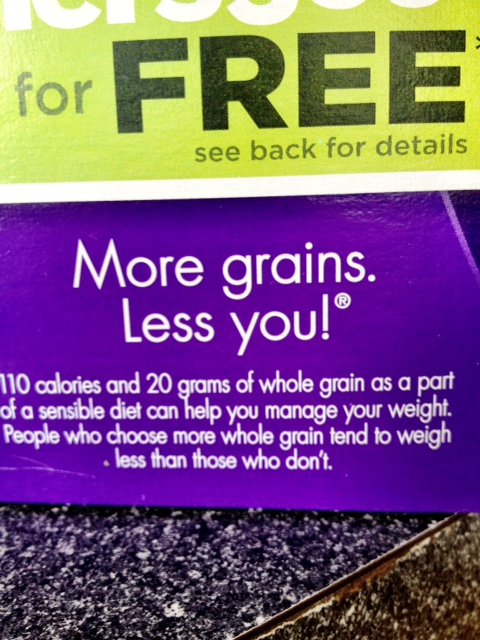
Making MORE, not less, of ourselves

But, but, but...here I've been working so hard to make MORE of me!

But, but, but…here I’ve been working so hard to make MORE of me!

I know I’m not always in the best mood in the morning, but it was still a shock to see this on the cereal box.  And to realize that this is what my (mercifully pre-literate and mercifully male) kids have been staring at.  And to realize that this kind of message is everywhere.  How broken is that?

I know they mean well, that it’s a weight-loss message, but still.  Come ON, Cheerios.  Surely you’ve noticed the whole self-actualization agenda that is at least trying to keep pace with our nation’s long-term self-hatred protocol?  Maybe this is another reason why I shouldn’t eat Cheerios.

In all seriousness, though, this has started me thinking about the range of ways our culture invites us to be less than we are, and not just physically (though that encompasses not only weight issues but the whole range of gender-normative behaviors and style).  Jobs are stultifying enough that most of us have to compromise most of our selves in order to earn the paycheck and the benefits we need; educational programs force us into outdated molds of specialization; even cocktail-party conversations (I think; I can barely remember that far back) expect a short answer to the standard question: What do you do?

Here’s what I’d like to say to that, today: I raise two pretty awesome little boys in ways I hope are feminist and respectful and empowering.  I read whenever I can.  I write (academic work, poetry, this blog, articles, children’s stories) and seek to write a lot more.  I hope and plan to get paid for writing.  I serve on the board of a major community action agency and chair its committee on community impact.  I used to teach college and build community-partnership and community-based learning programs.  I have a PhD and often wonder if and how I can put that to appropriate use again.  I consider teaching options.  I lead discussion groups for our state humanities council and my local public library.  I crochet and I sew, and I especially like working with upcycled and repurposed materials.  I work on recovering from a childhood that bizarrely merged great privilege with great difficulty.  I fix things that need fixing, when I can.  I talk to my neighbors and pitch in where I can.  I hope to build a community of moms where I live.  I discovered recently that I can kind of draw.  I struggle with how to balance my type-A-ness, which I need but instinctively dislike, with my husband’s more relaxed approach to life (type L?  L for Love?), which I admire but which doesn’t privilege order as much as I need.  I like getting older.  I like lifting weights and am kind of glad that my family’s propensity for osteoporosis makes it kind of non-optional.  I chastise myself a lot for not lifting often enough, though, and I’m working on that.  There’s more, but there’s always more, and that’s the POINT.

You see my resistance to the language of “less”?

Patti Digh has a great bit in her totally fabulous book “Life is a Verb,” in which she mentions a study where a guy asks kindergartners to raise their hands if they are painters.  All the hands shoot up.  Dancers? Ditto.  Singers?  Yes.  Then he asks college students the same thing, and hardly any hands go up.  “What happens in those years,” she asks, “between five and eighteen to our sense of joy and possibility and personal command of the universe?”

Personal command of the universe might be a bit much to ask, but the SENSE of it is glorious.  It’s the sense of our largeness, our infinite capacity, our minds and hearts as generous and accepting and brilliant as they were born to be.  Mindfulness practitioners often say that when we try to meditate, it’s like sitting inside a closet crammed with the detritus of our lives.  And as we practice more, the disappointment is that the same crap never really goes away.  But the closet gets bigger and bigger, becoming a room, a cathedral, an airplane hangar, and soon the wide blue sky.  A few old pairs of cleats and some back tax files don’t bother us nearly as much under those circumstances.

I find it’s the same thing with our general sense of self.  Bad hair, bad skin, an achy shoulder, a snide remark — all these things can fester if we keep ourselves small (ironically, often the same thing as keeping ourselves “secure”).  But if we admit our largeness, our GREATNESS — in the sense of our participation in the grand drama of human events, not some weird ego trip — then who really cares?  We are who we are, and we deserve to surround ourselves with people who love us and things that give us joy.  We deserve to celebrate exactly who and where we are.  More grains, Cheerios, by all means.  But please don’t try to make less of us.

Pinterest as spiritual practice

The Pinterest craze has provided many of us with new ways to kill time.  And I mean, kill it dead.  The unbelievable depth and breadth of resources available present an enormous challenge to those of us with a passion for, well, anything.  Because it’s all on there – the whole world of hobbies, ideas, design, innovation, crafts, houses, book ideas, every possible manifestation of human interest.  It’s easy to start, hard to put down, and even harder to catch up on sleep after your first week.  Which is why all kinds of folks are including Pinterest in their media fasts, their unplugging, their general efforts to return to sane and local living.  (Patti Digh has a great little piece on that here.)

The real challenge, I think, is in moderation, in judicious use of the resources with a discerning eye, so that you a) aren’t constantly on there, and b) you only pin what you want to use, for feeding you in some important way.  (Here, my pastor mother-in-law would smile and say: “As it so often is in our spiritual lives.”)  Indeed, one friend asked (on facebook, amusingly): “does Pinterest provide beauty or value, or does it just give us more information? Because I have enough information.”  I answered yes, beauty and value indeed, because of how it enables us to keep contact (distanced, sorted, organized contact) with information, with good ideas and beautiful, inspirational images.

I am one of those people who struggles to live in the present because I am always trying to bear (“to carry”) in mind too many kinds of information: the location of that recipe I want to cook for dinner; the directions for that fun activity I want to try with my kids tomorrow; the pattern for the hat I will crochet my niece for Christmas; the paint color I saw in someone’s bathroom that I want to try in ours.  And that’s just the domestic sphere!  What of the brilliant “slow money” article I keep losing track of? The book on radical homemaking that offers new ways of imagining barter? The website that’s a useful model for my consulting practice? My head is constantly moving on several levels at once, which is an advantage in terms of getting things done but a distinct disadvantage in the peace-of-mind category.  It took me until a few months into my Pinterest love-affair to realize the enormous gift it offered me: to be here and now without ceding my hold on the future.  It offers us what is essentially a spiritual opportunity, previously available (perhaps) only to those writers and contemplatives who kept and used tiny portable notebooks.  By pinning (in our portable phones, even?) the next great family activity or the last painting that made us gasp, we can store our cherished visions without giving them up; we can live our lives AND remember where and how those visions are; we can revisit them in all their detail and promise, erasing what no longer fits or reorganizing to accommodate new dreams; we can share these visions, when we choose to, with friends; and most of all we can do all this without fear of spending our lives away from center, from the here and now.  We can set down the dream, or pin it up, and not have to live in its shadow for fear of failure or forgetting.  That way we can be here, now, with our lived realities, and still honor the hopes we have for other, better, fuller lives.  Because we do have those hopes, and yet we only fulfill them through living, here and now, rather than dreaming in the ether.

On kindness

On Sunday morning, we woke up to a 58-degree house.  Which is not much colder than we USED TO keep it, but since having babies, it’s been warmer.  Indeed, the discovery that the furnace had broken helped alleviate our concern about the youngest, who had been crying on and off since 3 am.  Turns out he was cold.

The good news was that the high that day was predicted to be ABOVE zero — 16 degrees above zero, in fact!  But since it would drop to zero that night, and since it was a Sunday and since our furnace is old enough that the one place our heating guy could get the right part was closed and no one was returning his phone calls…well, we got that basement woodstove going and started opening cabinets.  We had some good passive solar going, and of course there was the requisite emergency baking (for the heat of the oven, you know), but it still seemed clear that we’d need a better strategy.

We considered turning off the water main and taking up a friend’s offer to stay with them that night, but that would have meant letting the woodstove go out, and that just seemed dangerous (my dad said to put antifreeze in every drain — yipes!).  But then we thought about the offer in a different way: here were friends we like but don’t get to see all that much, offering us not just a warm dinner (and cake!  CAKE!) but the whole necessary array of beds and cribs and tubs and whatnot.  Maybe, we thought, we should throw ourselves on this kindness, and see if there’s more out there, too.  So we called neighbors and ended up with two space heaters — enough to keep the pipes on each floor in good shape.  And we knew that if all else failed, we could pack up and go in the middle of the night: not one but TWO sets of friends offered to leave a door open so we could just barrel in and find our way to a bed, no matter what the time.  My favorite line from the whole experience was from our excellent neighbor Bruce said: “Whatever you need, the answer is yes.”  I breathe easier just WRITING it.  It felt like we were taken in and held by all this caring.

As I was telling my dad how all this went, he mentioned his stepson had a similar experience recently — his car broke down in front of a stranger’s house in the woods of New Hampshire, and they invited him and his five-year-old daughter in for warmth and cocoa.  As they waited for AAA and assorted paternal types to deal with the car, these kind folks chatted with Jon and Amelia, learning a) that they live near a little lake, and b) that while Amelia has snow shoes, she does not have ice skates.  So what did they do?  Went and found an outgrown pair in the closet that will fit her small feet, and gave her them, asking her merely to pass them along to another little girl when she outgrows them.

We always hear about the shootings, the disease, the fistfights, the disruptions.  We hear about the agony and the ecstasy, but we rarely hear about the simple kindness, the interconnection.  Margaret Wheatley is right, in So Far From Home, when she says “most people don’t want to know they’re interconnected…[it] is too much of a burden.  It requires that we take responsibility for noticing how we affect other people…” (p.55).  And that is monstrously hard.  But still, my theory is that there’s more basic goodness out there than we know. I believe that most humans want the opportunity to be kind, to be treated with kindness and to receive it with grace.  Our innate generosity gets papered over with cynicism, defensiveness, and fear; our natural openness gets shut off and buried like some kind of dangerous supply line that might spurt everywhere if uncontained.  And you know what?  It DOES spurt everywhere. The whole world gets wet.  Kindness begets kindness and our very vision begins to shift, peering as we do now through the soft rain of basic human goodness, visibility low so that we have to look at who and what are here right now.  But what else can we do?  Of course we look a little goofy, with our wet hair and our smiles, treating people as if they have a right to be loved. We wring ourselves out, have a laugh, and lay down in the sun to warm.

Friends: to have and to hold

I recently read Pam Houston’s latest book, “Contents May Have Shifted.”  Like most of her work, it’s a fascinating inside look at globetrotting, wilderness survival (usually both of those, together), relationships with men, and some measure of recovery from an abusive childhood.  And all of them lean heavily on her friendships with women — rich, whole, complicated, open, hilarious, and intimate. Most of the time, these friendships seem like backstory, or like the tide that moves her life, enabling her to cope with everything else.  But for the first time in this novel, it hit me: these friendships are her LIFE.  For real.

So of course it got me thinking about my own friendships, the handful of extraordinary women I treasure around the globe, and how the first thing I got when I had a baby was a bluetooth so I could talk while nursing.  Well, eventually my bluetooth died and I had another baby and then it just came to pass that most of my conversations with my friends were in my head.  And since that’s the kind of people these women are, it was okay just to touch base every six (or eighteen) months.  But here’s the thing: I MISS them.  I miss the sound of their voices, the stories of their cooking, their kids, their bosses, their wardrobes, their reading, their vacations, their partners, their home improvement projects, their yoga mishaps, their favorite new wine, their afternoon tea habits.  I miss the gestures that you can’t get over the phone anyway, but at least the turns of phrase will help.  It occurs to me that handwriting is an excellent substitute, so I’m digging up my stash of cards and trying to locate some stamps.  (STAMPS?)

How do we end up here, more connected than ever and yet so busy and distracted that we forget to even WANT the kind of deep connection that used to be the whole point?  And more significantly, how do we get back?  Or how do we move forward into each other’s lives in ways that honor what all we’ve got going on AND our need for each other?  How do we construct a village when we live so scattered?  I realize this is largely what the blogosphere has done for many of us, and I am powerfully grateful.  But there’s more to it than that, and I want to live in it.  So I’m trying harder to live like Pam (or her characters; that’s always a little fuzzy): to let people in, even right from the beginning.  To recognize the connection that’s there rather than play it down.  To issue invitations and keep issuing invitations; to go when and where you are invited.  To bring things with you, however small.  To realize that thank-you notes are not always about formality but are often actually about real gratitude that doesn’t NEED to be expressed but that WANTS to be.

I called a dear friend yesterday to see how her boys were recovering from the flu, and we had a hilarious hour of conversation, punctuated by the games and needs and uproar of our collective male offspring.  At one point, her four-year-old, who now has a suspected stomach bug, dragged his exhausted body across the floor to her, every fiber of his being working toward, it appeared, resisting the need to vomit.  She’s offering me a cautious “hang on a minute…” when I hear her boy ask in a sprightly way: “Who ya talkin to?”  Surprise!  He’s fine.  Just enjoying the drama of mama home — again — with all their illnesses.  She sighed, appropriately pleased to be still clean and dry, and told me in a thoughtful way: “You know, I’m really glad you called.  I don’t think I could have made it through another one of these days.  I may call you again this afternoon.”  You see?  We are lifelines, and laughter, and succor, and sanity.  We are, it often seems, all we’ve really got.  Which is absurd, in many ways, but you know what I mean: we are the only ones who get us completely, who ARE us, in a certain way.  So if our job is to be present to ourselves, surely that means in part being present to our better selves, wherever and in whomever those selves are located.

Because we’re a strange species

I wasn’t going to post tonight, because I’m tired and don’t have much to say.  My only real news is that I’m planning NOT to watch the Downton season premier because I can’t afford to lose two precious hours of sleep and I assume it’ll be streaming all week on PBS.  THAT’S the kind of day I’m having, friends.  But hey, it’s not bad.  I can handle it.  I thought to myself: I’ll just log onto Amazon quick and find me a wall calendar, because it’s been irritating that we don’t yet have one for our kitchen wall where we write down our shared lives.  (And without which no one gets anywhere.)

And then I saw the array of calendars at Amazon.  This is, honestly, the order in which they are appearing on the current page:

Hunger Games

Mystique X-Posed (yes, it’s porn)

Extraordinary Chickens (yes, it’s about poultry: the cover bird has a fabulous bouffant obscuring most of its face)

Victoriana

Nuns Having Fun

Game of Thrones

Harley Davidson

People, we are a strange and wonderful creation.  Or at the very least, strange.  You may wonder: what did I settle on?  Pema Chodron.  I need all the help I can get in remembering mindful living, though I suspect that these calm images and centering words may have the opposite effect on a bad day.  What the heck.  Won’t know till we try.

An actual post about Skyfall

Because the last one, though brilliant and witty and full of incisive critique, was lost by WordPress, and because I couldn’t duplicate the jaunty late-night feel of it, I offer only this:

How is it that we started out with a powerful, strategic leader (M) and a capable, daring field agent (Eve) and we ended up with a dead mother/grandmother and a secretary?  I’m all for fourth wave feminism and the power of the administrative pen, but this is the MOVIES.  M dies of a wound to the HIP?  At least she was shot, I suppose, instead of falling and breaking it.  And we did get to see a cinematic first: grandma making dirty bombs from household objects.  But the movie did such great and unprecedented things with sexuality (clearly, the director spent some time working out how best to use Daniel Craig’s thighs — and we’re glad he did).  You’d expect something more novel than M’s “at least I raised one good son” sentiment and Eve’s transformation from ass-kicker to note-taker.

Maybe this was the audience-development Bond, wherein new structures and conventions are pioneered even as old ones (like sleeping with the battered woman he purports to try and rescue) are maintained.  Maybe the next one will rock the planet.

One last note: what was up with the macro-lessons about technology?  Q lays a bread-crumb trail that either fails (since Silva shows up at Skyfall) or leads him there without the requisite corollary ambush.  Since Silva clearly uses technology (and psychology, that useful tool of field agents everywhere) to find Bond, I’m not sure the much-touted argument over Techwork v. Fieldwork really goes anywhere.  Your thoughts?