On dancing and seeds and grace

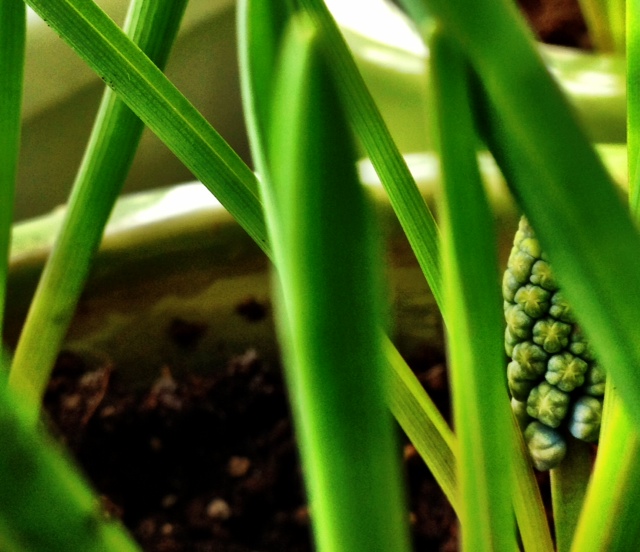
grape hyacinth budHere’s my afternoon: starting seeds with Ezra in the basement; coming upstairs to find Len and Chi home from the grocery store and provisioned with a tasty new beer (well, Len, anyway); dancing with both babies to The Miseducation of Lauryn Hill.  Her song “Bonus 2,” which is essentially First Corinthians brought to extraordinary life, always reaches out to me — but today, as I held my small fevered Ezra in my arms and danced, it was transcendent.  To sing those ancient words of love to my son, through Lauryn’s music, to feel the rhythm move through the bones of this old white Colonial, well, I was shaken.  I was lifted up.

I don’t often write about spirituality, or at least not as such.  It’s partly because I feel those are kind of private issues, and also because I’m uncomfortable with the ways articulations of our own faith can end up looking or feeling like advocacy or pushiness to others.  I confess, I’m also tired of the self-congratulatory tone of lots of the writing out there on religion.  And also, let’s face it: I’m a seeker who was raised Quaker (more in the secular humanist end of that spectrum) in a kind of do-as-I-say-not-as-I-do sort of way.  So I have no sense of authority, only a heart full of questions and gratitude.  I tend, then to use the language of mindfulness or grace, since the former is more of a practice and the latter more of an acceptance of what seems an obvious and widely accepted truth.  For me, there are lots of interchangeable words that describe what I have faith in: love, beauty, the sacred, harmony, nature, the universe, grace, providence, serendipity, the Way, the Light, truth, hope, and of course the many permutations of god.  It is clear to me that music is sacred, as are the gifts of all artists and growers and makers and seekers — all creatures, and especially those who offer up something of beauty, who uncover or create or otherwise act with generosity in this sad and broken world.

I’ve been trying to read Margaret Wheatley’s So Far From Home, though it’s hard, because its premise is that we cannot change the world; we can only accept our powerlessness and do our best to live whole and beautiful lives by doing the right work because it is work that needs to be done.  That living, that standing in contrast to the crazy and the broken, is itself transformative.  I buy this, mostly, because it seems smart and truer than anything else I know, but I’m not wise enough or whole enough to live within it.  I’m trying.   Most days, I’m still seeking, perhaps too anxiously, for that “right work,” unable to accept that where I am is enough.  But on a day like today, that truth rings out: of course it’s enough.  Perhaps not forever, but I don’t live in forever.  I live right here, right now, right in the middle of all this beauty, surrounded on all sides by grace.

Making MORE, not less, of ourselves

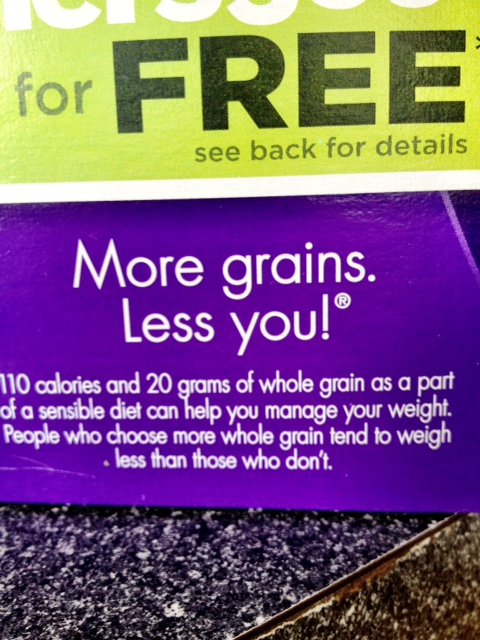
But, but, but...here I've been working so hard to make MORE of me!

But, but, but…here I’ve been working so hard to make MORE of me!

I know I’m not always in the best mood in the morning, but it was still a shock to see this on the cereal box.  And to realize that this is what my (mercifully pre-literate and mercifully male) kids have been staring at.  And to realize that this kind of message is everywhere.  How broken is that?

I know they mean well, that it’s a weight-loss message, but still.  Come ON, Cheerios.  Surely you’ve noticed the whole self-actualization agenda that is at least trying to keep pace with our nation’s long-term self-hatred protocol?  Maybe this is another reason why I shouldn’t eat Cheerios.

In all seriousness, though, this has started me thinking about the range of ways our culture invites us to be less than we are, and not just physically (though that encompasses not only weight issues but the whole range of gender-normative behaviors and style).  Jobs are stultifying enough that most of us have to compromise most of our selves in order to earn the paycheck and the benefits we need; educational programs force us into outdated molds of specialization; even cocktail-party conversations (I think; I can barely remember that far back) expect a short answer to the standard question: What do you do?

Here’s what I’d like to say to that, today: I raise two pretty awesome little boys in ways I hope are feminist and respectful and empowering.  I read whenever I can.  I write (academic work, poetry, this blog, articles, children’s stories) and seek to write a lot more.  I hope and plan to get paid for writing.  I serve on the board of a major community action agency and chair its committee on community impact.  I used to teach college and build community-partnership and community-based learning programs.  I have a PhD and often wonder if and how I can put that to appropriate use again.  I consider teaching options.  I lead discussion groups for our state humanities council and my local public library.  I crochet and I sew, and I especially like working with upcycled and repurposed materials.  I work on recovering from a childhood that bizarrely merged great privilege with great difficulty.  I fix things that need fixing, when I can.  I talk to my neighbors and pitch in where I can.  I hope to build a community of moms where I live.  I discovered recently that I can kind of draw.  I struggle with how to balance my type-A-ness, which I need but instinctively dislike, with my husband’s more relaxed approach to life (type L?  L for Love?), which I admire but which doesn’t privilege order as much as I need.  I like getting older.  I like lifting weights and am kind of glad that my family’s propensity for osteoporosis makes it kind of non-optional.  I chastise myself a lot for not lifting often enough, though, and I’m working on that.  There’s more, but there’s always more, and that’s the POINT.

You see my resistance to the language of “less”?

Patti Digh has a great bit in her totally fabulous book “Life is a Verb,” in which she mentions a study where a guy asks kindergartners to raise their hands if they are painters.  All the hands shoot up.  Dancers? Ditto.  Singers?  Yes.  Then he asks college students the same thing, and hardly any hands go up.  “What happens in those years,” she asks, “between five and eighteen to our sense of joy and possibility and personal command of the universe?”

Personal command of the universe might be a bit much to ask, but the SENSE of it is glorious.  It’s the sense of our largeness, our infinite capacity, our minds and hearts as generous and accepting and brilliant as they were born to be.  Mindfulness practitioners often say that when we try to meditate, it’s like sitting inside a closet crammed with the detritus of our lives.  And as we practice more, the disappointment is that the same crap never really goes away.  But the closet gets bigger and bigger, becoming a room, a cathedral, an airplane hangar, and soon the wide blue sky.  A few old pairs of cleats and some back tax files don’t bother us nearly as much under those circumstances.

I find it’s the same thing with our general sense of self.  Bad hair, bad skin, an achy shoulder, a snide remark — all these things can fester if we keep ourselves small (ironically, often the same thing as keeping ourselves “secure”).  But if we admit our largeness, our GREATNESS — in the sense of our participation in the grand drama of human events, not some weird ego trip — then who really cares?  We are who we are, and we deserve to surround ourselves with people who love us and things that give us joy.  We deserve to celebrate exactly who and where we are.  More grains, Cheerios, by all means.  But please don’t try to make less of us.

On Nemo, of course

Image

It’s not like we can write about anything else today.  At least, not those of us who live in the 3-foot zone.  But it does help to remember a few things:

1. This is one of the few winters where a storm like this wouldn’t make it impossible to see out our driveway.  Some years, it’s been like a cavern, with snow banks eight feet high on either side.  This, all things considered, is not all that severe.

2. We haven’t lost power!  Hurrah!  Celebrations!  Naturally, I kept expecting us to, so we had the woodstove on all night (including a 2:30 am run to reboot).  And then we had to do some emergency baking — Mimi’s German Apple Cake, from Rustic Fruit Desserts (the best such cookbook I’ve found).  These are not awful things.

3. Kind neighbors are glorious: one such just snowblowed (snowblew?) out the worst of our four- and five-foot drifts.  I heap blessings upon him and his family.

4. There were brownies.  From the day before.  All chewy.  And Len was too sick to really compete for them (yes, I will make this up to him, but for Nemo, well, it was what it was).

5. The beauty of all this snow is astonishing, and if you catch me at the right moment, I am even capable of seeing that.  Witness.

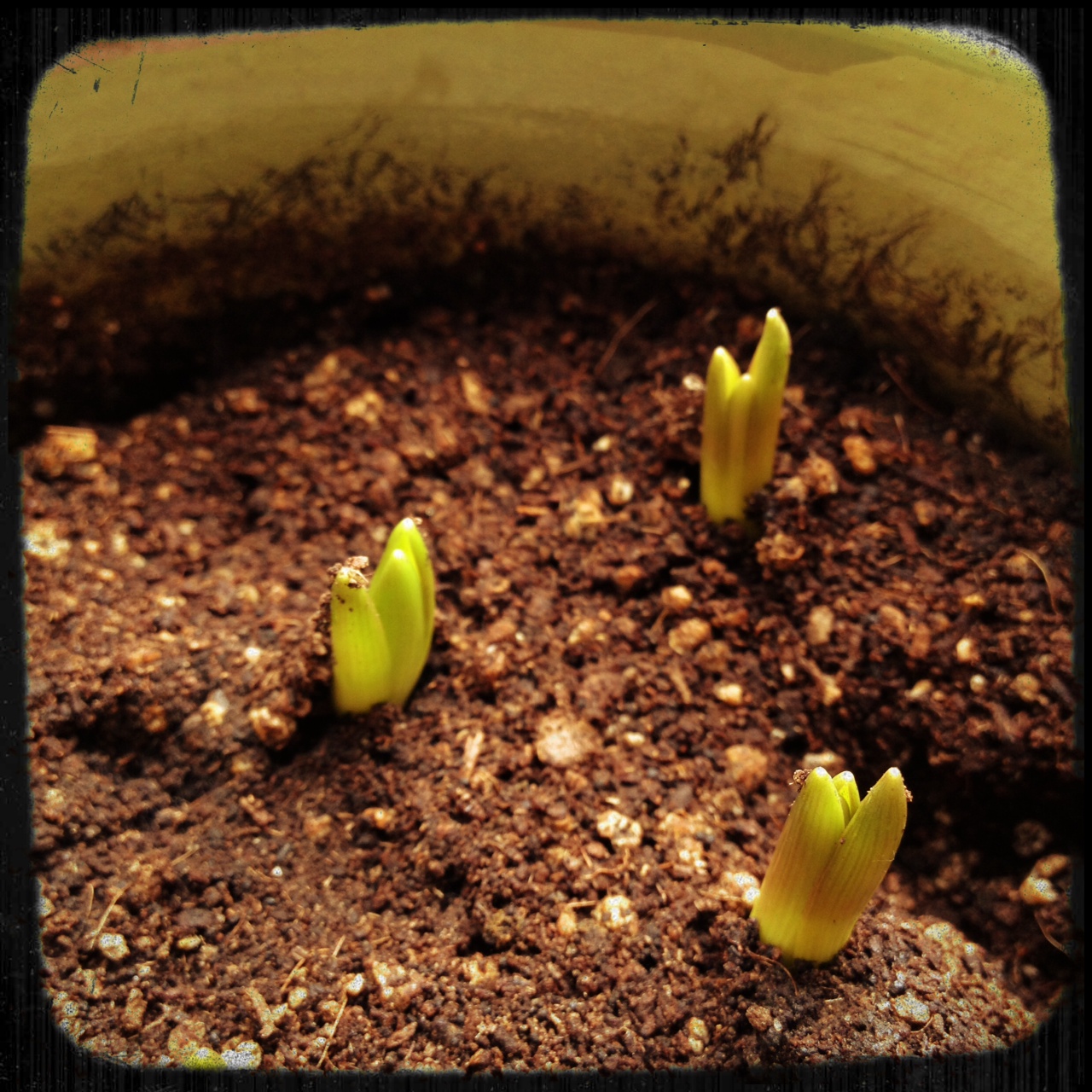
6. And we are, after all, heading inexorably toward spring.  See?

Bulbs in pot

Pinterest as spiritual practice

The Pinterest craze has provided many of us with new ways to kill time.  And I mean, kill it dead.  The unbelievable depth and breadth of resources available present an enormous challenge to those of us with a passion for, well, anything.  Because it’s all on there – the whole world of hobbies, ideas, design, innovation, crafts, houses, book ideas, every possible manifestation of human interest.  It’s easy to start, hard to put down, and even harder to catch up on sleep after your first week.  Which is why all kinds of folks are including Pinterest in their media fasts, their unplugging, their general efforts to return to sane and local living.  (Patti Digh has a great little piece on that here.)

The real challenge, I think, is in moderation, in judicious use of the resources with a discerning eye, so that you a) aren’t constantly on there, and b) you only pin what you want to use, for feeding you in some important way.  (Here, my pastor mother-in-law would smile and say: “As it so often is in our spiritual lives.”)  Indeed, one friend asked (on facebook, amusingly): “does Pinterest provide beauty or value, or does it just give us more information? Because I have enough information.”  I answered yes, beauty and value indeed, because of how it enables us to keep contact (distanced, sorted, organized contact) with information, with good ideas and beautiful, inspirational images.

I am one of those people who struggles to live in the present because I am always trying to bear (“to carry”) in mind too many kinds of information: the location of that recipe I want to cook for dinner; the directions for that fun activity I want to try with my kids tomorrow; the pattern for the hat I will crochet my niece for Christmas; the paint color I saw in someone’s bathroom that I want to try in ours.  And that’s just the domestic sphere!  What of the brilliant “slow money” article I keep losing track of? The book on radical homemaking that offers new ways of imagining barter? The website that’s a useful model for my consulting practice? My head is constantly moving on several levels at once, which is an advantage in terms of getting things done but a distinct disadvantage in the peace-of-mind category.  It took me until a few months into my Pinterest love-affair to realize the enormous gift it offered me: to be here and now without ceding my hold on the future.  It offers us what is essentially a spiritual opportunity, previously available (perhaps) only to those writers and contemplatives who kept and used tiny portable notebooks.  By pinning (in our portable phones, even?) the next great family activity or the last painting that made us gasp, we can store our cherished visions without giving them up; we can live our lives AND remember where and how those visions are; we can revisit them in all their detail and promise, erasing what no longer fits or reorganizing to accommodate new dreams; we can share these visions, when we choose to, with friends; and most of all we can do all this without fear of spending our lives away from center, from the here and now.  We can set down the dream, or pin it up, and not have to live in its shadow for fear of failure or forgetting.  That way we can be here, now, with our lived realities, and still honor the hopes we have for other, better, fuller lives.  Because we do have those hopes, and yet we only fulfill them through living, here and now, rather than dreaming in the ether.

On gardening, or planning to garden

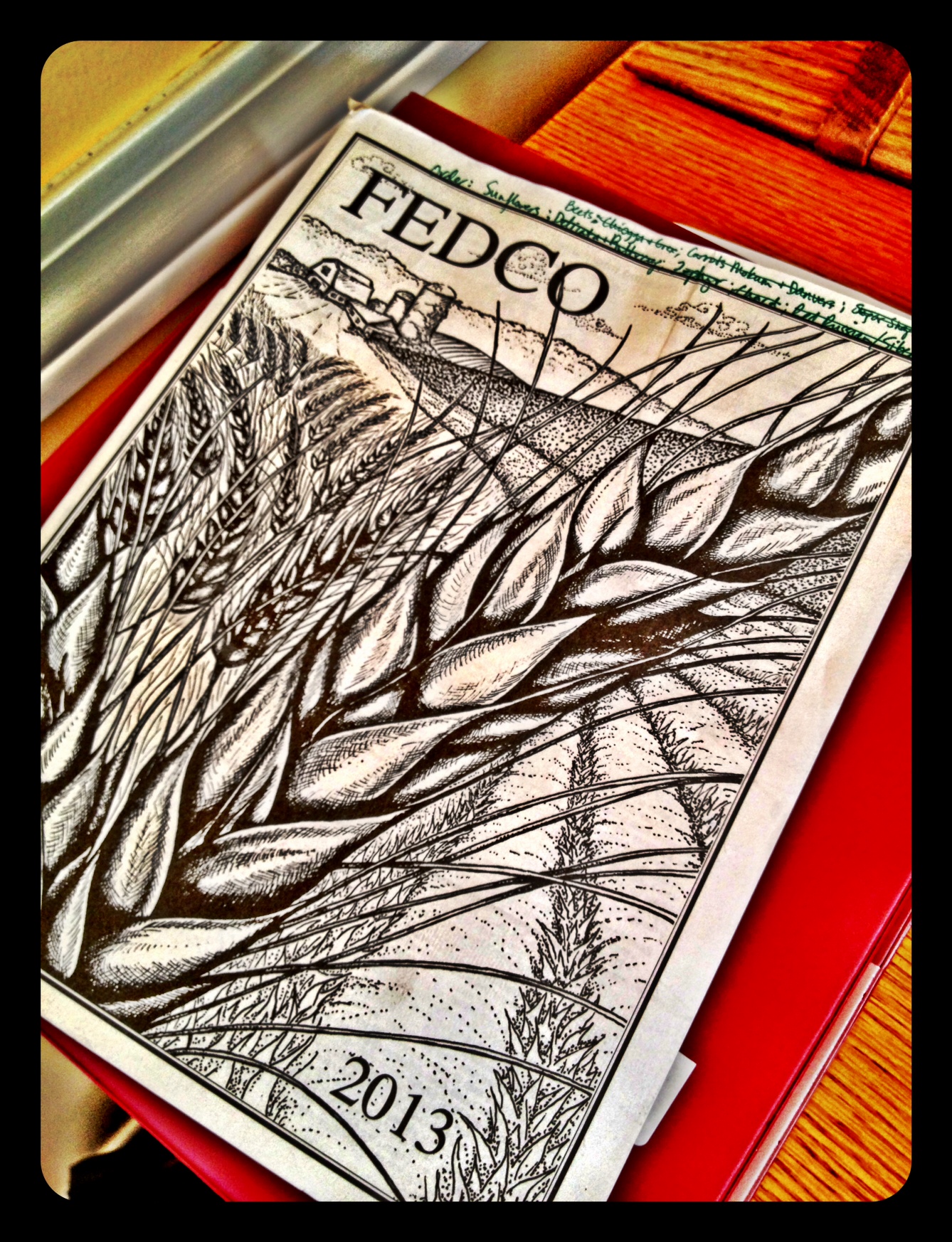
Most awesome seed source ever.

Most awesome seed source ever.

Is this what happens when we grow up?  Do we finally get clear about what matters and just root down?  I just sent my seed order in (only to discover the empty packet of my favorite lettuce: Winter Density…argh!).  It feels late, as it always does, and a few things are on back-order.  But mostly this year I feel a seismic change in the whole process.  Every year I pull together all my zip-lock bags of seeds and corral them into one huge basket, and then I go through and inventory what I have.  It’s a process I’ve loved over the years, as it fills me with a sense of abundance (look at all these gorgeous seeds!  Think of all the gorgeous PLANTS!) and with that delicious anticipation of ordering more.  Plus, when you feel like you’ve really gone overboard, ordering like 25 packets, you realize you’re only out $35.  Which is a lot of shopping bliss for your buck.  The big change this year, though, is in me rather than in the process: for the first time in history, I’m not all that interested in growing lots of different kinds of each vegetable.  (Flowers, yes.  Still.  Always.)  But I used to want six kinds of carrots, for example, to see which were best. I wanted to compare all the kinds of peas so I could know what I preferred and have some good variety in type and time to harvest.  Now, I’m realizing, I’m becoming a much more grounded gardener.  I want delicious; I want easy; I want staggered harvests and enough variety to keep cooking and eating interesting.  But I am more than happy to stick with tried-and-true, and my appreciation of new discoveries seems happy to stay in the realm of the theoretical.  I do not need to buy new varietals.  (There, Len, it’s in writing.  To your massive surprise, I know.  Mine too.)

I suspect this change is not really about the garden.  I suspect it’s about my life.  You see, gardening used to be a hobby – and now it’s one feature of my busy life with my family.  It has always saved us money, but now we count on that.  It has always kept us healthy, but now it teaches my children a lifelong love of healthy food.  It has always been a way for me to get grounded, to come back to my most basic self, and now it does that for two much smaller souls as well.  Nine kinds of peppers seems beside the point – though I am quick to defend the obvious point that there are roasters and jalapenos and Hungarian paprikas and bells, and there’s nothing wrong with a few of each.  But will I spend time reading about the fifty other kinds I don’t have?  Not this year.  No time, and my energy and curiosity are turned elsewhere: to people, large and small; to fiber and fabric; to writing and ideas and hope.

The next step, of course, in the process is cleaning off the seed-starting mats and shelves, checking the grow-lights and the soilless mix supply, investing in more wooden plant labels and a new, sharp Sharpie.  I’ve always loved these midwinter pilgrimages, but now they seem even more special, now that they are prompted by Ezra’s impatience.  Can we start seeds, Mama?  Yes, my son.  Yes, we can.  And all throughout the summer and fall, we can point to those plants and remember the smallness of their seeds in his palm, his chubby carrot fingers working to grasp and maneuver their tiny promise.

On patience, or, er, its absence

As we walk into Ezra’s school building this morning, he gleefully announces to the receptionist, the nearby teachers, and one or two families in the adjacent waiting room: “My mama just got really angry!”  Given that he delivered it with a smile, I suppose it might have been worse, but judging by the comments and snickers from the assorted onlookers, I’m guessing folks were feeling my pain.  Mercifully, I HAD BEEN angry but was no longer, or that little episode would have slid right past humorous and down into enraging.

You understand, I’m sure, how mornings can produce anger: the running around, the running late, things running down small faces that had been, just moments ago, ready to go.  Ezra decided to practice spitting by himself, which involved dribbling water all over his carefully-chosen (by him, at great length and with much turmoil) shirt.  Malachi decided to practice tooth-brushing on his own, which I’m all too happy to encourage, until I caught him scrubbing the fireplace bricks with his toothbrush.  The sidewalk is icy; the sippy cup is empty; the baby is halfway up the stairs.  Not a soul is listening to what I have to say.  It’s all a little much.  So of course I got angry.  And I yelled.  A door may or may not have been slammed.

In the car on the way to school, Ezra seemed unusually quiet, and then unusually chipper and cheerful.  As a child who often put on a happy face to bring my own family back to equilibrium (or at least civility), I was suddenly visited by the specter of all those burdens I never want him to carry.  Immediately, the anger was gone, and in its place was the sensible, loving, compassionate mama I like to think I usually am.  “Gosh,” I said to Ezra.  “Mama was really angry there for a little bit, huh.”

“Yeah.”

“I’m sorry I was so angry.  I’m sorry I yelled.  I know you and Malachi were doing things that weren’t ideal, but you’re kids.”

“Yeah.”

I know you’re working on how to be a better listener, and I’m going to work on not yelling and slamming things.  Next time Mama gets that angry, she’s going to take a deep breath and say: ‘Wow!  I’m really really angry.  I’m going to give myself a time out to calm down.’  Does that sound like a good idea?”

“Yeah.”  Then, a moment later, “Hey, Mama, I want to see the purple finch at my feeder.”  Okay, buddy, we’ll keep an eye out after school.

Anne Lamott says we have a chance to start a new 24 hours any time we choose.  Pema Chodron says: “This is our choice in every moment.  Do we relate to our circumstances with bitterness or with openness?”  Yes and yes.  And yes.  That small window, that tiny glimpse of reality in the middle of all the chaos — that can help us be open to what is rather than what we wish were.  And what IS might be infuriating in small ways, but it’s also pretty darn amazing in all the biggest ways: my kids so focused on their activities that they tune out the world; my kids learning the skills that will support them long after they’re out of my grasp.  (Plus, hey — my fireplace bricks got a little scrubbing for the first time in their lives.  Just so long as they don’t expect it to happen again.)  We breathe in.  We breathe out.

On kindness

On Sunday morning, we woke up to a 58-degree house.  Which is not much colder than we USED TO keep it, but since having babies, it’s been warmer.  Indeed, the discovery that the furnace had broken helped alleviate our concern about the youngest, who had been crying on and off since 3 am.  Turns out he was cold.

The good news was that the high that day was predicted to be ABOVE zero — 16 degrees above zero, in fact!  But since it would drop to zero that night, and since it was a Sunday and since our furnace is old enough that the one place our heating guy could get the right part was closed and no one was returning his phone calls…well, we got that basement woodstove going and started opening cabinets.  We had some good passive solar going, and of course there was the requisite emergency baking (for the heat of the oven, you know), but it still seemed clear that we’d need a better strategy.

We considered turning off the water main and taking up a friend’s offer to stay with them that night, but that would have meant letting the woodstove go out, and that just seemed dangerous (my dad said to put antifreeze in every drain — yipes!).  But then we thought about the offer in a different way: here were friends we like but don’t get to see all that much, offering us not just a warm dinner (and cake!  CAKE!) but the whole necessary array of beds and cribs and tubs and whatnot.  Maybe, we thought, we should throw ourselves on this kindness, and see if there’s more out there, too.  So we called neighbors and ended up with two space heaters — enough to keep the pipes on each floor in good shape.  And we knew that if all else failed, we could pack up and go in the middle of the night: not one but TWO sets of friends offered to leave a door open so we could just barrel in and find our way to a bed, no matter what the time.  My favorite line from the whole experience was from our excellent neighbor Bruce said: “Whatever you need, the answer is yes.”  I breathe easier just WRITING it.  It felt like we were taken in and held by all this caring.

As I was telling my dad how all this went, he mentioned his stepson had a similar experience recently — his car broke down in front of a stranger’s house in the woods of New Hampshire, and they invited him and his five-year-old daughter in for warmth and cocoa.  As they waited for AAA and assorted paternal types to deal with the car, these kind folks chatted with Jon and Amelia, learning a) that they live near a little lake, and b) that while Amelia has snow shoes, she does not have ice skates.  So what did they do?  Went and found an outgrown pair in the closet that will fit her small feet, and gave her them, asking her merely to pass them along to another little girl when she outgrows them.

We always hear about the shootings, the disease, the fistfights, the disruptions.  We hear about the agony and the ecstasy, but we rarely hear about the simple kindness, the interconnection.  Margaret Wheatley is right, in So Far From Home, when she says “most people don’t want to know they’re interconnected…[it] is too much of a burden.  It requires that we take responsibility for noticing how we affect other people…” (p.55).  And that is monstrously hard.  But still, my theory is that there’s more basic goodness out there than we know. I believe that most humans want the opportunity to be kind, to be treated with kindness and to receive it with grace.  Our innate generosity gets papered over with cynicism, defensiveness, and fear; our natural openness gets shut off and buried like some kind of dangerous supply line that might spurt everywhere if uncontained.  And you know what?  It DOES spurt everywhere. The whole world gets wet.  Kindness begets kindness and our very vision begins to shift, peering as we do now through the soft rain of basic human goodness, visibility low so that we have to look at who and what are here right now.  But what else can we do?  Of course we look a little goofy, with our wet hair and our smiles, treating people as if they have a right to be loved. We wring ourselves out, have a laugh, and lay down in the sun to warm.

On competence

Those of you who had careers you loved and excelled at and left to raise kids, you’ll know what I mean when I say that I CRAVE a sense of competence.  I used to zip around my world, well-dressed, well-informed, good at what I did.  It gave me (an unduly large) sense of purpose and it helped me feel at home, useful, valued.  Then, well, I had babies.

Now, of course, I’m not well-dressed and I rarely zip anywhere (unless there’s the sound of choking involved, or tiny feet on forbidden stairs).  But more importantly, I’m way outside of my zones of expertise.  Over the months and years, of course, you get good at some things — you learn the tricks to making the baby eat more applesauce, fall asleep faster, laugh more often.  You learn how to wash their hair without getting water in their eyes.  You learn how to draw a little bit, put on puppet shows, and dance with two small people at once.  But mysteries abound, and the failure to solve them is both constitutive of our tasks as parents and, more simply, a persistent pain in the ass.  How best to assist night-weaning?  How to promote potty-training? When to shift naptime?  There are days — like today — where the pre-5-am wake-up is not good for anyone, and breakfast time is generally a whine-fest.

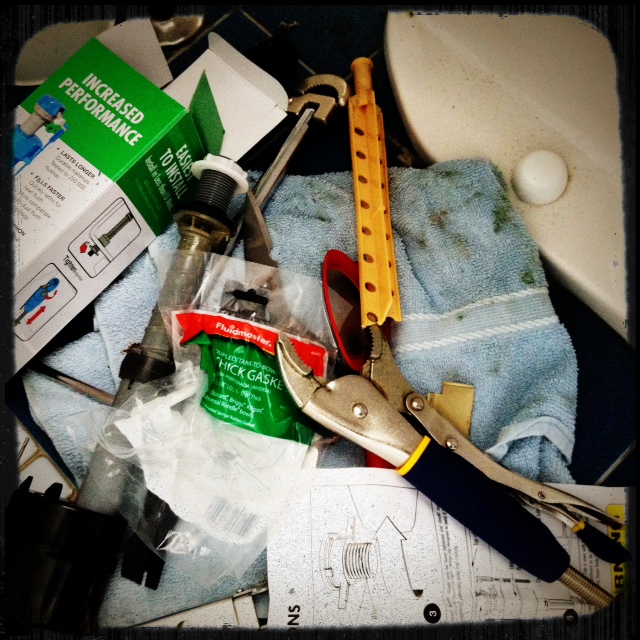
toilet repair detritusFortunately for all of us, today is also a DAY CARE DAY!!  Hah HAH!  I can get something DONE!  Unfortunately, the prime task at hand is fixing the broken toilet.  I realize that kind of sounds like a punch line, and it kind of IS, but here’s the thing: I love this kind of work.  I love it when you can actually see your accomplishment.  (Of course, I hate hate hate the three trips to Home Depot involved, especially because I planned ahead, but who knew the little pre-packaged nut-and-bolt set contains not the necessary THREE, but a useless TWO bolts?)  But there are so many things in our world and our lives that involved delayed gratification, or none at all, that something this concrete is, well, pretty awesome.  Plus, it uses ingenuity (that’s right, I thought to use the pliers as a sort of block to hammer lose the big central nut that would not come loose and was too big for our biggest wrench) AND WD40, and that’s a winning combination.  And I have to admit: I’ve always loved hardware stores.  They fill me with a sense of possibility, as if I might be doing more than just fixing a toilet, as if I might be building a beautiful, sunlit studio right between the asparagus patch and the apple tree.  Hmmmm.

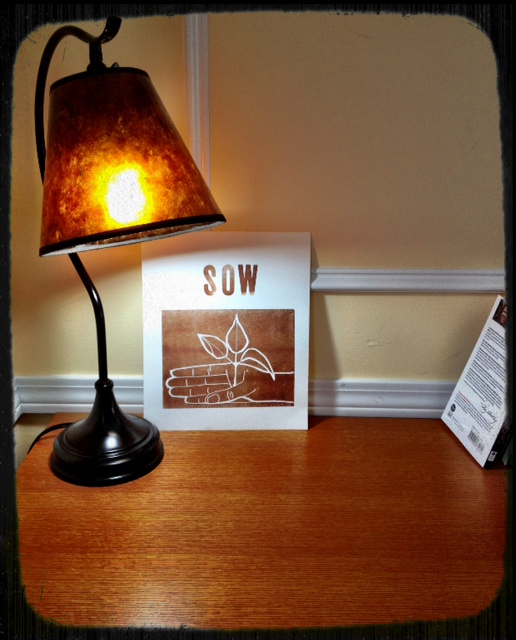
Competence and achievement, or the promise of them, have the power to pull me through another tired day, but more than that, they help me look at the usual crap fromclean desk a different position.  Today, for example, I didn’t just sort and file papers (again!): I cleaned my desk!  It’s beautiful, with a new lamp and an inspiring new print from my artist friend Kim Crichton (check her stuff out here!).  I didn’t just manage the ongoing saga of familial healthcare: I was an effective advocate for my son in a meaningful conversation with a doctor that settled some important points.  The energy to do things today, and the capacity to see them as whole and important, come from the toilet’s reminder that I am competent, that I can achieve things…and now the desk will remind me of the same thing.  (Right up until it’s covered in clutter again, I suppose…hey, we’re all a work in progress.)  My environment usually conspires against me, rife as it is with the needs and detritus of people’s lives.  But sometimes it’s useful to remember that the spaces we live in can also show us our best selves, if we’re willing to work to let them.

On the sweetness of children

We’ve developed something of a Goodwill habit at our house: I hunt down old sweaters and velvet to upcycle (and, of course, the occasional fabulous garment to wear), and the boys find books and toys.  We’ve had amazingly good luck lately, and the visits are fun for all of us.

On our trip yesterday, several people commented on how sweet my boys are.  One lady in particular did it at length and with the kind of pointed remarks and sidelong glances that made me look around for the other, less-than-sweet boys who were being implicitly criticized.  But it seemed she was entirely genuine.  I was pleased and gratified, of course, and I agreed with her: I DO have sweet boys.  Much of the time.  And, I explained, when they aren’t being sweet, well then, we aren’t out.  For long.

I realized as I said it that I may have finally cracked the code of all the “Love and Logic” and “Aha! Parenting” approaches.  If you can let go of your own agenda and your own attitude for long enough (which I find really really hard), you can really BE with your kids and hear how THEY are doing.  Which gives you either a vast array of emotional responses (anger, resentment, frustration, grief…) or, much more simply, a clear choice: to keep grumpy kids at home or to take them out in the world, knowing full well what that may entail.  On days when I’m close to my best self, like yesterday, I can make that choice and then not be particularly put out if the trip causes more turmoil instead of less.  In fact, yesterday we even had some moments of near-meltdown in the toy section, which led to me calmly crouching down by Ezra and explaining that we could stay and browse if he could be quieter and a good listener, or we could go home.  I suspect it was my (I confess) unusual calmness and rationality in meeting his little outburst that caused it to settle so fast.  But it was not ten minutes later when the kind lady started saying such nice things about him.

I’m kind of thrilled that these lessons are slowly settling in, slowly coming to life in how I actually work rather than how I’d LIKE to work.  Just showing up without an agenda makes it weirdly possible to pursue my agenda.  Being present to all the humor and chaos of my boys helps them tune into ME, too, so that when I’m fed to the eyeteeth with toys underfoot, we can have a cleanup game, together.  With dancing.  I feel like we’re all trained to find peace by escaping upheaval — but sometimes our lives ARE the upheaval, and the only peace (of hope of accomplishment) is relaxing into it.  If you can’t get out of it, get into it.  Like swimming, I guess: it’s when we stop thrashing with fear and exhaustion that our bodies can finally teach us to float, eyes closed, belly-up to the sun.

The perfect pumpkin bread

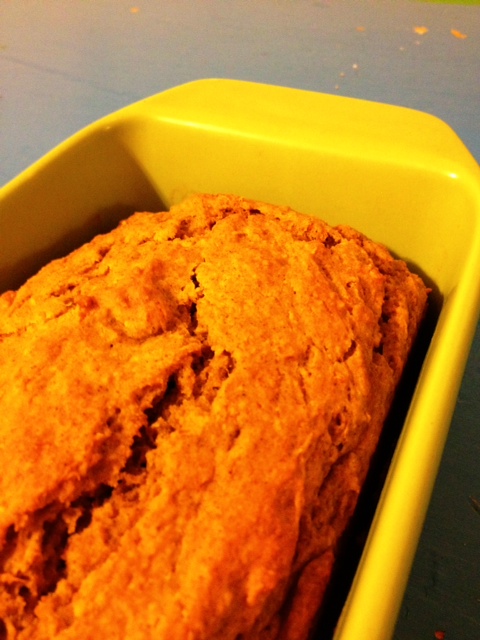
I know, I know, it’s an ambitious title.  But I’ve working on this for years, and I feel some confidence in the result.  wicked good pumpkin bread

My goals were these: pumpkin bread that is a) delicious and b) healthy.  It had to be tender and a little chewy and not harden up too much in the day or two following the bake.  I wanted to have some variability in spiciness and to be able to use either canned or real pumpkin.  Done.  Check.

Preheat oven to 350 F.  Makes two loaves.

Ingredients:

1.5 c all-purpose flour

1 c. whole wheat flour

1 c. oat flour (you can do what I did: buy the pricey stuff and THEN find out that you can grind oats in a blender to make it yourself, or you can just start the cheap way and feel all smug about it)

2 tsp baking powder

1 tsp allspice

1 tsp cinnamon

1 tsp nutmeg

1/2 tsp ginger

3/4 tsp salt

1/2 tsp baking soda

1 c. loosely or not-at-all packed brown sugar

3/4 c. milk (soy or cow’s, whatever)

1/3 c. vegetable oil

2 tsp vanilla

2 large eggs

1 15-oz can of pumpkin, or mashed roasted pumpkin (I used extra this time, maybe 15 oz, and loved the result)

Optional walnuts, chocolate chips, currants, whatever — though it’s pretty awesome plain.

Process:

Preheat oven to 350 F.

Mix dry ingredients together; make a well in the center.

Mix sugar through pumpkin in a separate bowl; add to the dries.

Add whatever extra stuff you feel you need.

Pour into two greased 8 or 8.5″ loaf pans and bake for 1 hour.

Notes:

You can also add 1/2 tsp of cloves and a pinch (or more) of cayenne if you want a spicier version.  Also, be glad this makes two loaves.  Strongly consider giving one away, but know that I will not judge you if you end up not.