On letting go of the story line

Pema Chodron, in various of her works, talks about “letting go of the story line” as one of the crucial skills that enables us to stick with the practice of living, of being present to our lives.  I had never even heard the concept until I went to a retreat she was running at Omega when I was 35 weeks pregnant.  The retreat was called “Smiling at Fear,” which seemed like a good idea, as I had just left not only a job but a whole career I’d spent 15 years building AND I was about to have my first child.  I was working and working at the concept of befriending my negative emotions and I just couldn’t see how you make friends with a runaway train and I was feeling the old desperation rise up in my throat.  But then she said that about the story line, and how we spend so much of our lives acting out particular stories that we feel define us, and all of a sudden I could see it.  Even THIS, the process of wanting to shift something and not being able to, was a story line I was committed to.  So what happens if we let go?  Well, it turned out that letting go of that one meant that I could just BE there — in a beautiful warm room with two extraordinary friends and several hundred other fascinating people.  With a wise and holy teacher before me and another one inside me: that joyful acrobat in my belly has never since stopped teaching me.  I was able to breathe, to stretch, to sit in quiet and gratitude.

I think often of the challenge of setting down the story line, and less often I actually remember to do it.  But sometimes life surprises me.  Yesterday, for example, was full of surprises.  My 14-year-old car had been making some terrible noises, and I realized that I really didn’t want it on the road, much less carrying me and my two precious babes.  I had convinced myself that it was a clutch problem, or worse, and that now, here, finally was the repair job that would be the death of Hubert (yes, after the excellent bloodhound in Best in Show.  We generally name our cars after dogs).  So I prepared for the worst by doing what I do: managing for time and money.  We spent some time looking up used cars online, and I concluded that Tuesday’s lineup of meetings would give me only four hours for car repair, so we’d better the diagnostics done Monday.  I called the shop (Center Street Auto in Auburn, Maine — if ever you need anything, they ROCK), and they graciously agreed to take a quick look for diagnostics if I came in at 11.  So both boys and I “took Hubert to the car doctor.”  Twenty minutes later, they handed back the keys, having identified and fixed a loosening wheel (!!!).  No cost, no trouble, no major life shift.  Oh!  Look at that.  I had the story all wrong.  Which is reason number 2 for setting down the story line: first, it makes you crazy if you let it define your life, and second, you might not even have the right story.

When we get home, I gratefully remove all the winter accoutrements from our three persons and head to the kitchen to figure out lunch.  But there’s water in the disposal (which is the only drain in our kitchen sink and which, we know from past experience, has no main drain cleanout beneath it, so any serious problem in the pipe becomes a serious plumbing issue in the house).  AH, I think.  There it is.  Not the car but the plumbing.  THAT will be our major problem.  But before I despair completely, I figure I’ll do the recon I’d feel stupid to skip: and of course, the under-sink unit had merely become unplugged somehow.  Crisis averted.  Story line aborted.  Or perhaps there’s a different story line starting to form: maybe I am a resourceful protagonist who can sometimes solve her own problems and so doesn’t need to freak out about them.  Everything in its own time, eh?

It was a sunny day, and warm (upper 20’s), and we still had a nice foot of snow on the ground, so I hauled both boys outside after naptime.  The storyline there is about hassle pre- and post- and about crying over snow in the wrists while we’re out there.  But I announced we’d have outside time, and by golly we did.  Ezra helped me pull Malachi in the little red sled and went down the hill twice himself; he even made the lower half of a snow angel. Twenty minutes of enjoyment outside and we went in for warm snacks.  The sun slanted glowingly into the kitchen; the neighbors’ trees were all bronzed and rosy at their tips; the startlingly clear sky showed not one but three jet trails, brighter than light, converging slowly toward Portland. Of course there’s going to be whining, I thought.  Of course the snow gets in at our wrists, right where our skin is most fragile and thin.  But this does not mean we stay inside.  We try to remember that we will warm up again; we zip up and tuck in and open our eyes to the sky.
On sleeplessness and dishevelment

A few thoughts, if I can remember them, on the jittery, anxious, grumpy, at-loose-ends way of being that results from too many nights up with the baby.  (Wait, that sounds like some nights we’re NOT up with the baby.  Not so.  Lately it’s just a lot more.)

1. There is a direct, linear relationship between sleeplessness and depression.  And aggression.  And memory loss.  Don’t let anyone tell you otherwise, because if they do they’re an asshole.

2. Sometimes things are inappropriately funny when you are severely sleep-deprived.  Nowhere near often enough, though.

3. Eating is a basic and necessary ritual that becomes less attractive and harder to remember.  Eat something.

4. The full beauty of chronic sleep deprivation is that at some point sleep is no longer desirable, nor attainable.  Under these circumstances, it’s best to warn those around you.  Because, really, they shouldn’t be.

5. Don’t talk to anyone you have to go through a phone tree to reach.  Do not, under any circumstances, try to figure out why you’ve paid out $8000 so far this year for health costs when your family has a $5000 deductible.  It’s not good for anyone.

6. It is unlikely that your child will suffocate in his sleep — or not — simply because you are awake to hear him.  For real, my friends.

7. Potty training.  There, I said it.  Not a conversation to have under these circumstances.  Big brother will have to cope with diapers for a little longer until someone — anyone — has the fortitude to remember where the potty is, let alone get his pantsless bottom on it.

Crap.  There were others but I don’t remember them.

On intentions and resolutions and out with the old and all that

One of my more delightful projects, since leaving full-time work, has been facilitating some discussion series for the Maine Humanities Council at our local public library.  The second of those, just completed, was on the contemporary detective novel as social novel — we read Laurie King, Tony Hillerman, Eliot Pattison, and Katherine V. Forrest.  In each of these, there’s the age-old tension between the-way-things-have-always-been and the forces of modernity; scholars of postcolonial theory will recognize all the makings of hybridity, of a world that is many things, combined, and that therefore is more complex and less easily boxed up than we might like.  Hillerman says it best, in “Dance Hall of the Dead,” when a character mentions the motto over the entryway of an Indian reservation school: “Tradition is the enemy of progress.”  Under these auspices, kids were pulled from their families, beaten for speaking their native languages, and turned from their cultural heritage.

What the heck does this have to do with New Year’s?  I’ve been thinking about the innate violence of resolutions, the way many of us feel encouraged now to excise the warts of our being and stitch up the wounds ourselves.  Lose weight (you fat slob); lay off the booze (though you’ll be dead boring if you do); stop cursing (what the #*&^! for?); get a damn job (unless you’re actually as worthless as you seem).  It’s a tough time of year anyway, and when you add in all that stock-taking and all those toggle-switch models of change (flip UP for good behavior, DOWN for bad), well, it gets plain painful.  I am, however, a big fan of the “intention” — a gentler, kinder version of a resolution that seems to start from the premise of oneself as a decent, rational, perhaps even lovable being, with a desire to commit to certain shifts.  Intentions seem to make room for human foibles; they seem less apt to end up as “successes” or “failures.”  Perhaps this is because of the kinds of traditions they stem from — Buddhist, yogic, mindful, generous.  These are traditions that accept us unconditionally, that insist, in fact, upon us being always and only who we are, warts and all.   In my book, these kinds of traditions are the only possibility for progress, largely because they don’t make room for the concept of “enemy.”  There’s you, there’s me, there’s the world, and we’re all just trying to get along without mauling ourselves or each other too badly.  I intend, then, to be kinder and more accepting of myself and others; I intend to honor the old as well as the new, in others and in myself.  I intend to seek transformation and positive change in myself and others (like, for example, potty-training); I intend to love us all as hard as is humanly possible in the process.

On birthdays

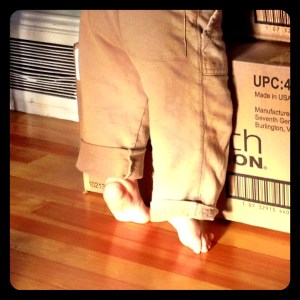
I have a friend named April who is my birthday idol.  She, like me, grew up in circumstances where it being your birthday only meant that you EXPECTED to have fun and be showered with love, not that you WOULD.  She, unlike me, became someone who designed her own birthdays to meet her expectations.  I, on the other hand, tend to struggle with Great Birthday Ambivalence, not wanting to have to plan it all myself but also wanting something I want.  You see the challenge? Chi's feet

This little struggle is one of many I hope to avoid passing on to my sons, and so I’m concentrating on thinking about their births, about their presence in my life, about their marvelous, miraculous specificity.  Above all, I’m realizing that their birthdays (especially the first one) are as much about me as about them.  All day, it’s: “at this time last year, we had just met you for the first time!”  “At this time last year, you were having your first mama-milk!”  Standing up from the table after lunch, I stretched tall and felt the usual tug of deep c-section scar tissue…and, of course, thought of how much my body has put up with for the sake of these beloved creatures.  Their birthdays are, really, a celebration of capacity, of generosity, of animal instinct and tenderness.  A rejoicing in who they are and what they love; an exploration of how the everyday makes room for the exceptional.  Best of all is seeing the older boy tend to the younger, leading not one but TWO rousing choruses of “Happy Birthday,” and actually honoring his new status as Owner-in-Chief of some pretty interesting new toys.

These are times we want to snapshot, to cordon off, as if it would help us get our hands on this slippery, uncontainable life.  But like the children themselves, they move too fast for clarity, and we’re left with a joyous blur of someone crawling at high speed toward the door.

On the sense(s) of love

Ezra, in the throes of recovery from several simultaneous dread diseases, ate something close to an actual dinner tonight. This led to a significant increase in chattiness at bedtime. In the dark, as he’s supposed to be falling asleep snuggled next to me, he offers in an enthusiastic whisper: “Mama? Red-eyed tree frogs have red toes. And they’re sticky so they can climb every something they want to climb. And they can jump every jump they want to jump.” As Kingsolver once said: “It is senseless to love anything this much.”

Here’s the thing about love: it shows up in more ways than you thought were possible.  It’s in the color of your kid’s hair and eyes; the tiny muscles of his chest; the sweet rancid smell of his morning breath; the blurred speed of his words as he tells a very important story very fast; the giggle as his baby brother pats his back for the first time.  It’s in his hearty rendering of ABC’s (both “his” version and Alpha-Pig’s version) in the back seat of the car; his intense concentration on linking up his wooden train set; his fierce insistence that the LYING DOWN tiger sticker is more important than the WALKING AROUND tiger sticker.  The stone-amber of his eyes; the quick intelligence of his mind; the unselfconsciousness of his dancing.

When he was a baby, Ezra had a tendency to touch, with one hand, a mole on my chest while he nursed.  Little did I know that that habit meant my cleavage would become his “lovey,” his touchstone, his ultimate source of comfort.  For days, now, during his illnesses, he’s been ritually grabbing for my chest, despite the fact that he hasn’t nursed in eighteen months.  And tonight, as we lay reading “The Library Lion,” he said, “Hey, Mama?  Is it okay if I take a break now?  I need to use this finger to count the children.”  In the library in the book, he meant.  I have new hope for tomorrow.

On getting off one’s duff

Or, as Seth Godin refers to it in a recent blog post, “shipping your art.”

“What, exactly, are you insisting will happen before you start shipping your art?” he asks.
A helpfully clarifying question.  For me: both children will achieve perfect health, the house will seem manageable, and I’ll have a great job and an exercise habit.  Ah.  I see his point.  Plus, when the “art” you will “ship” has a great deal to do with the aforementioned living skills, well, waiting moves beyond illogical to flat-out ironic.

On gifts, especially hope

We travel to New Hampshire at most Christmases when we don’t have a brand-new baby (or the threat of one), to see my dad and stepmother.  They live in a beautiful house they designed and built, completely off-grid, on a mountaintop in the Monadnock region.  It is, I always say, a wonderful house from which to be in the world.  That sounds like an oxymoron, but it’s not: the house is full of windows, as its primary energy sources are active and passive solar, and out every window is a vista of striking beauty.  Just being here is restorative, but also inspiring, and the back-and-forth between the two sensations is little short of a miracle.

I’ve been thinking about inspiration a lot, lately, in all of its forms, and about miracles.  It’s hard to think of one, I suppose, without the other.  I mean the Thich Nhat Hahn version of miracles rather than the standard Christian varieties (the miracle, he says, is not to walk on the water; the miracle, he says, is to walk on the earth).  But at Christmas time, I am reminded that much of humanity heralds as a miracle the birth of an infant around this time, and his astonishing gifts of kindness, courage, generosity, and clear sight.  Having two small boys of my own is miraculous enough to me — their small hands (Chi’s fingers, I decided yesterday, measure nearly an inch now, from tip to dimple) — but that they occasionally also exhibit these larger gifts is staggering.  It gives me, in a phrase, hope for humanity.

Barbara Kingsolver’s character Codi in the unparalleled Animal Dreams struggles with hope, having learned early that loss hurts (here we remember The Princess Bride: “Life IS pain, highness.  Anyone who says otherwise is selling something).  But Codi has a sister, Hallie, who lives inside her hope: “What I want is so basic I’m almost embarrassed to say it.  Elementary kindness.  Enough to eat, enough to go around.  That kids might grow up one day to be neither the destroyers nor the destroyed.”  I’m paraphrasing, since I left the novel at home, but I’ve read enough times to be fairly sure I’m close.  Hallie says, “The very least you can do in your life is figure out what you hope for.  The very most you can do is live inside that hope.” It’s easier to live in what’s already around you, to try to welcome that or at least not fight it tooth and nail, and to try to make small differences where possible.  But this, I know, demands a shift in what Kingsolver dubs “ground orientation.”  As Codi says, “I’d spent a long time circling above the clouds, looking for signs of life.  Hallie was down there living it.”  Perhaps the hope, then, is not necessarily the abstract kind that sets lofty goals and five-year plans.  Or perhaps it might be, depending on the person.  For me, the hope seems smaller, more local, at least these days.

And as I write that, I realize that I’m fulfilling the prophecy of Loyd in that novel, whose brief disquisition on what animals dream about constructs the title of the novel.  “I think animals dream about whatever they do in real life…it’s the same with people…your life, what you do and all that, it’s not separate from your dreams, it grows up out of them.  So if you want sweet dreams, you’ve got to live a sweet life.”  (This section is horribly bastardized, a hybrid misquote from a longer conversation.  But you get the idea.)  So as my life has shrunk, and yet expanded in a L’Engle-esque miracle, my dreams have shrunk.  Perhaps I should say, focused. And I’m eager to see the bigger work return to center stage, because I still believe in the macro-levels of  hope that are realized from there.  And yet, at Christmas, it’s easy to be reminded as all mothers are, that in each child lie the seeds of transformation, of hope, for us and for the world.  It’s possible — I might even say it’s likely — that we are, each of us, the gift of hope, the possibility of honesty and beauty and love.

On strategizing

Work is one of those areas we tend to ruin for kids, like healthy eating and time management.  We act like we’ve got it together, and in reality, we’re just feeling our way along with a handful of principles and a heartful of hope.  “What do you want to be when you grow up?” we ask, like it’s a simple decision to make and a simple path that stretches forward from there.  Ah, for the good old days when the choice seemed feasible and easy.  A doctor.  No, today I want to be a teacher.  An ice-skater. An airplane pilot.

The challenge arises when you’re 39 with two kids, three degrees, and fifteen years of solid work in a given field under your belt, and you’re trying to broaden your thinking.  You’re just dripping with intentionality, and it’s starting to get annoying.  Not as annoying as the disabling sonar of your three-year-old’s wail or the baby’s uncanny persistence in the face of what he KNOWS is off-limits — but annoying.  Get a job, you hear some cruel voice say in the back of your head.  It’s hard to know, though, which of these that voice really means:

  1. Get paid; stop being a drain on resources.  (To which I say: do the damn math.  Stay-at-home moms are worth about $110 K/year, according to Salary.com and other sources. And yet, I miss our DINK days, no doubt.)
  2. Get validation. (To which I say: yes, please.  I could use that.  But validation comes in many forms.)
  3. Get out of the house. (Indeed. Good plan.)
  4. Get involved in work that makes a bigger difference.  (But I AM!  I serve on boards and write and am raising feminist boys, and…well, yeah, I miss that, too.)

So you need a strategy, but not the old kind, where you shake every job-hunt tree in reach and see what falls out.  No, this kind of strategy needs multiple prongs and greater strategery.  Here, you need to honor (with a straight face, if possible) the multiple facets of your life, the many skills you have, the many longings.  You need to quiet the voices of criticism and their obnoxious reminders that those wasted degrees are IVY LEAGUE degrees.  Put differently, you don’t want to end up charging full-bore at something you THINK you want, only to find out you’re wrong.  So now you do this:

  1. Job-hunt in the conventional ways, for work in your field and close to your field and close enough that you think you’d like it.
  2. Develop the writing: seek publishers and editors and contacts and assignments.  Take workshops.  Jump in.
  3. Develop the crafting: remember that not everyone is out making cool scarves from recycled velvet dresses, or sweet hats from old sweaters. You do have vision and you do have skill, and there are folks close to home who are creating markets that might sell your stuff.
  4. Network, broadly and openly, about the Search.  Acknowledge its multiplicity.  Own its complexity.  People love to give advice and to help — take it.  All of it.
  5. Work hard not to resent your children for needing you or your spouse for having a daily life that involves silence, reading, professional respect, and music of his choosing.  Work hard to stay centered and limber and whole.

Good plan, no? The devil (or at the very least, the wee cherubs and their noiseful chaos) is in the implementation.

On Resilience and Repetition

Yesterday my eleven-month-old began the arduous process of learning to stand upon his own two feet.  I don’t mean hauling himself upright using whatever available leverage he can find (a couch, a bookshelf, my nipple), but rather gathering his legs beneath him and using their muscles to lift.  It puts me in mind of yoga, of the tree pose in particular, where we reach from one foot, planted in the ground, through open hips and chest up toward our hands which point skyward.  The smallest adjustment and attention can locate great power or make us aware of instability. The point is less to achieve balance than to return, again and again, to balancing. This repetition of action and intention is pretty close to magical.  We learn to fall with grace, indeed to expect to fall. We try to see the falling as another chance to perfect the art of getting up again (or, let’s get real: it’s a chance to rehearse the reasons why, in that moment, yoga totally sucks).  If you’re less than a year old, you don’t really get mired in the how and why of the fall; we are where we are, it seems, in any given moment of this little cycle, and that includes leaning, adjusting, straining, reaching out for support.  In Malachi’s case, it involved ending abruptly on his cushiony bottom over and over again until something else became even more magical than standing.  Oh, look!  A bird stuffie!

I suspect that this is a parable for something else, that the resilience an infant shows in mastering the arts of daily life is something we must draw on more intentionally than we do.  It means moving out beyond what’s comfortable; keeping laser focus on the task at hand; understanding that setbacks are less about you than about the forces of gravity and inertia in the world.  It also means crawling back to a space of nurture when the nurture is needed.

I’m re-reading “Love Walked In” by Marisa de los Santos, a beautifully-written book of rather extraordinary depth, despite its “chick-lit” label. One of our heroines, eleven-year-old Clare, is struggling with her mother’s new and undiagnosed mental illness, and her coping strategies are developed through careful analysis of the experiences of orphans in literature.  She concludes that orphans get listened to in one of two ways: through “pluck” or through being attractive and likable. These are indeed powerful forms of resilience — to speak boldly one’s own truth and/or to identify and appeal to the truth of the other. Our life’s balance, it would seem, hangs somewhere in between the two…and fortunately, we have endless opportunities to keep trying.  What was that Evian ad a few years ago?  Every day is a new chance to be healthy, or some such thing?  Not just every day, every minute.  For Chi, standing is the new challenge…for me, perhaps, getting my ass off this couch and into some healing yoga before the chaos of the day is full upon me.

On Flailing

I’d say this has been one of those days, but I fear it’s been one of those weeks.  Or months.  Or worse.  It just feels like I can’t get ahead.  I realize some of this is chronic caregiver stuff: laundry, cleaning, cooking that are just completed when it’s time to do them again.  I try to think of these things not as goals to be attained but as the background activities of my life, the patterns of the everyday.  But it’s hard when I’m so tired some days that getting dinner on the table IS in fact a major achievement.  What’s troubling me most, anyway, isn’t the dismal routine of maintenance but instead the strange psychological adaptations that are happening.  The onslaught of winter isn’t helping, with its corollary SAD and Vitamin D deficiency, and maybe that can account for what’s going on.  But I’m somewhere between agoraphobia and hibernation, and anyone will tell you that’s a tricky place to be.  I’m CRAVING time at an office, with tasks and challenges that need my brain and expertise.  I’m lusting after adult conversation, preferably not about children.  Most of all, I want blessed quiet and my body, my space, my environs to myself.  This feels ungrateful but it’s truly not: it’s just that I, like almost everyone, am too complex to do just one thing or be just one way.  I love parenting and I love the other things I’ve done with my life, and I’m headed toward a new kind of balancing, I hope.  In the meantime: I do the strange and crazy dance a friend in college termed “full body flail” and try not to act out in public.