On (not) seeing ourselves

A friend of mine who is six months pregnant just posted on Facebook that after days of running around in sweats and not showering, she kind of forgot she was pregnant.  But once she got glammed up again, and into regular maternity clothes, she was reminded.  (I know, I know; she’s CLEARLY in the blissful second-trimester-so-not-everything-hurts-yet stage.  We honor her by not pointing this out in reply.)

And I was just thinking today, while strolling down the lawn with a son’s hand in each of mine, that my favorite thing about having kids (at least my kids, at least on a happy sunny afternoon) is how totally ME they make me feel.  With them, I am funny; I am loved; I am wanted — regardless of how I might actually look. In fact, I am often surprised to emerge from some enjoyable interaction with my family, where I’m feeling smart and engaging and magnetic, and wander past a mirror.  Good heavens — who is that wrinkled frump with the atrocious bedhead?

I suppose there’s a pretty obvious down-side to this phenomenon, but mostly I just love it.  I mean, as an American woman, I’ve spent most of my life a little unhappy about how I look.  (I say “a little” because I’m one of the lucky ones — my genes tend toward slimness, in what I hope is a decent tradeoff for the cancer and alcoholism that they also seem eager to share.)  Forgetting how we look to others is one of the great pleasures of life AND one of the great signs we’re living well.

The all-girls summer camp I went to and worked at had very few mirrors, and I remember being startled, sometimes, that I HAD a face and a body.  My time was spent making friends, making things, learning skills; my body was always running and swimming, canoeing and hiking, singing and dancing.  I was an energy, a personality embedded in a physical competence that was always stretching; I relied on that body for what it could DO for me, not for what it looked like.  I still love watching women athletes at their sport, because it’s one of the only times we get to see female bodies in peak form, carried with a sense of expertise and comfort rather than self-consciousness.

And of course all this shifts somewhat once we have babies (IF we have babies; the same argument applies to the general process of living on the planet, too) — the sags and the bags, the wrinkles, the stretch marks.  But it’s like that meme I saw one time: these aren’t stretch marks.  You’re a tiger, baby, and you’ve earned your stripes.  (Yes, I’d copy the meme here except I’m unclear about meme copyright AND the belly pictured doesn’t look quite like mine…)  There are myriad reasons our bodies are even more amazing now that they’ve grown and nourished little lives.  But what’s even cooler to me is this: forget about how our bodies look.  Just forget about it.  They do the hard and constant work of feeding, cleaning, sharing, amusing, and teaching our people.  They are where we need to be, and let’s hope it’s comfortable there.  We do what we can to take care of our bodies, but our focus is on our intelligence, our compassion, our creativity, our patience.  The joy of building.  The sacredness of what we’ve built.  And it’s absolutely delightful that we are often invisible to ourselves precisely because we’re too busy living all that beauty.

On various forms of training

It’s always strange when things that are supposed to line up don’t: when the brilliant, highly verbal, well-adapted child refuses to potty-train until three-and-a-half; when the ten weeks of gradual and successful getting-back-into-running suddenly collapse in a new and constant bilateral knee pain; when remarkable patience and empathy in the face of all kinds of difficulty suddenly vanishes, leaving you astonished you ever behaved reasonably at all.  But that seems to be the bear of this thing called life: nothing is linear.  “Progress” is only ever incremental and more or less impossible to chart.  We can’t move forward efficiently unless we pause at every point where someone needs a hug or an ice pack or a listening ear.  It makes sense that we are this way; the part that doesn’t make sense is that we keep imagining our world works differently.  We maintain hopes and expectations that have nothing to do with reality, and, still worse, that we KNOW have nothing to do with reality.

And so, we are advised, we try to let those go.  We try to be here and now, accepting whatever is going on.  And I love that approach, I really do.  It opens me to all kinds of possibilities that I wouldn’t even NOTICE, otherwise.  But somewhere deep inside me is always that other set of voices, asking “really?  You’ve pooped on the potty before: you can do it again, no?”  I hear those voices, I try to nod to them and thank them for their good intentions in supporting our boy’s efforts, and then I ask them to please keep it down for a little while.  There’s someone else I need to listen to right now.  And I wrap him up tight in my arms and try to hear.

The grand irony here, of course, is that many of these myths of progress find their homes in various kinds of training: to use the potty; to follow a physical therapy regimen; to keep a household manageable; to build a career.  But those training arenas, those places of learning, are precisely where the myth of linear progress is most powerful and most damaging.  What we need is training in mindfulness, training in training, if you will: the kind of training that will enable us to see where we fall down and give ourselves a gentle hand back up.  We need to be reminded that we are always practicing and never perfect, that we all have accidents and make mistakes and that the trick is learning to accept it with grace.  So as much as supporting a potty-learner can be a hassle (yes, I was the recipient of a full stream of urine down the center of my back today), it’s also a good chance to say out loud to someone else these most vital lessons: we listen to our selves and then try to do what seems best.  We have courage if we are afraid.  We understand that everyone tries new things, that this is a big part of what life is about.  Sometimes we succeed and sometimes we don’t.  But we keep on trying and that is what makes us who we are.  Like the lambeosaurus in Jane Yolen’s “How do Dinosaurs Eat Their Food” — we try things. Like the deal I make with my students in every class I teach: you trust me enough to give the work your all and I will trust you enough to really hear what you desire and are capable of.  This kind of testing, this exploration of trust, is one way we live out our faith in the world and in each other.

On teaching and learning, part 1

I say “part 1” because I assume there are going to be a bunch of these.  Yes, I’ve started teaching again — just one course, for senior-level university students, in which they study issues of sustainability and write a thesis on it.  I have always loved teaching, especially the part about getting to design awesome new courses myself, so this is very satisfying.  But this is the first time my time (and income) have been so incredibly constrained, so there have been some challenges on those fronts.  Raising babies, as they say, is really a full-time job.  But here’s what I’m learning so far:

1. Adult learners rock.  The average age at the public institution where I’m teaching is 32; the student body is 80% women; sounds like everyone has kids or jobs or both, and often several of each.  These people are not interested in wasting time or money, and they bring their whole selves to the course.  Keeps me on my toes.

2. Online teaching (the course is “blended,” so we meet face-to-face for just under half the weeks of the course) takes a lot of preparation but is no different, in essence, from other forms of thoughtful and effective pedagogies.  There are lots of cool new tools to learn and lot of time necessary to get things up and running, but it’s all premised on the same basics: start where people are; be clear about goals and processes; provide space, time, and encouragement for exploration.  Whenever possible, engage people’s whole selves — we know from research as well as from common sense that people learn about what they care about.

3. And go meta.  It’s always worthwhile to teach ABOUT what we are doing: reading and writing ABOUT research help us think more intentionally and more effectively about what our goals and methods are when we do our research.  Especially for adult learners, the largest obstacles often have nothing to do with the reading, research, or writing itself: they have to do with the mystification of the process and the apparent inaccessibility of the culture.  (Because of sentences like that one.)  But it’s not a closed club, and it’s not rocket science.  We are already scholars.

For those of you who don’t know me, it might be relevant that I’ve taught at three very different kinds of institutions before that, some of them very prestigious and all of them full of very interesting and engaged students…as well as a variety of folks who are there because of parental or cultural expectations.  Much of the energy you bring to the classroom (and course design, and responding to writing, and all the other places and activities of teaching) has to go toward motivating students and capturing their elusive (and often partial) attention.  As I’ve always said: you can lead a horse to water but you can’t make it drink…good teaching, then, is about finding ways to make the horse thirsty.  I’ve typically done that through community engagement, which works powerfully for these purposes and often has the beautiful side effects of waking students up to vital issues of (in)difference, (in)justice, and the inextricability of our various lives.  But these students, this summer, already KNOW a lot of that stuff — they’ve lived it.  And I’m thrilled for the chance to support them in their deepening scholarly work.

On the day after I taught my first class this week, I was home reading with my younger son.  He does not like reading, or has not.  This has troubled me mightily, as I adore books and so does my older son.  I’ve noticed that there are a few books Chi likes, and they all have baby-pictures in them, or songs, or overt rhythms, or moving parts.  I’ve been waiting and waiting for the time when he begins to like STORIES for their own sake, when the characters and plot-lines take on importance.  But on that morning, I learned something essential: maybe he won’t ever like stories for the same reasons I do.  Maybe he is simply motivated in different ways.  But that doesn’t mean he won’t also be a reader.  He recently fell in love with Grandma’s dog when they brought her here on a visit, and after they went home again we actually called Grandma and Grandpa to Facetime…with the dog.  Chi could not contain his excitement, and he bounced and shouted and tried to grab the phone.  Afterward, I remembered a book he had rejected before, a collection of dog “portraits” in pictures and poems that the rest of us had loved.  Well, my heavens.  Now it’s Chi’s favorite book ever.  And I was reminded, for the nine-hundred-and-eighty-first time: what we do as teachers is NOT to make people into us, or even assume that we might want to.  What we do as teachers is try to figure out what moves them and work from there.  We try to give them the tools, the know-how, and perhaps even the inclination to understand and move purposefully in the world.  Because a sense of caring, just as much as a set of competencies, is what we need to try and fix what we see is broken.

What are you taking care of?

Ezra, in the midst of pulling books off his shelf the other morning, turned to me and announced: “When I grow up, I am going to take care of giraffes.”  Then he turned to his brother, who was standing on Ezra’s bed with his tiny face pressed to the window: “Malachi, what are you going to take care of when you grow up?”

We are invited to think about our work in a lot of ways – what we do, how much money we make, what industry we are part of, what sector we contribute to.  But maybe this should be our core question: what, or who, do we take care of?

I used to teach a senior seminar on work as service; all the students were doing a non-profit internship of some kind as a way of exploring a field they might consider for the future.  And we all came together one evening a week to talk over readings on vocation, sustainability, meaning-making, community, and the sociology of work.  It was one of my gladdest times, one of the truest moments of vocation for me personally, because it brought together my best and favorite tools: teaching, critical reading, group discussion, exploratory writing, program-management, community partnership, administration in the original sense of caring for or ministering to.  And the seminar asked essentially Ezra’s question, though never so bluntly.  I wish it had.

As I write this, Jack Johnson’s “lullaby” version of “With My Own Two Hands” is on the stereo, and I realize that it names our common desire: to make the world a more beautiful place, a safer place, with our own two hands.  And open beside me on the scuffed blue kitchen table is Wendell Berry’s incomparable Hannah Coulter, and she is telling us of how in times of grief we stand by one another, we stand with one another: “He came to offer himself…to love us without hope or help” (55).  And eventually, she says “the comfort somehow gets passed around: a few words that are never forgotten, a note in the mail, a look, a touch, a pat, a hug, a kind of waiting with, a kind of standing by, to the end” (62).  What we build and what we hold up only exist by virtue of love, of ad-ministration; what would it look like if we named that truth?  If we thought of our work in the world as always a taking care?

William Sullivan wrote a brilliant book called Work and Integrity: the Perils and Promise of Civic Professionalism.  In it, he traces the civic roots of the professions – business began because people needed goods; lawyers happened because people needed a system to manage disputes and to institutionalize fairness; doctors, well obviously, doctors have always existed in one form or another, though only in recent history do we carve out with such diligence the many forms and ranks of physical care-giving.  He suggests, boldly and reasonably (in fact, it’s bold to be so plainly reasonable) that we might all benefit from a return to these foundational commitments.  Yes.  Of course.  The absence of them is what makes us all so outraged, astonished, and generally speechless: when a drug company hides evidence that its medication does harm; when a financial corporation allows the loss of lifetime-savings entrusted to its care; when food crops are sprayed with poisons so someone can make a bigger or faster profit.  These are betrayals of the basic human contract and certainly violations of the unwritten code of professions.  Who, we might ask, are those decision-makers taking care of?

I know there is room for disagreement.  There always is, and there always should be.  But can we begin with better questions?  Can we learn to question ourselves and our colleagues?  Can we keep a clearer sense of what’s at stake?  Because it’s pretty big and there’s kind of a lot of it: our whole selves, our communities, our nation, our earth.  The air we breathe and the water we drink.  And, Ezra would add, “oceans and jungles and fish and gorillas and babies.”  Right.

So: what are you taking care of?

On spring

It’s here!  It’s here!  This week we shall see the exact moment that is most exciting in any given year: when the sequence of things blooming or otherwise demanding to be noticed gets so full, so overlapping, so abundant that I lose track.  There are grape hyacinths coming up in the nursery bed (which year by year cedes more biodiversity to campanula glomerata — otherwise a rather well-behaved plant, it seems dangerously happy here); daffodils nearing peak by the driveway; crocuses fully gone by in front of the about-to-burst hyacinth.  The forsythia has announced itself; the red maple casts its glorious, ineffable scent over the landscape.  The columbine stands inches tall, fists of bright deep green unfurling into scallopy bunches.  The lilac is pretending it hasn’t noticed all this warm weather, still grey and bony against the sky, but we know its little ways.

I’m in my annual emotional tug-of-war with the vegetable garden: I’ve waited too long, but it was cold and wet, so perhaps it’s okay…but why didn’t I use that time to add soil amendments?  (There are answers, perfectly good ones, but that would defeat the purpose of this little conversation.)  There are broccoli and cauliflower seedlings in, and brussels sprouts and teeny little Gonzalez cabbages.  The garlic was in from last year, and now leeks, onions, and shallots are in there too.  A little parsley (so much self-sows that I rarely start fresh), a little sorrel (less every year because I tire of its bullying), and too much tarragon (because really, who needs a cubic yard of it?  But there it is, and I can’t give it away fast enough).  But my spring greens!  It’s almost too late!  Thank god I got the peas in last weekend or I’d be out there in the dark now (like some people I know).  Desperate times, desperate measures.

I discovered today the severed head of a broccoli seedling, next to some decent-sized holes with sad little pea seeds around their edges.  I’m seriously contemplating asking neighbors with dogs to walk them around our lawn to discourage whatever hideous beast is eating things out there.  I’ve never really had to contend with pests, and it now seems clear that’s because I always had large brown dogs wandering the property.  And I can’t seem to stoop to repellents, because paying for canine urine after all those years of dog-ownership, well, it just seems odd.  But I should take some steps before I lose my equanimity and become someone we’d all rather avoid.

And you?  How is your garden this spring?


On meeting chaos with joy

I started writing this post seven minutes ago, only to be interrupted by a phone call from a job prospect, wondering if we can talk via skype rather than conventional phone. So now I’m downloading skype for my new computer and trying to remember if I have a login and whatnot (it’s been a while since I used skype, since facetime works better around here and most of my peeps have macs or iPhones). And it will complicate life later, because now I have to consider how I look and how my background looks…sigh. This strikes me as a typical moment in a typical “me” day.

Okay, and as I am downloading skype and creating a new account (because it’s faster than trying to track down my old one), I get an email from a student who will be taking my summer class at the University of Southern Maine. I reply, carefully, and with the consideration her thoughtful questions demand. Twenty-three minutes after I started writing, I continue.

See? See? I want to shout to Life. THIS is what I’m up against. I can’t do a darned thing for myself without the whole WORLD rushing in. But here’s the thing (even after the hyperbole): I love all this multiplicity. Sure, it makes me crazy sometimes, but I love knowing that tomorrow I get to play with my boys again, and it’ll be warmer, so maybe we’ll head back to the playground near our house and I’ll watch Chi learn to climb higher and farther (which stops my heart but is wicked good for my reflexes). Maybe we’ll pick more flowers, or just look at the deepening maroon of the emerging hyacinths. (Ezra told me yesterday: “Sometimes I just like to say the word hyacinths. Hyacinths.” He’s so my boy.) Maybe there will be swinging; maybe there will be falling down; almost certainly there will be some shouting and also lots of hugs. And I won’t get a damn thing done except support two very small people in the process of becoming bigger people. And here’s the best part: the day after THAT I get to spend prepping my summer course, which is a senior thesis seminar on sustainability. How lucky am I? And how nuts, that these are only the two largest and most urgent of my many different tasks and responsibilities? This goes for all of us, I know.

It occurs to me that the absence of pattern, or maybe the prevalence of interruption, is a hard thing for all human creatures, small and big, and also that our efforts to construct regular patterns can keep us focused on the wrong things, or looking through the wrong lenses. It’s one of the prime lessons of parenting, right? That attention to the random, spontaneous declaration is rewarding; that saying yes instead of no can take us all further, together; that getting messy is okay when we have nowhere to go and we live in the company of a great blessing called the washing machine. The hardest days of all are the days we have to get stuff done, when, as my mother-in-law once famously put it, “We don’t have TIME for joy!”

We always have time for joy. It is the root of our humor and lord knows we need that ALL the time. It is the base of our compassion, without which we aren’t even human. It is, at best, the quiet breath that’s always waiting inside us, the one we are physiologically incapable of actually fully exhaling. The trick is remembering it, befriending it, and, quite frankly, expecting it to be around as much as it is. It’s a beautiful surprise, constantly available, and ultimately life-altering.

On tension

Surface tension.  Also known as total serenity.

Surface tension. Also known as total serenity.

I used to be a singer, a habit which has served me well as a parent (and not just for singing pretty songs).  Four nights a week when I was in college, my women’s acapella group would rehearse for two hours, and we’d usually perform at least one other night.  It was a lot of singing and it came from a place of extraordinary joy.  Plus, my abs were things of beauty: firm, sculpted, and in perfect support of my breath, voice, posture.

Shortly after that, I started taking yoga for the first time.  I listened enthusiastically to the suggestions on breathing: “Let the air fill you up!”  I can do that!  “The fullness of your breath grounds you, connecting you to the world around you.”  Yes!  But then: “Let your belly be soft.”  WHAT?  Obviously, I said to myself, these yogi people know nothing about breathing.

Now, nearly twenty years later, I find that I have lived, mostly, in a constant state of suspension between these two ideals: tension (albeit supportive) and softness (albeit chosen, and therefore disciplined).  I suspect this has something to do with the human condition: that we are given certain circumstances and we need both to accept them (softness) and to make something of them (tension).

This is the essence of Saul Alinsky’s principle, that we have to live in the world as it is and work toward the world as it should be.  It is also the essence of productivity: understand where you are that you might move forward (and the kind of non-acceptance that manifests as self-flagellation doesn’t help).  It’s the essence of teaching: start where the students are and go on from there.  And of course it’s the essence of parenting, of love, and creativity: compassion, for ourselves, our kids, our world, must undergird every disciplined effort to build and teach and grow.

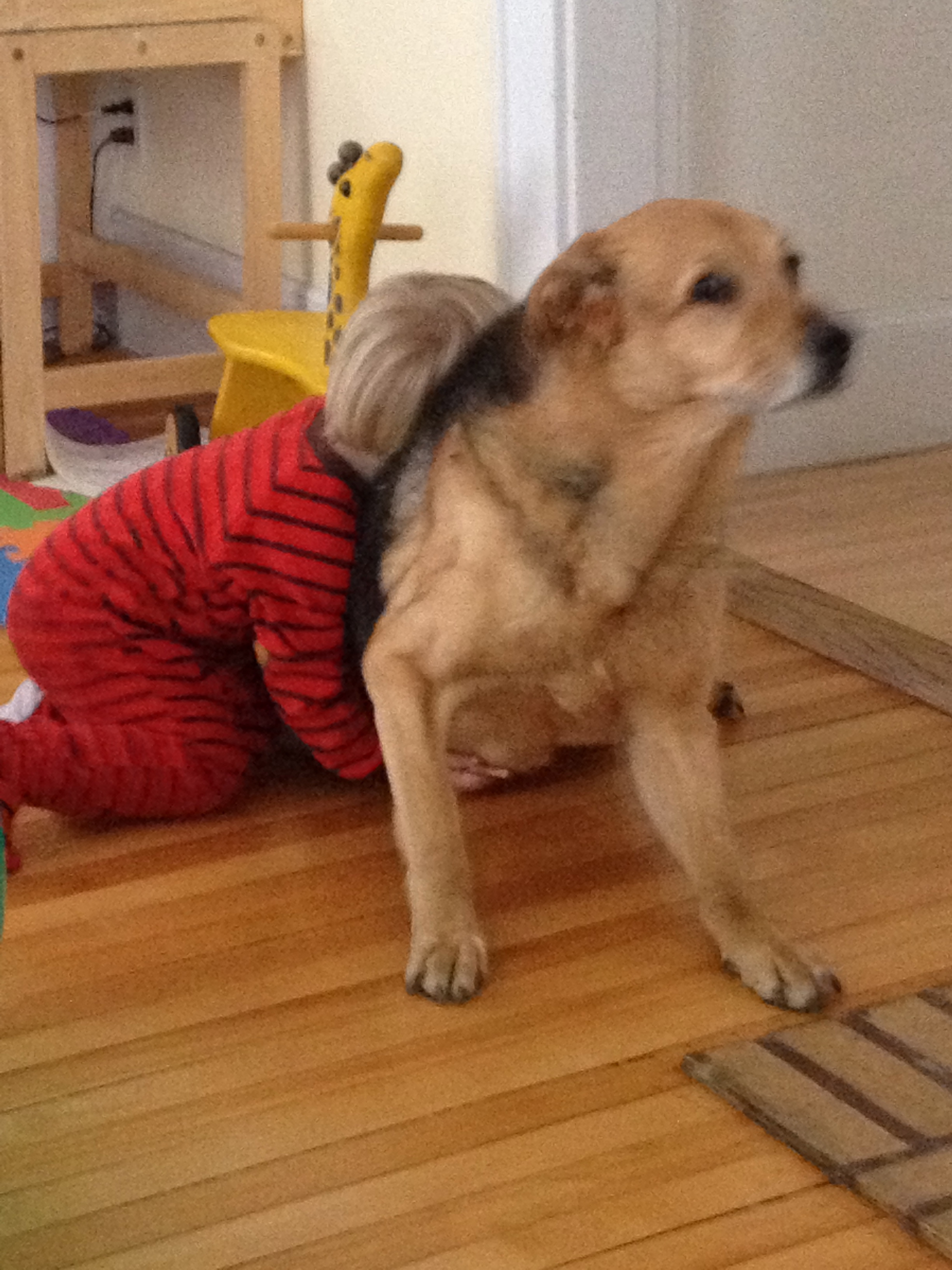
All the love is making this dog tense.

All the love is making this dog tense.

We can all agree that breath (and for “breath,” from here on out, read “love,” “openness,” “curiosity,” or “spirit”) fills us up, that it simultaneously grounds us and lets us fly.  The musculature and intentionality that produce such breathing are real and profound: such breathing is our natural state (as in sleep), but in the world of our realities, pretty much everything gets in the way and messes it up.  So between nightmares and day jobs, childcare and health care, commuting and computing, we end up – most days – tangled beyond recognition.  For most of us, it takes a walk in the woods (which we don’t take) or a round of meditation (which we don’t get) to rediscover our core.  When we do, we can begin to parse our lives with a little more clarity.  Without clarity and rest, we tend to experience stress (which might be considered tension with an attitude problem).

But here’s the thing: tension itself is not bad.  Tension is a kind of discipline or structure, and its manifest in both.  There are many ways to good posture, or effective work habits, or appropriate human interaction, and tension is a part of them.  I am reminded of the persistent knee and hip pain I experienced in graduate school that stopped my running habit, and of the excruciating SI joint issues that developed in my first pregnancy and didn’t resolve long after the second.  I had worked out and stretched diligently through the first but learned in the second that rest was the only solution, so by the time I sought expert help I was not the strongest person you know.  I was, however one of the more flexible.  And that turned out to be the problem.  I didn’t have enough tension!

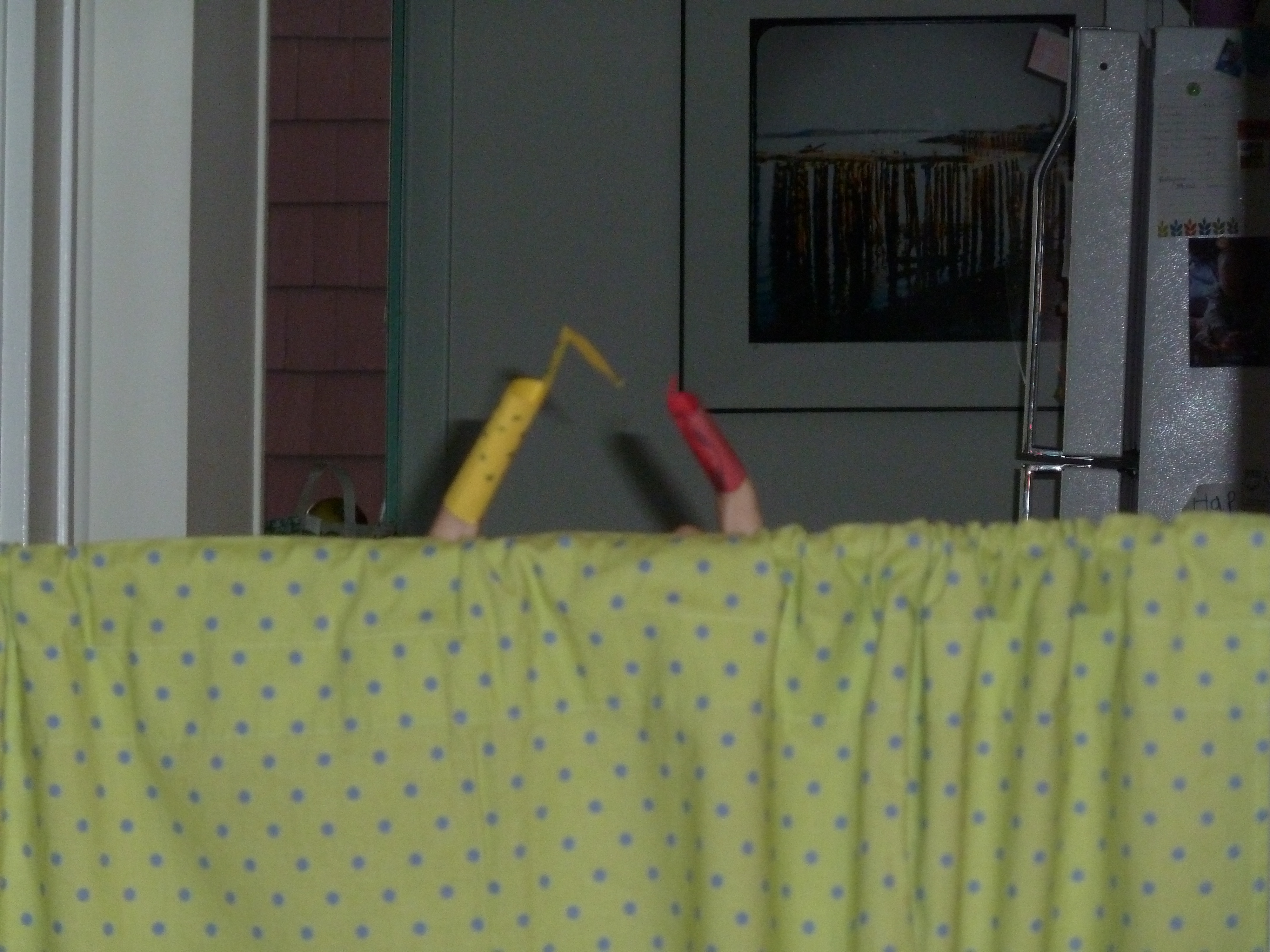
You maybe can't tell, but this is a tension rod holding up our puppet theater.  Tension promotes play.

You maybe can’t tell, but this is a tension rod holding up our puppet theater. Tension promotes play.

Hahahaha, she laughs, only slightly hysterical – two babies under three years old and mounting fiscal pressure that made it important to get more work and find more daycare…but it’s true.  That kind of emotional tension was keeping me from the strength-training that my body needed in order to create the muscular tension that would hold my bones in the right places.  Roughly.  Part of the pain was from too much tension; part of it was from too little.  Sound familiar?

It’s the same logic with our lives: an absence of tension doesn’t mean smooth sailing: it means we aren’t learning or pushing or changing or MAKING change.  Of course it’s delightful when in the midst of complications something goes smoothly (I still remember, as do all women who have delivered a baby vaginally while conscious, that moment of exquisite, whooshing relief when at long last that tiny body fully squeezes out of your own).  The trick to managing tension in the rest of our lives, I’m finding, is that damned balancing act.  We need some tension, but not too much; we need resilience and self-care for when we are overwhelmed by too much tension anyway; we need the right kinds of tension, at the right times and places, to keep us alert and accountable; we need counterbalancing forms of relaxation to remind us of our natural state and to help us recalibrate.  This is to say, we need the sturdy muscles of our singer’s core to give us voice, to help us run.  And we need to know how to release that posture to assume a gentler one for the yoga mat.  We need to relieve that tension through twisting core stretches and maintain it with vigorous exercise.  But what we can’t do, it seems, is sidestep the question entirely.  Which I’ll admit makes me a little grumpy.  Because I like the idea of smooth sailing.  I’ll let you know how that works out for me.

And another thing I’m learning from the kids

I’m greatly impressed, lately, by the power of silence.  And not just the kind you think I mean, where the noise finally subsides and we can hear the ringing in our ears and take a deep breath before it all starts up again.  No, I mean the kind of silence that is intentionally made and kept as a conscious choice.  My older son, Ezra, likes to ask for silence in the car on the way home from daycare.  And tonight, as I lay next to him at bedtime and asked if he wanted a song, he said, “Not yet, Mama.”  And he lay quietly for a good long while.  I used to listen, in the silence, for the things I wasn’t hearing: the music, the conversations, the stories.  I used to plan for what would come next or imagine what might have been.  But lately I’m just trying to do what he does: to hear the world as it is and his own presence in it, without comment or contribution.  Just listening to all that comes in on the breath and noticing all that goes out with it.  The world is a full place indeed, and those places of quiet are one of my son’s many gifts.

Our home bread revolution

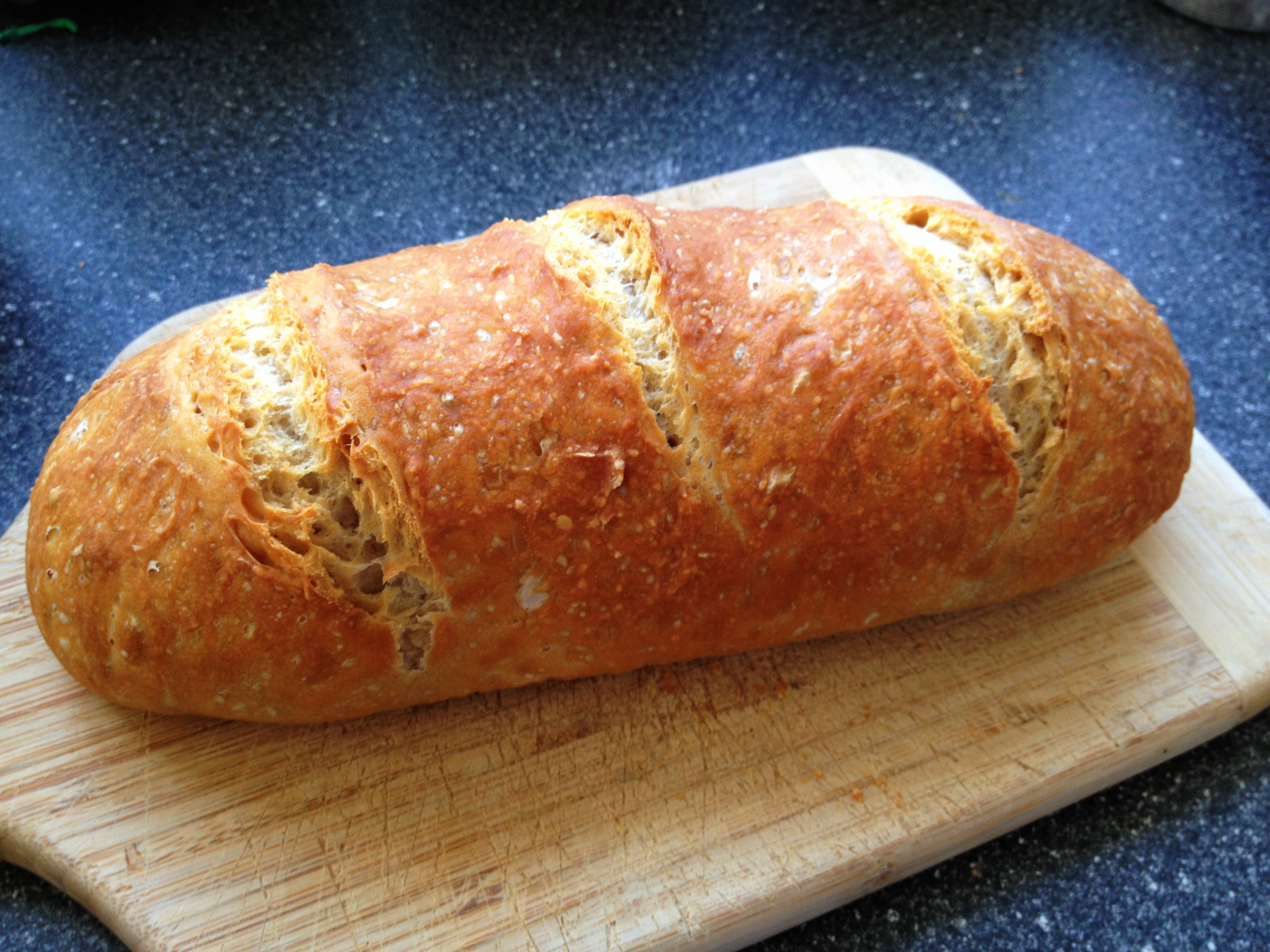
IMG_1245I am someone who lives in the perpetual struggle between wanting to live frugally and wanting to eat well.  There are certain non-negotiables: organic dairy products; decent wine/beer; and until recently, good bread.  There are two fabulous local bakeries that we like to support (don’t you love it when a good cause is also the best food around?), but we are also bread-hogs, and our little habit was costing us maybe $50 a month.  I’d tried baking bread off and on for the last few decades, but the best I could do was a very good (but highly specific) polenta bread and a decent sandwich loaf.  All other attempts were met with varying degrees of disappointment and rage.  By me, I hasten to add.  Len loves whatever I cook and is uniformly supportive (which I don’t understand but revel in).

So imagine my skepticism when I read about these “no-knead” bread strategies that cost less than a buck a loaf.  But imagine my experimental enthusiasm as well!  A few weeks ago, I tried it.  This is the recipe that, I believe, started with Mark Bittman’s thing on no-knead bread, but I found it here at the Italian Dish Blog.  It seems like an awful lot of flour (and I changed it some, as detailed below), but then, it makes three loaves of bread!  And the most incredible thing is that it is really really easy AND really really delicious.  Raise your skeptical eyebrows all you want, people.  Try it and see.

So several times a week, now, our house is filled with the glorious aroma of baking bread; our lives are enriched by those first warm slices slathered in melting butter; our ordinary toast — with jam, with melted cheddar, with slices of creamy avocado — is now a thing of transcendent beauty.  Once a week I mix a new batch and let it sit.  Honestly, the worst thing about this whole undertaking is that the bowl I use takes up too much room in the fridge.  Poor poor me.

So here’s the recipe:

  • 3 cups warm water
  • 1 1/2 Tablespoons (or 4 1/2 teaspoons or 2 packets) granulated fast-acting yeast
  • 1 1/2 Tablespoons (ditto) coarse salt
  • 3 1/2 cups bread flour
  • 1 1/2 cups all-purpose flour
  • 1 1/2 cups white whole wheat flour

You mix the yeast and salt into the warm water — I use a fork to make sure it’s all dissolved.

Mix the flours together and then add them to the yeasty water all at once.  Mix until moist.

Cover and allow to rise (not airtight) for about two hours — longer is fine.  We understand the vagaries of life, and so does this dough.  (And in case you feel like there’s some professional fancy dough-covering device needed — nah.  I use a recycled plastic grocery bag with the handles tied in front.  Sue me.)

Refrigerate at least 3 hours (this dough is really sticky and wet, and refrigeration makes it easier to handle).  I leave the bowl in the fridge for up to a week, taking off what I need as I go.  Though you will be tempted to rest other foodstuffs on TOP of the dough bowl, it’s probably not a great idea.

To bake: put a sheet of parchment paper on a lipless cookie sheet or pizza peel.  When it curls up repeatedly, curse under your breath and place the parchment paper box lengthwise across it to hold it down while you prepare the dough.

Cut off, with a serrated knife, about a third of the dough.  If it’s sticking to your hands, you can dust them with flour, but I rarely need to do that, and it’s much faster if you don’t have to get things OUT for this.  Shape the dough into a sausagey-french-loaf-kind-of-shape as quickly as you can, pulling the top under to the bottom and hanging it to lengthen it .  The surface should be taut and smooth.  This should all take maybe 30 seconds.  Set dough on parchment paper-covered cookie sheet.  Let rise 30-40 minutes (and don’t worry if it doesn’t do much.  Mine rarely does).

20 minutes before baking, put a pizza stone in the center rack of the oven and a shallowish pan on a lower rack (I find it best if the pan is not directly beneath the stone).  Preheat your oven to 450.

Immediately before baking, slash the top of the bread three times with a sharp knife.  Slide the dough, paper and all, onto the hot pizza stone.  Then quickly pour one cup of water into the pan and close the oven door.  Bake 30 minutes, turning the paper once if your oven is crappy and uneven like mine.

When bread is almost finished, use a clean towel to lift the loaf briefly, peel off the paper, and return the bread to the stone (ideally to a new, hotter spot on said stone).  Crisp for five more minutes to brown the bottom crust.

Enjoy your absolute wizardry; brag to all your friends.  Regret it when they demand taste-tests.  A few days (or hours) later, when your loaf is gone, just grab more dough from the bowl and fire it all up again.

A last note: when you go to make a new batch, you don’t have to wash out the bowl.  According to the authors at The Italian Dish Blog, the leftover yeasty doughy goodness just adds to the flavor.  And indeed it does, my friends.  Indeed it does.  Divine.

If all this sounds a little much, rest assured that it’s quicker than reading these instructions.  It’s quicker than BUYING bread.  It’s a simple habit to develop and you’ll be glad you did. (Heavens, you’d think I was investing in your bread success.  I don’t know how to do that.)  Anyway, enjoy.

On gardening and sharing the love

This is a quick little post because I’m prepping to teach a organic-vegetable-gardening workshop this morning, and I’m excited and wanted to share.

What fun!  Gardening!  Friends!  Love it!

I’ve put together an array of resources, most of which are electronic, and I’m presenting them on my Pinterest board “Garden workshop” if you’re a Pinner.  If not, I’ll post them on my “growing” page here soon.  But the best and coolest one is from MOFGA, and is available here.

If you’re new to gardening, or just want a handy reference in one place, this is it!  Love it.  Love the Maine Organic Farmers and Gardeners Association.  Love the gardening.  Love the love.