I’m greatly impressed, lately, by the power of silence. And not just the kind you think I mean, where the noise finally subsides and we can hear the ringing in our ears and take a deep breath before it all starts up again. No, I mean the kind of silence that is intentionally made and kept as a conscious choice. My older son, Ezra, likes to ask for silence in the car on the way home from daycare. And tonight, as I lay next to him at bedtime and asked if he wanted a song, he said, “Not yet, Mama.” And he lay quietly for a good long while. I used to listen, in the silence, for the things I wasn’t hearing: the music, the conversations, the stories. I used to plan for what would come next or imagine what might have been. But lately I’m just trying to do what he does: to hear the world as it is and his own presence in it, without comment or contribution. Just listening to all that comes in on the breath and noticing all that goes out with it. The world is a full place indeed, and those places of quiet are one of my son’s many gifts.
Tag Archives: mindfulness
On being too many things
If any of you share my somewhat shame-faced but whole-hearted love of the cheesy dance movie “Center Stage,” you’ll recognize this brilliant line: “Girl, you are too many things!”
It comes when the gorgeous and talented but attitudinally-impaired Yva Rodriguez has just danced her stunning surprise lead role in the academy director’s major new piece, and her performance shocks everyone not just because she was a substitute: she was flawless. She was inspired. She brought individuals to tears and the house to its feet. Most importantly, she realizes for the first time that she truly does LOVE this work, this life, and that her own sense of self-importance and defensiveness really take a back seat to her passion and joy in the work. Her best friend, Eric O. Jones (“O as in Oprah — she’s my idol”), offers her that unforgettable line, perfect in its capacity to honor all the many facets of herself. It’s not “Oh, yay, you did a great a job,” or “What a terrific career opportunity” or even “congratulations on overcoming your obvious fears of success.” It’s “you are too many things!” You are all that and more: scared and courageous, brilliant and flawed, vulnerable and hostile and beautiful. That’s the kind of encouragement we all need.
We had some reminders in our house recently of the risks of underestimating ourselves, of curling up in our shells because we’re tired and sore. We’ve also had some reminders of how crucial it is to do just that kind of retreat. The challenge, I guess, is knowing when or in which fields it’s okay to hide out, and when to more forward, trusting the path to open up ahead of us with fewer brambles than before. Part of the challenge, too, is knowing how to ask for guidance, who to ask and with what kinds of framing. Do we seek to be better at what we do, or to help out more where we are, or do we try to challenge and nurture our core selves, whatever that might look like? Does the latter always advance the former?
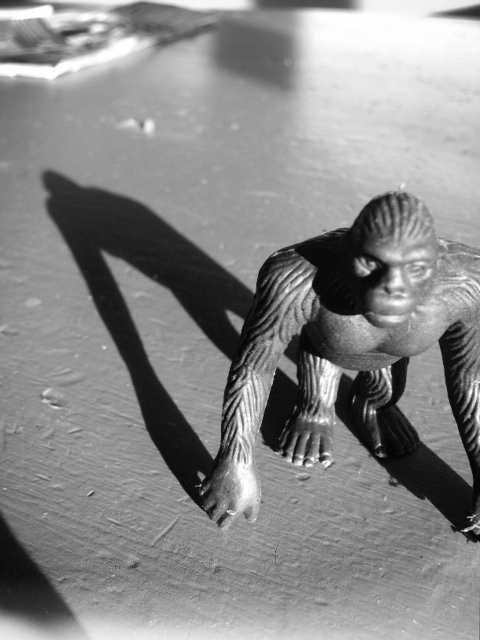
Image by Leonard Bartel of LE Bartel PhotoArts. Check out his other brilliant work online at http://www.bartelphoto.com.
This stuff seems purely academic in a certain way, except that when you pile it all up, it takes on form and begins to loom. It casts dark shadows. Like this.
When the exhaustion and the irritation and the career concerns and the money worries and the new-computer-buyer’s-remorse are all heaped together, they start to look a little like that guy. So I’m glad that I get to actually SEE him, to remember that he’s a children’s toy, that we can pick him up and move him around, that his long shadow is just a result of where we’ve put him in relationship to the sun. It helps.
It also helps, I find, to revert to the present mode again. To realize that even if it’s not the time to haul out every tinkertoy in the known world right before bath, it MAY be time to put the baby down first and then spend extra long with the Dr. Seuss-a-thon the three-year-old wants. It MAY be time to hold said three-year-old extra close for longer than usual, because he is your child and he makes you whole and this is why we are alive. We are indeed too many things, all at once, and we’re no good at living in that kind of story. We want the drama of a particular narrative and the resolution of conclusions; we want plots that unfold with tidy themes. There’s rarely enough room for the outrageous glory of the everyday while fatigue hums along our bones like wires. We cannot contain in language, or even sometimes in our hearts, the enormous bog-wallow that is our lives, everything steeped in everything else, our fears and ambitions and concerns and hopes. The closest we can come, I guess, is to accept the bigness and the touchingness and the inextricability — and to keep showing up, right here, right now, to see what’s rising to the surface.
Pinterest as spiritual practice
The Pinterest craze has provided many of us with new ways to kill time. And I mean, kill it dead. The unbelievable depth and breadth of resources available present an enormous challenge to those of us with a passion for, well, anything. Because it’s all on there – the whole world of hobbies, ideas, design, innovation, crafts, houses, book ideas, every possible manifestation of human interest. It’s easy to start, hard to put down, and even harder to catch up on sleep after your first week. Which is why all kinds of folks are including Pinterest in their media fasts, their unplugging, their general efforts to return to sane and local living. (Patti Digh has a great little piece on that here.)
The real challenge, I think, is in moderation, in judicious use of the resources with a discerning eye, so that you a) aren’t constantly on there, and b) you only pin what you want to use, for feeding you in some important way. (Here, my pastor mother-in-law would smile and say: “As it so often is in our spiritual lives.”) Indeed, one friend asked (on facebook, amusingly): “does Pinterest provide beauty or value, or does it just give us more information? Because I have enough information.” I answered yes, beauty and value indeed, because of how it enables us to keep contact (distanced, sorted, organized contact) with information, with good ideas and beautiful, inspirational images.
I am one of those people who struggles to live in the present because I am always trying to bear (“to carry”) in mind too many kinds of information: the location of that recipe I want to cook for dinner; the directions for that fun activity I want to try with my kids tomorrow; the pattern for the hat I will crochet my niece for Christmas; the paint color I saw in someone’s bathroom that I want to try in ours. And that’s just the domestic sphere! What of the brilliant “slow money” article I keep losing track of? The book on radical homemaking that offers new ways of imagining barter? The website that’s a useful model for my consulting practice? My head is constantly moving on several levels at once, which is an advantage in terms of getting things done but a distinct disadvantage in the peace-of-mind category. It took me until a few months into my Pinterest love-affair to realize the enormous gift it offered me: to be here and now without ceding my hold on the future. It offers us what is essentially a spiritual opportunity, previously available (perhaps) only to those writers and contemplatives who kept and used tiny portable notebooks. By pinning (in our portable phones, even?) the next great family activity or the last painting that made us gasp, we can store our cherished visions without giving them up; we can live our lives AND remember where and how those visions are; we can revisit them in all their detail and promise, erasing what no longer fits or reorganizing to accommodate new dreams; we can share these visions, when we choose to, with friends; and most of all we can do all this without fear of spending our lives away from center, from the here and now. We can set down the dream, or pin it up, and not have to live in its shadow for fear of failure or forgetting. That way we can be here, now, with our lived realities, and still honor the hopes we have for other, better, fuller lives. Because we do have those hopes, and yet we only fulfill them through living, here and now, rather than dreaming in the ether.
On the challenges of showing up
When I was in graduate school, I worked at a really good restaurant that some friends of mine were opening. It was a small place, and serious about their food, drink, and service. To support that, they made every staffer go through an intensive and prolonged training where you tasted every single thing on the menu (oh, hardship) and learned about how it’s made and how to describe it. The wine part turned out to be especially interesting to me, because we were given the proper schooling on how to “taste” wine, and I found that I resisted mightily. I could taste all the same things everyone else was talking about, and the descriptions all made sense and I enjoyed having a new vocabulary, especially one with such cultural cache (how the eff do you write a French accent in here?). But I could not, and cannot, let wine roll all the way off the edges of my tongue. It is way too intense for me. It’s almost physically painful. Our teacher, the wife of the team (who has since completed sommelier school at Windows on the World and opened her own wine shop) was amused — apparently there are people who are considered “super-tasters” who have these issues. That seems too fancy a title for me, but the fact remains that I cannot abide the intensity of wine that way. Some folks can’t drink hard liquor for the same reason; others hate spicy food. Sometimes experience is just too much and we want to calm the stimulus or avoid it altogether.
I tend to think about mindful living in the same way, especially parenting. I’ve realized lately that I spent much of the fall in kind of a daze, dealing with one familial health issue after another, and so rarely actually attending to the people rather than the problems. I’m becoming aware of this as I see how much my kids have grown, how the shapes of their faces are changing, the growth of downy hair on their arms and cheeks. We walked at the pond today and Ezra stomped puddles the whole way there, rather than riding in the stroller; Malachi wanted to get out and walk, holding onto my hands, up and back, up and back one particular stretch. I’m trying not to avoid the anguish of their growing up anymore. I’m trying to think of the truth I heard of a child’s first day of school: how terrified you are for them, and for you, and how thrilled you are as well. That the two not defeat each other, or cancel each other out, seems like a major goal, or perhaps a small miracle. So that’s how I’m trying to live these days: to see and relish the absurdity of softness and roundness that is still, for a while, Chi’s little body, and not to worry about what comes next. Many days, that seems too tall an order, because how else do we prepare ourselves for the angst and chaos ahead? But maybe all this mindful stuff is right after all, and the only reality is now, and the only truly great thing we can do is show up.
One of the ways you know you’re living with the right people
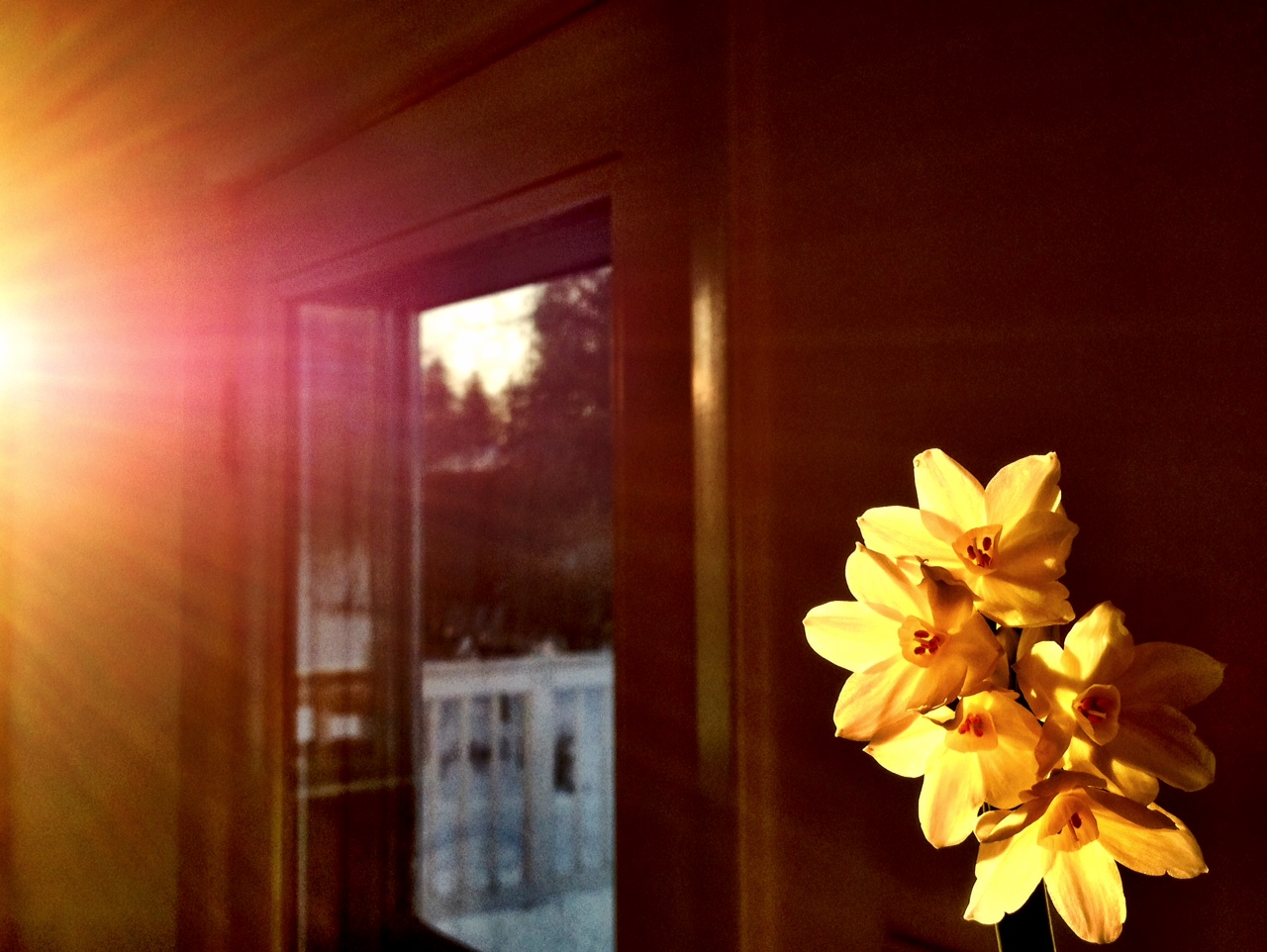
This morning was a hurried morning, as they usually are. Potty training isn’t making life any easier yet.
Malachi surprised all of us by sleeping 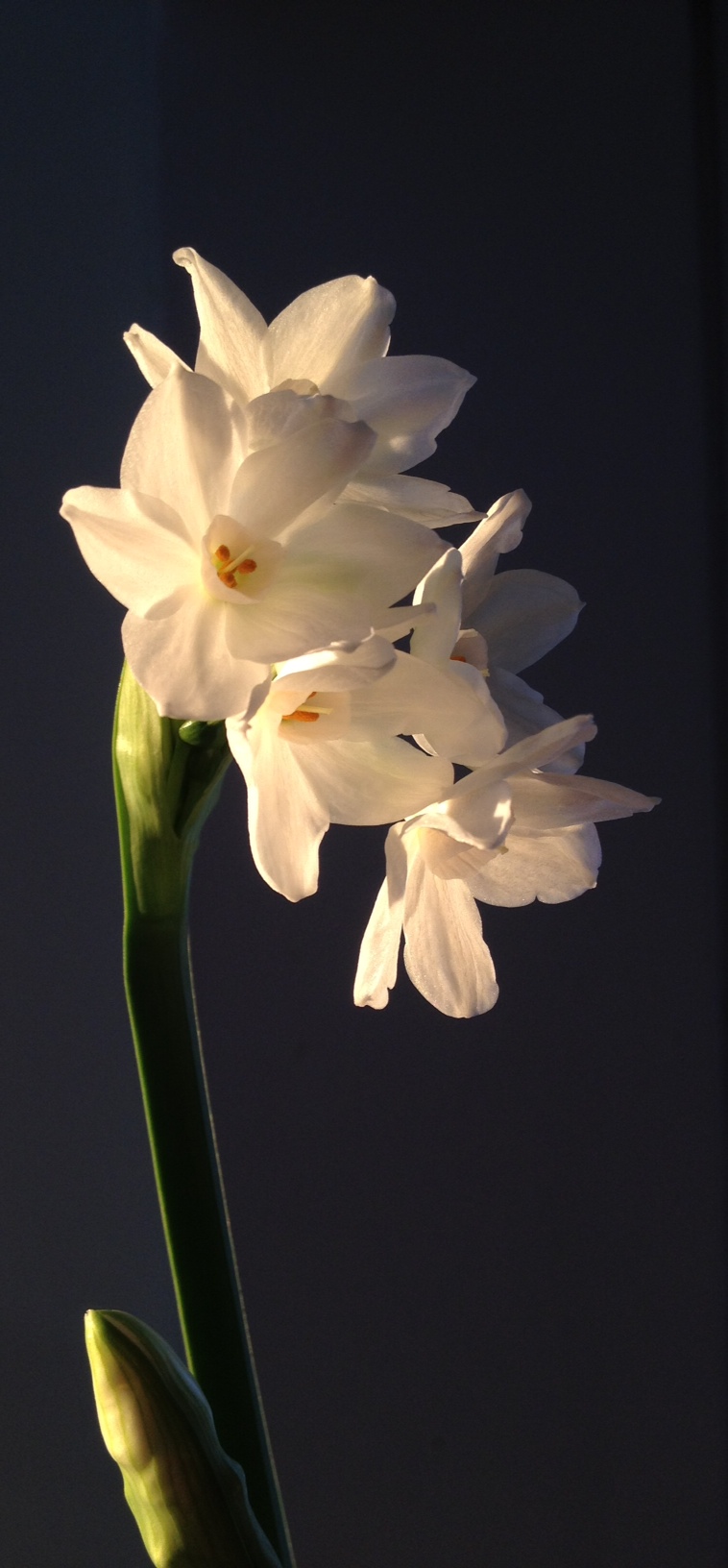 well from midnight to 6, so he awoke confused and starvacious. Ezra announced he did not sleep enough, which was why he was sad and grumpy and unable to use his big-boy voice. There were Cheerios everywhere and Sunbutter on my sleeve and coffee splatter on Len’s work tie. In the midst of all this noise and hustle, the sun rises above the neighbor’s trees and beams directly in the eastern window, backlighting the newly-unfurled paperwhite so that it glows, transformed, a fierce beacon on a fragile stalk. Ezra and Len and I stare amazed for a moment before I grab my phone/camera; then Len grabs his and Ezra starts grabbing at our waists for us to lift him up to see. Malachi, strapped into his high chair, spends some time trying to owl his neck all the way around and then gives it up, content to eat and watch us watching. Where else, I ask you, would I find people so willing to let their lives be altered by such a brief moment of beauty? Who else would see this and drop everything to stand in its light, breathing more quietly while we wait for the sun to shift?
On letting go of the story line
Pema Chodron, in various of her works, talks about “letting go of the story line” as one of the crucial skills that enables us to stick with the practice of living, of being present to our lives. I had never even heard the concept until I went to a retreat she was running at Omega when I was 35 weeks pregnant. The retreat was called “Smiling at Fear,” which seemed like a good idea, as I had just left not only a job but a whole career I’d spent 15 years building AND I was about to have my first child. I was working and working at the concept of befriending my negative emotions and I just couldn’t see how you make friends with a runaway train and I was feeling the old desperation rise up in my throat. But then she said that about the story line, and how we spend so much of our lives acting out particular stories that we feel define us, and all of a sudden I could see it. Even THIS, the process of wanting to shift something and not being able to, was a story line I was committed to. So what happens if we let go? Well, it turned out that letting go of that one meant that I could just BE there — in a beautiful warm room with two extraordinary friends and several hundred other fascinating people. With a wise and holy teacher before me and another one inside me: that joyful acrobat in my belly has never since stopped teaching me. I was able to breathe, to stretch, to sit in quiet and gratitude.
I think often of the challenge of setting down the story line, and less often I actually remember to do it. But sometimes life surprises me. Yesterday, for example, was full of surprises. My 14-year-old car had been making some terrible noises, and I realized that I really didn’t want it on the road, much less carrying me and my two precious babes. I had convinced myself that it was a clutch problem, or worse, and that now, here, finally was the repair job that would be the death of Hubert (yes, after the excellent bloodhound in Best in Show. We generally name our cars after dogs). So I prepared for the worst by doing what I do: managing for time and money. We spent some time looking up used cars online, and I concluded that Tuesday’s lineup of meetings would give me only four hours for car repair, so we’d better the diagnostics done Monday. I called the shop (Center Street Auto in Auburn, Maine — if ever you need anything, they ROCK), and they graciously agreed to take a quick look for diagnostics if I came in at 11. So both boys and I “took Hubert to the car doctor.” Twenty minutes later, they handed back the keys, having identified and fixed a loosening wheel (!!!). No cost, no trouble, no major life shift. Oh! Look at that. I had the story all wrong. Which is reason number 2 for setting down the story line: first, it makes you crazy if you let it define your life, and second, you might not even have the right story.
When we get home, I gratefully remove all the winter accoutrements from our three persons and head to the kitchen to figure out lunch. But there’s water in the disposal (which is the only drain in our kitchen sink and which, we know from past experience, has no main drain cleanout beneath it, so any serious problem in the pipe becomes a serious plumbing issue in the house). AH, I think. There it is. Not the car but the plumbing. THAT will be our major problem. But before I despair completely, I figure I’ll do the recon I’d feel stupid to skip: and of course, the under-sink unit had merely become unplugged somehow. Crisis averted. Story line aborted. Or perhaps there’s a different story line starting to form: maybe I am a resourceful protagonist who can sometimes solve her own problems and so doesn’t need to freak out about them. Everything in its own time, eh?
It was a sunny day, and warm (upper 20’s), and we still had a nice foot of snow on the ground, so I hauled both boys outside after naptime. The storyline there is about hassle pre- and post- and about crying over snow in the wrists while we’re out there. But I announced we’d have outside time, and by golly we did. Ezra helped me pull Malachi in the little red sled and went down the hill twice himself; he even made the lower half of a snow angel. Twenty minutes of enjoyment outside and we went in for warm snacks. The sun slanted glowingly into the kitchen; the neighbors’ trees were all bronzed and rosy at their tips; the startlingly clear sky showed not one but three jet trails, brighter than light, converging slowly toward Portland. Of course there’s going to be whining, I thought. Of course the snow gets in at our wrists, right where our skin is most fragile and thin. But this does not mean we stay inside. We try to remember that we will warm up again; we zip up and tuck in and open our eyes to the sky.
 On Crafting a Life