On being too many things

If any of you share my somewhat shame-faced but whole-hearted love of the cheesy dance movie “Center Stage,” you’ll recognize this brilliant line: “Girl, you are too many things!”

It comes when the gorgeous and talented but attitudinally-impaired Yva Rodriguez has just danced her stunning surprise lead role in the academy director’s major new piece, and her performance shocks everyone not just because she was a substitute: she was flawless.  She was inspired.  She brought individuals to tears and the house to its feet.  Most importantly, she realizes for the first time that she truly does LOVE this work, this life, and that her own sense of self-importance and defensiveness really take a back seat to her passion and joy in the work. Her best friend, Eric O. Jones (“O as in Oprah — she’s my idol”), offers her that unforgettable line, perfect in its capacity to honor all the many facets of herself.  It’s not “Oh, yay, you did a great a job,” or “What a terrific career opportunity” or even “congratulations on overcoming your obvious fears of success.”  It’s “you are too many things!”  You are all that and more: scared and courageous, brilliant and flawed, vulnerable and hostile and beautiful.  That’s the kind of encouragement we all need.

We had some reminders in our house recently of the risks of underestimating ourselves, of curling up in our shells because we’re tired and sore.  We’ve also had some reminders of how crucial it is to do just that kind of retreat.  The challenge, I guess, is knowing when or in which fields it’s okay to hide out, and when to more forward, trusting the path to open up ahead of us with fewer brambles than before.  Part of the challenge, too, is knowing how to ask for guidance, who to ask and with what kinds of framing.  Do we seek to be better at what we do, or to help out more where we are, or do we try to challenge and nurture our core selves, whatever that might look like?  Does the latter always advance the former?
IMG_1243

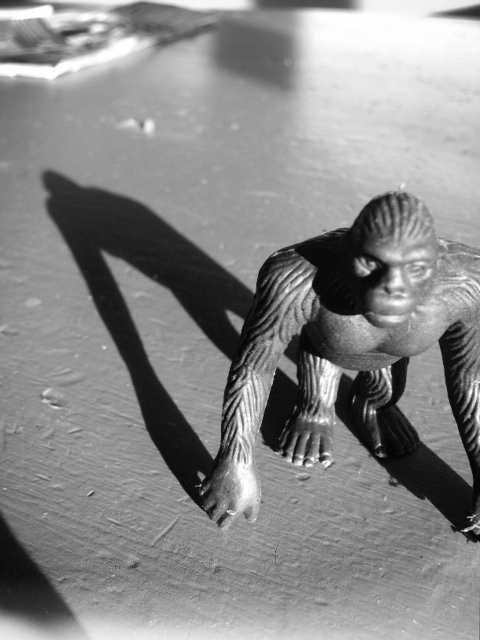
Image by Leonard Bartel of LE Bartel PhotoArts. Check out his other brilliant work online at http://www.bartelphoto.com.

This stuff seems purely academic in a certain way, except that when you pile it all up, it takes on form and begins to loom.  It casts dark shadows.  Like this.

When the exhaustion and the irritation and the career concerns and the money worries and the new-computer-buyer’s-remorse are all heaped together, they start to look a little like that guy.  So I’m glad that I get to actually SEE him, to remember that he’s a children’s toy, that we can pick him up and move him around, that his long shadow is just a result of where we’ve put him in relationship to the sun.  It helps.

It also helps, I find, to revert to the present mode again.  To realize that even if it’s not the time to haul out every tinkertoy in the known world right before bath, it MAY be time to put the baby down first and then spend extra long with the Dr. Seuss-a-thon the three-year-old wants.  It MAY be time to hold said three-year-old extra close for longer than usual, because he is your child and he makes you whole and this is why we are alive.  We are indeed too many things, all at once, and we’re no good at living in that kind of story.  We want the drama of a particular narrative and the resolution of conclusions; we want plots that unfold with tidy themes.  There’s rarely enough room for the outrageous glory of the everyday while fatigue hums along our bones like wires.  We cannot contain in language, or even sometimes in our hearts, the enormous bog-wallow that is our lives, everything steeped in everything else, our fears and ambitions and concerns and hopes.  The closest we can come, I guess, is to accept the bigness and the touchingness and the inextricability — and to keep showing up, right here, right now, to see what’s rising to the surface.
Excuses, excuses

I’ve been reading a range of books on how to live better, manage tasks better, be kinder, explore more — you know, LIVE.  I’m always fascinated by how many of them articulate the same kinds of common sense we’ve been hearing for years, yet make it sound fresh and important and attractive.  Which is vital if you’re someone like me, who has a great deal of common sense and yet a whole host of excuses for being stuck in a rut.  It’s MY rut.  It’s not uncomfortable.  I’ve made it sort of homey, papered it with possibilities and laid out a few nice cushions on the floor.  And I spend a lot of time there.

But these writers say we should explore!  We should take risks!  And be uncomfortable!  And the bummer is, they’re right.  Sometimes the discomfort is as small as giving up the precious quiet cup-of-coffee minutes of a baby’s nap to write a blog post; sometimes it’s as huge as cold-calling for consulting gigs.  Sometimes it’s in between, like meeting the new neighbors and trying to decide what if anything to make them for a welcome dinner.  I guess I’m more of an introvert than I thought.

The most important tool, I find, for staying stuck in my rut is the excuse.  I rarely even have to offer them to others — I use them on myself.  I’m truly gifted at rationalization.  But there’s a point when our knowledge of ourselves makes even the best excuses evident: when we wake up in the morning with back pain because we keep skipping our exercises, well, then, there’s really no excuse for skipping the exercises.  No matter what I tell me.  If we want a particular kind of job, then all our brilliant excuses for postponing the search are going to be, well, stupid and self-defeating.  And I don’t know about you, but I dislike feeling stupid and defeating myself (though again, I am excellent at both: this is one area where you really don’t want to run with your strengths).

How, then, do we get past all this?  I’m on the fence about that.  Surprise.  I am really liking Scott Belsky’s “Making Ideas Happen” and its Action Method; I also really like the gentler, more spiritual approaches of Patti Digh.  I am drawn to the clarity and categorization of Strengthsfinder, but I believe in the broader, more mindful approach of, say, Parker Palmer.  As much as I appreciate what she’s doing, Gretchen Rubin’s “Happiness Project” makes me a little itchy — perhaps I am just allergic to the tone of direct achievement and 20/20 hindsight when I feel myself groping around in the dark.  And Seth Godin is always appealing, but usually more as a shot in the arm, maybe-I’ll-take-up-mountain-biking-while-I’m-churning-out-utterly-brilliant-novels kind of way.  Mostly, I think, what I need is a Natalie Goldberg-esque kind of practice, a daily writing-cum-meditation that helps me see what’s in play and sit quietly in its presence.

What I DON’T need is a computer that has stopped connecting to the internet anyway anyhow…but that’s what I have.  Now I have to see if I can fix it, or see if I can find someone who can, for cheap, or buy a new one.  All advice welcome.  (And yes, that’s my excuse for late posting.  I’ll get back to it, I promise.)

🙂

On the flurries

It has been snowing lightly off and on for weeks.  Months, I believe. Forever, in fact.  Which is enough to drive anyone a little crazy, especially toward the tail end of a long Maine winter.  But another kind of flurry is complicating things too: a work-flurry.

I’m someone who has always sought and valued routine, even though I’m a little bored by it.  My preferred mode of living is comfortable routine with fun variations and surprises.  So why, you might ask, am I pursuing this life of writing and teaching and consulting?  I guess because the pull and excitement of those fields, coupled with the attraction of time with kids, just seem more magnetic right now than the security that used to be so vital.  Last week I felt comfortable with that.  This week, with all of the following things happening, it seems a little nutty:

  1. two offers to teach courses at area colleges over the summer;
  2. one possible collaborative book project to develop and write;
  3. one academic book chapter awaiting final comments from the editors;
  4. one article to write for the very cool L/A Magazine;
  5. one fabulous blog to develop and maintain;
  6. one other blog I’ve been itching to start;
  7. one gardening workshop to host for local folks;
  8. one GARDEN to plan and plant (seed-starting only at this stage, but still);
  9. one board committee meeting to chair; one larger board meeting to attend;
  10. one book discussion session to facilitate in a monthly meeting at our public library;
  11. one book discussion series to plan for the fall for the library/Maine Humanities Council;
  12. the usual array of doctor’s appointments and work-related travel and family life to manage.

And this Sunday is the changeover to daylight savings time.  Which is nice, because it will mean that the baby gets up at 3:30 instead of 4:30 am.  So we’ve got that going for us.

Seriously, why do we do what we do, especially when it’s volunteer or really low-paid?  For me: I’m itching to make these things work.  I’m in the relationship-building phase of a number of initiatives and it all seems worth it right now.  What are the things that pull you in many directions?  How do you manage their competing priorities?  And how do you stay sane during it?  It’s like the snow at this time of year, isn’t it: you never quite know what those clouds will produce, and you surely don’t know if it’ll stick.  But you know that seasons are changing and you know you can’t stop time, so at some point you just hold out your hands and try to  be grateful for what lands.

It’s Sunday morning, people

And at our house that means we have room for some of these:

  • Baking some bread (again, from The Italian Dish’s recipe);
  • Watching the smallest among us explore his space and his (distressingly loud) new lion roar;
  • Making smoothies (yoghurt, banana, frozen raspberries and peaches, oj) and trying them out on the baby-who-might-we-hope-to-god-be-outgrowing-his-dairy-intolerance;
  • Carefully assisting the drinking of said smoothies and cleaning up as we go;
  • Appreciating Ezra’s careful pronunciation of “tusks” and “scientists,” complete with his gloat that he can, in fact, pronounce difficult words like “tusks” and “scientists”;
  • Discussing (with Len, lest you mistake my childrens’ early interests) austerity  and Warren Buffett’s idea about managing the federal debt and generally airing our concerns about the future of our economy;
  • Contemplating what if any further seed-starting should happen today, now that we’ve got the tomatoes, parsley, dahlias, zinnias, and marigolds underway;
  • Revising my new work-management plan, which is basically a chart with the five categories of “work”-type stuff as columns and a range of different projects or tasks below — my strategy is to use this to keep the responsibilities before me, and to commit to checking off at least ONE of the things in each column weekly.  I’m curious, in this first week, to see where the check-marks naturally fall.  If you’re interested, I can post the chart;
  • Planning a new blog post on getting things done, based on a little facebook research I did recently…I figure if there are strategies that are shared by freelance techies; writers with full-time day jobs; perpetually curious students; professors with serious media addictions; and moms with multiple jobs, both paid and creative — well, then, perhaps they are useful strategies.  Worth a shot.
  • Wondering if it is going to snow about an inch every day for the next two months like it has for the last week or so.  I am weary of the overcast.

What are you up to today?

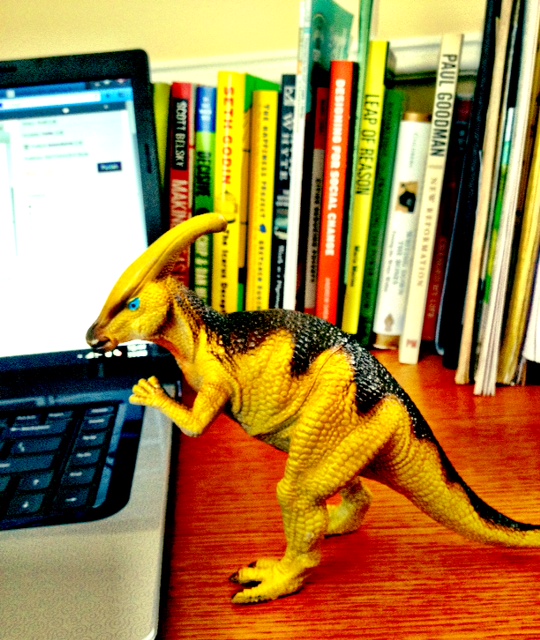
Parasaurolophus attack.

Parasaurolophus attack.

Uh, oh, I have to go.  I’m under assault by a parasaurolophus.  Right here on my desk.  It roars.

On writing as an act of generosity

I am a big fan of generosity.  I love the notion of giving, of gift as interaction and interaction as gift.  And I’m a big fan of writing.  But it has only recently occurred to me that those might be the same thing.

Naturally, there are many writers whose work felt like a gift to me — Barbara Kingsolver, Wendell Berry, Billy Collins, and many more — but it felt private.  It was the emotional counterpart to my teenage habit of hugging a book to my chest as I snuck off somewhere to read (since I was not supposed to be reading but rather doing something “productive” like washing dishes).  I cherished the words and the stories and I felt wildly privileged that they spoke to me.  To ME!  But as I got healthier and wholer, I came to see that the larger political significance I’d always attributed to stories was perhaps the same thing as this deeply personal conversation, just on a broader scale.  As these and other writers opened my eyes and my soul to the wider world, and as I learned (ironically, well AFTER my PhD in Comparative Literature) how many other eyes and souls were out there, doors ajar, because of their writing, I came to see that this is their gift to the world.  Barbara Kingsolver, in fact, talks about this in a video she did way back when Animal Dreams was first published (which I can’t seem to find today); she says, essentially, that the most important thing she can do for this broken world is to put her butt in chair and write.  It’s true, she tends to work on the macro level, I think: witness this excerpt from a conversation with David Gergen about how stories structure and define our world, our nation, our communities:

“DAVID GERGEN: –but through your own novels to invent a new set of stories for us, is that what you’re about?

BARBARA KINGSOLVER: It is in my own little corner. That’s what I’m trying to do. I love what Joseph Campbell said about mythology. He said that our stories are what holds us together as a culture, and as long as they’re true for us, and as long as they work for us, they–we thrive. And when they cease to become true, we fall apart, and we have to reconstruct them or revitalize them. We have to come up with new myths.”

And of course that’s what she does: her stories enable us to connect to the land and the people who work it; to understand the histories of human movements and failures; to imagine ourselves into a capacity for managing heart-wrenching, world-churning change that right now seems certainly fatal.  But what’s brilliant about Kingsolver is that she works on the micro level as well.  Her characters and her language are so compelling, so utterly moving and hilarious and desperate and comforting, that we can’t help but be drawn in.  As a reader, I’m in awe of that.

But now I find myself thinking, for the first times in my life, as a WRITER too.  It feels like hubris, and perhaps it is. But I’m slowly, slowly catching up to the notion that when we have a gift to give and we believe in generosity, then we have to give it.  Even if it is our writing.  Even if it is a painful exposure or a risk or an embarrassment, or whatever it turns out to be.  Maybe we have to do it.  (I’ve had little angels tell me this before — angels in the sense of folks who show up to say wise things or be there when you need them — the most memorable of which was a guy at a conference in San Francisco years ago who came up to me after I’d spoken in a seminar to ask what my book was called.  I said I hadn’t written one, and he asked why not, and then he held my eyes while I squirmed.  “This isn’t about ego,” he said.  “The world needs to hear what you have to say.  You have to get out of the way.”)

So here I am, trying to get out of the way, though a little confused by the whole thing and unsure of what comes next.  I am grateful for the readers I have and hopeful for more; I am grateful for the extraordinary writers (novelists, bloggers, poets, and authors of all stripes) who inspire me every day with their bravery and their brilliance.  I am grateful, I suppose, for the gift I’m perceiving and for those of you who are out there to give it right back by receiving.

On dancing and seeds and grace

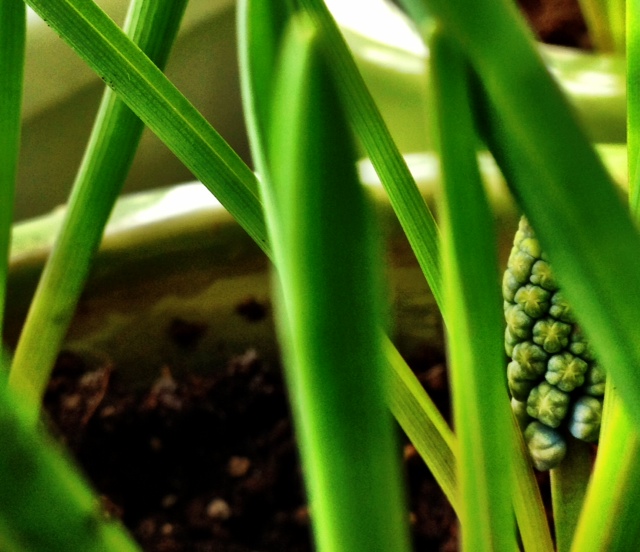
grape hyacinth budHere’s my afternoon: starting seeds with Ezra in the basement; coming upstairs to find Len and Chi home from the grocery store and provisioned with a tasty new beer (well, Len, anyway); dancing with both babies to The Miseducation of Lauryn Hill.  Her song “Bonus 2,” which is essentially First Corinthians brought to extraordinary life, always reaches out to me — but today, as I held my small fevered Ezra in my arms and danced, it was transcendent.  To sing those ancient words of love to my son, through Lauryn’s music, to feel the rhythm move through the bones of this old white Colonial, well, I was shaken.  I was lifted up.

I don’t often write about spirituality, or at least not as such.  It’s partly because I feel those are kind of private issues, and also because I’m uncomfortable with the ways articulations of our own faith can end up looking or feeling like advocacy or pushiness to others.  I confess, I’m also tired of the self-congratulatory tone of lots of the writing out there on religion.  And also, let’s face it: I’m a seeker who was raised Quaker (more in the secular humanist end of that spectrum) in a kind of do-as-I-say-not-as-I-do sort of way.  So I have no sense of authority, only a heart full of questions and gratitude.  I tend, then to use the language of mindfulness or grace, since the former is more of a practice and the latter more of an acceptance of what seems an obvious and widely accepted truth.  For me, there are lots of interchangeable words that describe what I have faith in: love, beauty, the sacred, harmony, nature, the universe, grace, providence, serendipity, the Way, the Light, truth, hope, and of course the many permutations of god.  It is clear to me that music is sacred, as are the gifts of all artists and growers and makers and seekers — all creatures, and especially those who offer up something of beauty, who uncover or create or otherwise act with generosity in this sad and broken world.

I’ve been trying to read Margaret Wheatley’s So Far From Home, though it’s hard, because its premise is that we cannot change the world; we can only accept our powerlessness and do our best to live whole and beautiful lives by doing the right work because it is work that needs to be done.  That living, that standing in contrast to the crazy and the broken, is itself transformative.  I buy this, mostly, because it seems smart and truer than anything else I know, but I’m not wise enough or whole enough to live within it.  I’m trying.   Most days, I’m still seeking, perhaps too anxiously, for that “right work,” unable to accept that where I am is enough.  But on a day like today, that truth rings out: of course it’s enough.  Perhaps not forever, but I don’t live in forever.  I live right here, right now, right in the middle of all this beauty, surrounded on all sides by grace.

Making MORE, not less, of ourselves

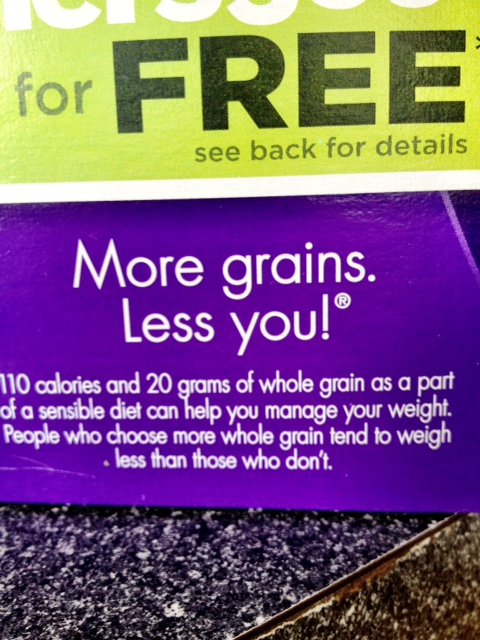
But, but, but...here I've been working so hard to make MORE of me!

But, but, but…here I’ve been working so hard to make MORE of me!

I know I’m not always in the best mood in the morning, but it was still a shock to see this on the cereal box.  And to realize that this is what my (mercifully pre-literate and mercifully male) kids have been staring at.  And to realize that this kind of message is everywhere.  How broken is that?

I know they mean well, that it’s a weight-loss message, but still.  Come ON, Cheerios.  Surely you’ve noticed the whole self-actualization agenda that is at least trying to keep pace with our nation’s long-term self-hatred protocol?  Maybe this is another reason why I shouldn’t eat Cheerios.

In all seriousness, though, this has started me thinking about the range of ways our culture invites us to be less than we are, and not just physically (though that encompasses not only weight issues but the whole range of gender-normative behaviors and style).  Jobs are stultifying enough that most of us have to compromise most of our selves in order to earn the paycheck and the benefits we need; educational programs force us into outdated molds of specialization; even cocktail-party conversations (I think; I can barely remember that far back) expect a short answer to the standard question: What do you do?

Here’s what I’d like to say to that, today: I raise two pretty awesome little boys in ways I hope are feminist and respectful and empowering.  I read whenever I can.  I write (academic work, poetry, this blog, articles, children’s stories) and seek to write a lot more.  I hope and plan to get paid for writing.  I serve on the board of a major community action agency and chair its committee on community impact.  I used to teach college and build community-partnership and community-based learning programs.  I have a PhD and often wonder if and how I can put that to appropriate use again.  I consider teaching options.  I lead discussion groups for our state humanities council and my local public library.  I crochet and I sew, and I especially like working with upcycled and repurposed materials.  I work on recovering from a childhood that bizarrely merged great privilege with great difficulty.  I fix things that need fixing, when I can.  I talk to my neighbors and pitch in where I can.  I hope to build a community of moms where I live.  I discovered recently that I can kind of draw.  I struggle with how to balance my type-A-ness, which I need but instinctively dislike, with my husband’s more relaxed approach to life (type L?  L for Love?), which I admire but which doesn’t privilege order as much as I need.  I like getting older.  I like lifting weights and am kind of glad that my family’s propensity for osteoporosis makes it kind of non-optional.  I chastise myself a lot for not lifting often enough, though, and I’m working on that.  There’s more, but there’s always more, and that’s the POINT.

You see my resistance to the language of “less”?

Patti Digh has a great bit in her totally fabulous book “Life is a Verb,” in which she mentions a study where a guy asks kindergartners to raise their hands if they are painters.  All the hands shoot up.  Dancers? Ditto.  Singers?  Yes.  Then he asks college students the same thing, and hardly any hands go up.  “What happens in those years,” she asks, “between five and eighteen to our sense of joy and possibility and personal command of the universe?”

Personal command of the universe might be a bit much to ask, but the SENSE of it is glorious.  It’s the sense of our largeness, our infinite capacity, our minds and hearts as generous and accepting and brilliant as they were born to be.  Mindfulness practitioners often say that when we try to meditate, it’s like sitting inside a closet crammed with the detritus of our lives.  And as we practice more, the disappointment is that the same crap never really goes away.  But the closet gets bigger and bigger, becoming a room, a cathedral, an airplane hangar, and soon the wide blue sky.  A few old pairs of cleats and some back tax files don’t bother us nearly as much under those circumstances.

I find it’s the same thing with our general sense of self.  Bad hair, bad skin, an achy shoulder, a snide remark — all these things can fester if we keep ourselves small (ironically, often the same thing as keeping ourselves “secure”).  But if we admit our largeness, our GREATNESS — in the sense of our participation in the grand drama of human events, not some weird ego trip — then who really cares?  We are who we are, and we deserve to surround ourselves with people who love us and things that give us joy.  We deserve to celebrate exactly who and where we are.  More grains, Cheerios, by all means.  But please don’t try to make less of us.

Pinterest as spiritual practice

The Pinterest craze has provided many of us with new ways to kill time.  And I mean, kill it dead.  The unbelievable depth and breadth of resources available present an enormous challenge to those of us with a passion for, well, anything.  Because it’s all on there – the whole world of hobbies, ideas, design, innovation, crafts, houses, book ideas, every possible manifestation of human interest.  It’s easy to start, hard to put down, and even harder to catch up on sleep after your first week.  Which is why all kinds of folks are including Pinterest in their media fasts, their unplugging, their general efforts to return to sane and local living.  (Patti Digh has a great little piece on that here.)

The real challenge, I think, is in moderation, in judicious use of the resources with a discerning eye, so that you a) aren’t constantly on there, and b) you only pin what you want to use, for feeding you in some important way.  (Here, my pastor mother-in-law would smile and say: “As it so often is in our spiritual lives.”)  Indeed, one friend asked (on facebook, amusingly): “does Pinterest provide beauty or value, or does it just give us more information? Because I have enough information.”  I answered yes, beauty and value indeed, because of how it enables us to keep contact (distanced, sorted, organized contact) with information, with good ideas and beautiful, inspirational images.

I am one of those people who struggles to live in the present because I am always trying to bear (“to carry”) in mind too many kinds of information: the location of that recipe I want to cook for dinner; the directions for that fun activity I want to try with my kids tomorrow; the pattern for the hat I will crochet my niece for Christmas; the paint color I saw in someone’s bathroom that I want to try in ours.  And that’s just the domestic sphere!  What of the brilliant “slow money” article I keep losing track of? The book on radical homemaking that offers new ways of imagining barter? The website that’s a useful model for my consulting practice? My head is constantly moving on several levels at once, which is an advantage in terms of getting things done but a distinct disadvantage in the peace-of-mind category.  It took me until a few months into my Pinterest love-affair to realize the enormous gift it offered me: to be here and now without ceding my hold on the future.  It offers us what is essentially a spiritual opportunity, previously available (perhaps) only to those writers and contemplatives who kept and used tiny portable notebooks.  By pinning (in our portable phones, even?) the next great family activity or the last painting that made us gasp, we can store our cherished visions without giving them up; we can live our lives AND remember where and how those visions are; we can revisit them in all their detail and promise, erasing what no longer fits or reorganizing to accommodate new dreams; we can share these visions, when we choose to, with friends; and most of all we can do all this without fear of spending our lives away from center, from the here and now.  We can set down the dream, or pin it up, and not have to live in its shadow for fear of failure or forgetting.  That way we can be here, now, with our lived realities, and still honor the hopes we have for other, better, fuller lives.  Because we do have those hopes, and yet we only fulfill them through living, here and now, rather than dreaming in the ether.

On gardening, or planning to garden

Most awesome seed source ever.

Most awesome seed source ever.

Is this what happens when we grow up?  Do we finally get clear about what matters and just root down?  I just sent my seed order in (only to discover the empty packet of my favorite lettuce: Winter Density…argh!).  It feels late, as it always does, and a few things are on back-order.  But mostly this year I feel a seismic change in the whole process.  Every year I pull together all my zip-lock bags of seeds and corral them into one huge basket, and then I go through and inventory what I have.  It’s a process I’ve loved over the years, as it fills me with a sense of abundance (look at all these gorgeous seeds!  Think of all the gorgeous PLANTS!) and with that delicious anticipation of ordering more.  Plus, when you feel like you’ve really gone overboard, ordering like 25 packets, you realize you’re only out $35.  Which is a lot of shopping bliss for your buck.  The big change this year, though, is in me rather than in the process: for the first time in history, I’m not all that interested in growing lots of different kinds of each vegetable.  (Flowers, yes.  Still.  Always.)  But I used to want six kinds of carrots, for example, to see which were best. I wanted to compare all the kinds of peas so I could know what I preferred and have some good variety in type and time to harvest.  Now, I’m realizing, I’m becoming a much more grounded gardener.  I want delicious; I want easy; I want staggered harvests and enough variety to keep cooking and eating interesting.  But I am more than happy to stick with tried-and-true, and my appreciation of new discoveries seems happy to stay in the realm of the theoretical.  I do not need to buy new varietals.  (There, Len, it’s in writing.  To your massive surprise, I know.  Mine too.)

I suspect this change is not really about the garden.  I suspect it’s about my life.  You see, gardening used to be a hobby – and now it’s one feature of my busy life with my family.  It has always saved us money, but now we count on that.  It has always kept us healthy, but now it teaches my children a lifelong love of healthy food.  It has always been a way for me to get grounded, to come back to my most basic self, and now it does that for two much smaller souls as well.  Nine kinds of peppers seems beside the point – though I am quick to defend the obvious point that there are roasters and jalapenos and Hungarian paprikas and bells, and there’s nothing wrong with a few of each.  But will I spend time reading about the fifty other kinds I don’t have?  Not this year.  No time, and my energy and curiosity are turned elsewhere: to people, large and small; to fiber and fabric; to writing and ideas and hope.

The next step, of course, in the process is cleaning off the seed-starting mats and shelves, checking the grow-lights and the soilless mix supply, investing in more wooden plant labels and a new, sharp Sharpie.  I’ve always loved these midwinter pilgrimages, but now they seem even more special, now that they are prompted by Ezra’s impatience.  Can we start seeds, Mama?  Yes, my son.  Yes, we can.  And all throughout the summer and fall, we can point to those plants and remember the smallness of their seeds in his palm, his chubby carrot fingers working to grasp and maneuver their tiny promise.

On patience, or, er, its absence

As we walk into Ezra’s school building this morning, he gleefully announces to the receptionist, the nearby teachers, and one or two families in the adjacent waiting room: “My mama just got really angry!”  Given that he delivered it with a smile, I suppose it might have been worse, but judging by the comments and snickers from the assorted onlookers, I’m guessing folks were feeling my pain.  Mercifully, I HAD BEEN angry but was no longer, or that little episode would have slid right past humorous and down into enraging.

You understand, I’m sure, how mornings can produce anger: the running around, the running late, things running down small faces that had been, just moments ago, ready to go.  Ezra decided to practice spitting by himself, which involved dribbling water all over his carefully-chosen (by him, at great length and with much turmoil) shirt.  Malachi decided to practice tooth-brushing on his own, which I’m all too happy to encourage, until I caught him scrubbing the fireplace bricks with his toothbrush.  The sidewalk is icy; the sippy cup is empty; the baby is halfway up the stairs.  Not a soul is listening to what I have to say.  It’s all a little much.  So of course I got angry.  And I yelled.  A door may or may not have been slammed.

In the car on the way to school, Ezra seemed unusually quiet, and then unusually chipper and cheerful.  As a child who often put on a happy face to bring my own family back to equilibrium (or at least civility), I was suddenly visited by the specter of all those burdens I never want him to carry.  Immediately, the anger was gone, and in its place was the sensible, loving, compassionate mama I like to think I usually am.  “Gosh,” I said to Ezra.  “Mama was really angry there for a little bit, huh.”

“Yeah.”

“I’m sorry I was so angry.  I’m sorry I yelled.  I know you and Malachi were doing things that weren’t ideal, but you’re kids.”

“Yeah.”

I know you’re working on how to be a better listener, and I’m going to work on not yelling and slamming things.  Next time Mama gets that angry, she’s going to take a deep breath and say: ‘Wow!  I’m really really angry.  I’m going to give myself a time out to calm down.’  Does that sound like a good idea?”

“Yeah.”  Then, a moment later, “Hey, Mama, I want to see the purple finch at my feeder.”  Okay, buddy, we’ll keep an eye out after school.

Anne Lamott says we have a chance to start a new 24 hours any time we choose.  Pema Chodron says: “This is our choice in every moment.  Do we relate to our circumstances with bitterness or with openness?”  Yes and yes.  And yes.  That small window, that tiny glimpse of reality in the middle of all the chaos — that can help us be open to what is rather than what we wish were.  And what IS might be infuriating in small ways, but it’s also pretty darn amazing in all the biggest ways: my kids so focused on their activities that they tune out the world; my kids learning the skills that will support them long after they’re out of my grasp.  (Plus, hey — my fireplace bricks got a little scrubbing for the first time in their lives.  Just so long as they don’t expect it to happen again.)  We breathe in.  We breathe out.