On the flurries

It has been snowing lightly off and on for weeks.  Months, I believe. Forever, in fact.  Which is enough to drive anyone a little crazy, especially toward the tail end of a long Maine winter.  But another kind of flurry is complicating things too: a work-flurry.

I’m someone who has always sought and valued routine, even though I’m a little bored by it.  My preferred mode of living is comfortable routine with fun variations and surprises.  So why, you might ask, am I pursuing this life of writing and teaching and consulting?  I guess because the pull and excitement of those fields, coupled with the attraction of time with kids, just seem more magnetic right now than the security that used to be so vital.  Last week I felt comfortable with that.  This week, with all of the following things happening, it seems a little nutty:

  1. two offers to teach courses at area colleges over the summer;
  2. one possible collaborative book project to develop and write;
  3. one academic book chapter awaiting final comments from the editors;
  4. one article to write for the very cool L/A Magazine;
  5. one fabulous blog to develop and maintain;
  6. one other blog I’ve been itching to start;
  7. one gardening workshop to host for local folks;
  8. one GARDEN to plan and plant (seed-starting only at this stage, but still);
  9. one board committee meeting to chair; one larger board meeting to attend;
  10. one book discussion session to facilitate in a monthly meeting at our public library;
  11. one book discussion series to plan for the fall for the library/Maine Humanities Council;
  12. the usual array of doctor’s appointments and work-related travel and family life to manage.

And this Sunday is the changeover to daylight savings time.  Which is nice, because it will mean that the baby gets up at 3:30 instead of 4:30 am.  So we’ve got that going for us.

Seriously, why do we do what we do, especially when it’s volunteer or really low-paid?  For me: I’m itching to make these things work.  I’m in the relationship-building phase of a number of initiatives and it all seems worth it right now.  What are the things that pull you in many directions?  How do you manage their competing priorities?  And how do you stay sane during it?  It’s like the snow at this time of year, isn’t it: you never quite know what those clouds will produce, and you surely don’t know if it’ll stick.  But you know that seasons are changing and you know you can’t stop time, so at some point you just hold out your hands and try to  be grateful for what lands.
It’s Sunday morning, people

And at our house that means we have room for some of these:

  • Baking some bread (again, from The Italian Dish’s recipe);
  • Watching the smallest among us explore his space and his (distressingly loud) new lion roar;
  • Making smoothies (yoghurt, banana, frozen raspberries and peaches, oj) and trying them out on the baby-who-might-we-hope-to-god-be-outgrowing-his-dairy-intolerance;
  • Carefully assisting the drinking of said smoothies and cleaning up as we go;
  • Appreciating Ezra’s careful pronunciation of “tusks” and “scientists,” complete with his gloat that he can, in fact, pronounce difficult words like “tusks” and “scientists”;
  • Discussing (with Len, lest you mistake my childrens’ early interests) austerity  and Warren Buffett’s idea about managing the federal debt and generally airing our concerns about the future of our economy;
  • Contemplating what if any further seed-starting should happen today, now that we’ve got the tomatoes, parsley, dahlias, zinnias, and marigolds underway;
  • Revising my new work-management plan, which is basically a chart with the five categories of “work”-type stuff as columns and a range of different projects or tasks below — my strategy is to use this to keep the responsibilities before me, and to commit to checking off at least ONE of the things in each column weekly.  I’m curious, in this first week, to see where the check-marks naturally fall.  If you’re interested, I can post the chart;
  • Planning a new blog post on getting things done, based on a little facebook research I did recently…I figure if there are strategies that are shared by freelance techies; writers with full-time day jobs; perpetually curious students; professors with serious media addictions; and moms with multiple jobs, both paid and creative — well, then, perhaps they are useful strategies.  Worth a shot.
  • Wondering if it is going to snow about an inch every day for the next two months like it has for the last week or so.  I am weary of the overcast.

What are you up to today?

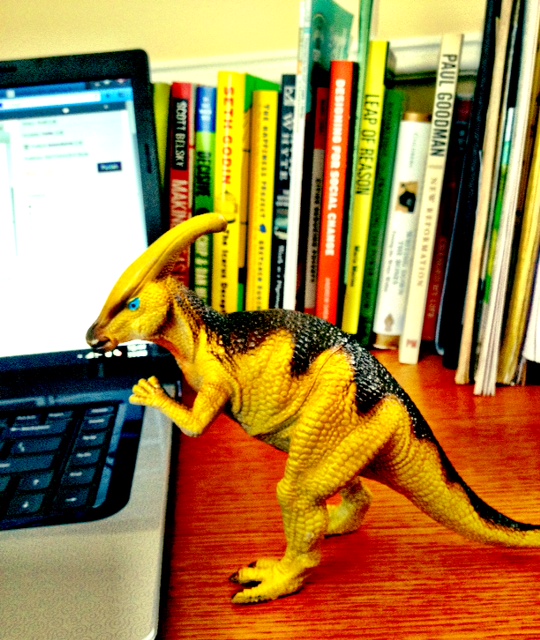
Parasaurolophus attack.

Parasaurolophus attack.

Uh, oh, I have to go.  I’m under assault by a parasaurolophus.  Right here on my desk.  It roars.

On writing as an act of generosity

I am a big fan of generosity.  I love the notion of giving, of gift as interaction and interaction as gift.  And I’m a big fan of writing.  But it has only recently occurred to me that those might be the same thing.

Naturally, there are many writers whose work felt like a gift to me — Barbara Kingsolver, Wendell Berry, Billy Collins, and many more — but it felt private.  It was the emotional counterpart to my teenage habit of hugging a book to my chest as I snuck off somewhere to read (since I was not supposed to be reading but rather doing something “productive” like washing dishes).  I cherished the words and the stories and I felt wildly privileged that they spoke to me.  To ME!  But as I got healthier and wholer, I came to see that the larger political significance I’d always attributed to stories was perhaps the same thing as this deeply personal conversation, just on a broader scale.  As these and other writers opened my eyes and my soul to the wider world, and as I learned (ironically, well AFTER my PhD in Comparative Literature) how many other eyes and souls were out there, doors ajar, because of their writing, I came to see that this is their gift to the world.  Barbara Kingsolver, in fact, talks about this in a video she did way back when Animal Dreams was first published (which I can’t seem to find today); she says, essentially, that the most important thing she can do for this broken world is to put her butt in chair and write.  It’s true, she tends to work on the macro level, I think: witness this excerpt from a conversation with David Gergen about how stories structure and define our world, our nation, our communities:

“DAVID GERGEN: –but through your own novels to invent a new set of stories for us, is that what you’re about?

BARBARA KINGSOLVER: It is in my own little corner. That’s what I’m trying to do. I love what Joseph Campbell said about mythology. He said that our stories are what holds us together as a culture, and as long as they’re true for us, and as long as they work for us, they–we thrive. And when they cease to become true, we fall apart, and we have to reconstruct them or revitalize them. We have to come up with new myths.”

And of course that’s what she does: her stories enable us to connect to the land and the people who work it; to understand the histories of human movements and failures; to imagine ourselves into a capacity for managing heart-wrenching, world-churning change that right now seems certainly fatal.  But what’s brilliant about Kingsolver is that she works on the micro level as well.  Her characters and her language are so compelling, so utterly moving and hilarious and desperate and comforting, that we can’t help but be drawn in.  As a reader, I’m in awe of that.

But now I find myself thinking, for the first times in my life, as a WRITER too.  It feels like hubris, and perhaps it is. But I’m slowly, slowly catching up to the notion that when we have a gift to give and we believe in generosity, then we have to give it.  Even if it is our writing.  Even if it is a painful exposure or a risk or an embarrassment, or whatever it turns out to be.  Maybe we have to do it.  (I’ve had little angels tell me this before — angels in the sense of folks who show up to say wise things or be there when you need them — the most memorable of which was a guy at a conference in San Francisco years ago who came up to me after I’d spoken in a seminar to ask what my book was called.  I said I hadn’t written one, and he asked why not, and then he held my eyes while I squirmed.  “This isn’t about ego,” he said.  “The world needs to hear what you have to say.  You have to get out of the way.”)

So here I am, trying to get out of the way, though a little confused by the whole thing and unsure of what comes next.  I am grateful for the readers I have and hopeful for more; I am grateful for the extraordinary writers (novelists, bloggers, poets, and authors of all stripes) who inspire me every day with their bravery and their brilliance.  I am grateful, I suppose, for the gift I’m perceiving and for those of you who are out there to give it right back by receiving.

On dancing and seeds and grace

grape hyacinth budHere’s my afternoon: starting seeds with Ezra in the basement; coming upstairs to find Len and Chi home from the grocery store and provisioned with a tasty new beer (well, Len, anyway); dancing with both babies to The Miseducation of Lauryn Hill.  Her song “Bonus 2,” which is essentially First Corinthians brought to extraordinary life, always reaches out to me — but today, as I held my small fevered Ezra in my arms and danced, it was transcendent.  To sing those ancient words of love to my son, through Lauryn’s music, to feel the rhythm move through the bones of this old white Colonial, well, I was shaken.  I was lifted up.

I don’t often write about spirituality, or at least not as such.  It’s partly because I feel those are kind of private issues, and also because I’m uncomfortable with the ways articulations of our own faith can end up looking or feeling like advocacy or pushiness to others.  I confess, I’m also tired of the self-congratulatory tone of lots of the writing out there on religion.  And also, let’s face it: I’m a seeker who was raised Quaker (more in the secular humanist end of that spectrum) in a kind of do-as-I-say-not-as-I-do sort of way.  So I have no sense of authority, only a heart full of questions and gratitude.  I tend, then to use the language of mindfulness or grace, since the former is more of a practice and the latter more of an acceptance of what seems an obvious and widely accepted truth.  For me, there are lots of interchangeable words that describe what I have faith in: love, beauty, the sacred, harmony, nature, the universe, grace, providence, serendipity, the Way, the Light, truth, hope, and of course the many permutations of god.  It is clear to me that music is sacred, as are the gifts of all artists and growers and makers and seekers — all creatures, and especially those who offer up something of beauty, who uncover or create or otherwise act with generosity in this sad and broken world.

I’ve been trying to read Margaret Wheatley’s So Far From Home, though it’s hard, because its premise is that we cannot change the world; we can only accept our powerlessness and do our best to live whole and beautiful lives by doing the right work because it is work that needs to be done.  That living, that standing in contrast to the crazy and the broken, is itself transformative.  I buy this, mostly, because it seems smart and truer than anything else I know, but I’m not wise enough or whole enough to live within it.  I’m trying.   Most days, I’m still seeking, perhaps too anxiously, for that “right work,” unable to accept that where I am is enough.  But on a day like today, that truth rings out: of course it’s enough.  Perhaps not forever, but I don’t live in forever.  I live right here, right now, right in the middle of all this beauty, surrounded on all sides by grace.

Making MORE, not less, of ourselves

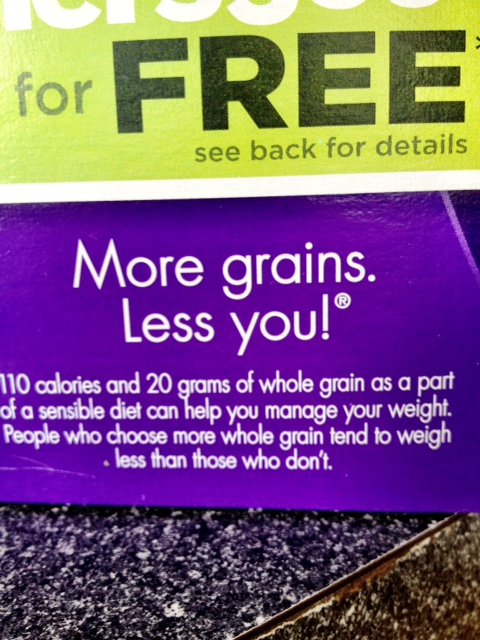
But, but, but...here I've been working so hard to make MORE of me!

But, but, but…here I’ve been working so hard to make MORE of me!

I know I’m not always in the best mood in the morning, but it was still a shock to see this on the cereal box.  And to realize that this is what my (mercifully pre-literate and mercifully male) kids have been staring at.  And to realize that this kind of message is everywhere.  How broken is that?

I know they mean well, that it’s a weight-loss message, but still.  Come ON, Cheerios.  Surely you’ve noticed the whole self-actualization agenda that is at least trying to keep pace with our nation’s long-term self-hatred protocol?  Maybe this is another reason why I shouldn’t eat Cheerios.

In all seriousness, though, this has started me thinking about the range of ways our culture invites us to be less than we are, and not just physically (though that encompasses not only weight issues but the whole range of gender-normative behaviors and style).  Jobs are stultifying enough that most of us have to compromise most of our selves in order to earn the paycheck and the benefits we need; educational programs force us into outdated molds of specialization; even cocktail-party conversations (I think; I can barely remember that far back) expect a short answer to the standard question: What do you do?

Here’s what I’d like to say to that, today: I raise two pretty awesome little boys in ways I hope are feminist and respectful and empowering.  I read whenever I can.  I write (academic work, poetry, this blog, articles, children’s stories) and seek to write a lot more.  I hope and plan to get paid for writing.  I serve on the board of a major community action agency and chair its committee on community impact.  I used to teach college and build community-partnership and community-based learning programs.  I have a PhD and often wonder if and how I can put that to appropriate use again.  I consider teaching options.  I lead discussion groups for our state humanities council and my local public library.  I crochet and I sew, and I especially like working with upcycled and repurposed materials.  I work on recovering from a childhood that bizarrely merged great privilege with great difficulty.  I fix things that need fixing, when I can.  I talk to my neighbors and pitch in where I can.  I hope to build a community of moms where I live.  I discovered recently that I can kind of draw.  I struggle with how to balance my type-A-ness, which I need but instinctively dislike, with my husband’s more relaxed approach to life (type L?  L for Love?), which I admire but which doesn’t privilege order as much as I need.  I like getting older.  I like lifting weights and am kind of glad that my family’s propensity for osteoporosis makes it kind of non-optional.  I chastise myself a lot for not lifting often enough, though, and I’m working on that.  There’s more, but there’s always more, and that’s the POINT.

You see my resistance to the language of “less”?

Patti Digh has a great bit in her totally fabulous book “Life is a Verb,” in which she mentions a study where a guy asks kindergartners to raise their hands if they are painters.  All the hands shoot up.  Dancers? Ditto.  Singers?  Yes.  Then he asks college students the same thing, and hardly any hands go up.  “What happens in those years,” she asks, “between five and eighteen to our sense of joy and possibility and personal command of the universe?”

Personal command of the universe might be a bit much to ask, but the SENSE of it is glorious.  It’s the sense of our largeness, our infinite capacity, our minds and hearts as generous and accepting and brilliant as they were born to be.  Mindfulness practitioners often say that when we try to meditate, it’s like sitting inside a closet crammed with the detritus of our lives.  And as we practice more, the disappointment is that the same crap never really goes away.  But the closet gets bigger and bigger, becoming a room, a cathedral, an airplane hangar, and soon the wide blue sky.  A few old pairs of cleats and some back tax files don’t bother us nearly as much under those circumstances.

I find it’s the same thing with our general sense of self.  Bad hair, bad skin, an achy shoulder, a snide remark — all these things can fester if we keep ourselves small (ironically, often the same thing as keeping ourselves “secure”).  But if we admit our largeness, our GREATNESS — in the sense of our participation in the grand drama of human events, not some weird ego trip — then who really cares?  We are who we are, and we deserve to surround ourselves with people who love us and things that give us joy.  We deserve to celebrate exactly who and where we are.  More grains, Cheerios, by all means.  But please don’t try to make less of us.

On competence

Those of you who had careers you loved and excelled at and left to raise kids, you’ll know what I mean when I say that I CRAVE a sense of competence.  I used to zip around my world, well-dressed, well-informed, good at what I did.  It gave me (an unduly large) sense of purpose and it helped me feel at home, useful, valued.  Then, well, I had babies.

Now, of course, I’m not well-dressed and I rarely zip anywhere (unless there’s the sound of choking involved, or tiny feet on forbidden stairs).  But more importantly, I’m way outside of my zones of expertise.  Over the months and years, of course, you get good at some things — you learn the tricks to making the baby eat more applesauce, fall asleep faster, laugh more often.  You learn how to wash their hair without getting water in their eyes.  You learn how to draw a little bit, put on puppet shows, and dance with two small people at once.  But mysteries abound, and the failure to solve them is both constitutive of our tasks as parents and, more simply, a persistent pain in the ass.  How best to assist night-weaning?  How to promote potty-training? When to shift naptime?  There are days — like today — where the pre-5-am wake-up is not good for anyone, and breakfast time is generally a whine-fest.

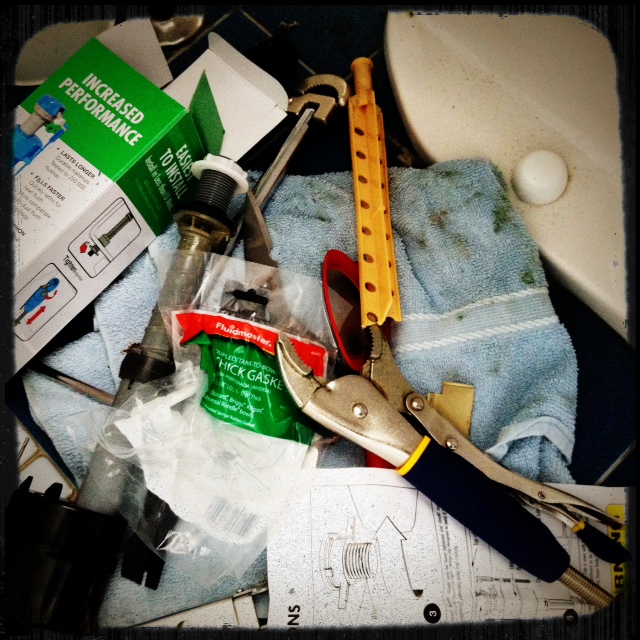
toilet repair detritusFortunately for all of us, today is also a DAY CARE DAY!!  Hah HAH!  I can get something DONE!  Unfortunately, the prime task at hand is fixing the broken toilet.  I realize that kind of sounds like a punch line, and it kind of IS, but here’s the thing: I love this kind of work.  I love it when you can actually see your accomplishment.  (Of course, I hate hate hate the three trips to Home Depot involved, especially because I planned ahead, but who knew the little pre-packaged nut-and-bolt set contains not the necessary THREE, but a useless TWO bolts?)  But there are so many things in our world and our lives that involved delayed gratification, or none at all, that something this concrete is, well, pretty awesome.  Plus, it uses ingenuity (that’s right, I thought to use the pliers as a sort of block to hammer lose the big central nut that would not come loose and was too big for our biggest wrench) AND WD40, and that’s a winning combination.  And I have to admit: I’ve always loved hardware stores.  They fill me with a sense of possibility, as if I might be doing more than just fixing a toilet, as if I might be building a beautiful, sunlit studio right between the asparagus patch and the apple tree.  Hmmmm.

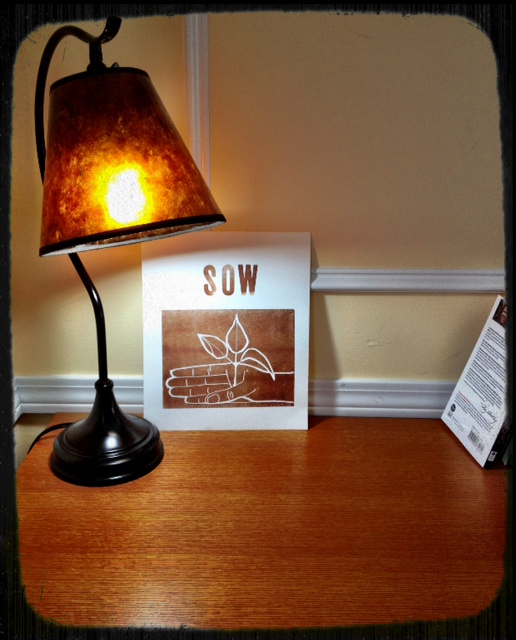
Competence and achievement, or the promise of them, have the power to pull me through another tired day, but more than that, they help me look at the usual crap fromclean desk a different position.  Today, for example, I didn’t just sort and file papers (again!): I cleaned my desk!  It’s beautiful, with a new lamp and an inspiring new print from my artist friend Kim Crichton (check her stuff out here!).  I didn’t just manage the ongoing saga of familial healthcare: I was an effective advocate for my son in a meaningful conversation with a doctor that settled some important points.  The energy to do things today, and the capacity to see them as whole and important, come from the toilet’s reminder that I am competent, that I can achieve things…and now the desk will remind me of the same thing.  (Right up until it’s covered in clutter again, I suppose…hey, we’re all a work in progress.)  My environment usually conspires against me, rife as it is with the needs and detritus of people’s lives.  But sometimes it’s useful to remember that the spaces we live in can also show us our best selves, if we’re willing to work to let them.

On the challenges of showing up

When I was in graduate school, I worked at a really good restaurant that some friends of mine were opening.  It was a small place, and serious about their food, drink, and service.  To support that, they made every staffer go through an intensive and prolonged training where you tasted every single thing on the menu (oh, hardship) and learned about how it’s made and how to describe it.  The wine part turned out to be especially interesting to me, because we were given the proper schooling on how to “taste” wine, and I found that I resisted mightily.  I could taste all the same things everyone else was talking about, and the descriptions all made sense and I enjoyed having a new vocabulary, especially one with such cultural cache (how the eff do you write a French accent in here?).  But I could not, and cannot, let wine roll all the way off the edges of my tongue.  It is way too intense for me.  It’s almost physically painful.  Our teacher, the wife of the team (who has since completed sommelier school at Windows on the World and opened her own wine shop) was amused — apparently there are people who are considered “super-tasters” who have these issues.  That seems too fancy a title for me, but the fact remains that I cannot abide the intensity of wine that way.  Some folks can’t drink hard liquor for the same reason; others hate spicy food.  Sometimes experience is just too much and we want to calm the stimulus or avoid it altogether.

I tend to think about mindful living in the same way, especially parenting.  I’ve realized lately that I spent much of the fall in kind of a daze, dealing with one familial health issue after another, and so rarely actually attending to the people rather than the problems.  I’m becoming aware of this as I see how much my kids have grown, how the shapes of their faces are changing, the growth of downy hair on their arms and cheeks.  We walked at the pond today and Ezra stomped puddles the whole way there, rather than riding in the stroller; Malachi wanted to get out and walk, holding onto my hands, up and back, up and back one particular stretch.  I’m trying not to avoid the anguish of their growing up anymore.  I’m trying to think of the truth I heard of a child’s first day of school: how terrified you are for them, and for you, and how thrilled you are as well.  That the two not defeat each other, or cancel each other out, seems like a major goal, or perhaps a small miracle.  So that’s how I’m trying to live these days: to see and relish the absurdity of softness and roundness that is still, for a while, Chi’s little body, and not to worry about what comes next.  Many days, that seems too tall an order, because how else do we prepare ourselves for the angst and chaos ahead?  But maybe all this mindful stuff is right after all, and the only reality is now, and the only truly great thing we can do is show up.

On getting off one’s duff

Or, as Seth Godin refers to it in a recent blog post, “shipping your art.”

“What, exactly, are you insisting will happen before you start shipping your art?” he asks.
A helpfully clarifying question.  For me: both children will achieve perfect health, the house will seem manageable, and I’ll have a great job and an exercise habit.  Ah.  I see his point.  Plus, when the “art” you will “ship” has a great deal to do with the aforementioned living skills, well, waiting moves beyond illogical to flat-out ironic.

On strategizing

Work is one of those areas we tend to ruin for kids, like healthy eating and time management.  We act like we’ve got it together, and in reality, we’re just feeling our way along with a handful of principles and a heartful of hope.  “What do you want to be when you grow up?” we ask, like it’s a simple decision to make and a simple path that stretches forward from there.  Ah, for the good old days when the choice seemed feasible and easy.  A doctor.  No, today I want to be a teacher.  An ice-skater. An airplane pilot.

The challenge arises when you’re 39 with two kids, three degrees, and fifteen years of solid work in a given field under your belt, and you’re trying to broaden your thinking.  You’re just dripping with intentionality, and it’s starting to get annoying.  Not as annoying as the disabling sonar of your three-year-old’s wail or the baby’s uncanny persistence in the face of what he KNOWS is off-limits — but annoying.  Get a job, you hear some cruel voice say in the back of your head.  It’s hard to know, though, which of these that voice really means:

  1. Get paid; stop being a drain on resources.  (To which I say: do the damn math.  Stay-at-home moms are worth about $110 K/year, according to Salary.com and other sources. And yet, I miss our DINK days, no doubt.)
  2. Get validation. (To which I say: yes, please.  I could use that.  But validation comes in many forms.)
  3. Get out of the house. (Indeed. Good plan.)
  4. Get involved in work that makes a bigger difference.  (But I AM!  I serve on boards and write and am raising feminist boys, and…well, yeah, I miss that, too.)

So you need a strategy, but not the old kind, where you shake every job-hunt tree in reach and see what falls out.  No, this kind of strategy needs multiple prongs and greater strategery.  Here, you need to honor (with a straight face, if possible) the multiple facets of your life, the many skills you have, the many longings.  You need to quiet the voices of criticism and their obnoxious reminders that those wasted degrees are IVY LEAGUE degrees.  Put differently, you don’t want to end up charging full-bore at something you THINK you want, only to find out you’re wrong.  So now you do this:

  1. Job-hunt in the conventional ways, for work in your field and close to your field and close enough that you think you’d like it.
  2. Develop the writing: seek publishers and editors and contacts and assignments.  Take workshops.  Jump in.
  3. Develop the crafting: remember that not everyone is out making cool scarves from recycled velvet dresses, or sweet hats from old sweaters. You do have vision and you do have skill, and there are folks close to home who are creating markets that might sell your stuff.
  4. Network, broadly and openly, about the Search.  Acknowledge its multiplicity.  Own its complexity.  People love to give advice and to help — take it.  All of it.
  5. Work hard not to resent your children for needing you or your spouse for having a daily life that involves silence, reading, professional respect, and music of his choosing.  Work hard to stay centered and limber and whole.

Good plan, no? The devil (or at the very least, the wee cherubs and their noiseful chaos) is in the implementation.

The candle that lights the others

I’ve been stewing in my own juices lately over this whole question of work — how exactly do I envision my life, and how do I know if my vision is lousy or wholly unrealistic?  Am I drawn to what draws me because it is “right” for me, or is it just history, degrees, pathology?  When I ask my facebook friends what I should do, they all mention my handcrafts — which I believe has to mean something.  But I have lived a life of teaching.  I have BEEN, I like to think, I have been told, the candle that lights the others.  I love that work.  I want to do more of it.

We all have activities we enjoy and goals we pursue and ways of being that feed us.  Vocation, we are told, is “the place where your own deep gladness and the world’s deep hunger meet” (Buechner); it is also “the thing you can’t not do” (Godwin). But I am a slippery fish: I learned early to do and not do what worked for those around me, and to be more or less happy with that.  I am like Kingsolver’s character Ada in “Poisonwood Bible”: I can make anything fit anywhere.  I recognize that I HAVE deep gladness, and of course I realize that the world has many deep hungers, but I find many fields where the two cross paths.  This infuriates me and gives me hope.

What seems ultimately clear to me, though, is that I take pleasure in facilitating learning or inspiration.  I love helping people to see what they could not before.  Heck, I even love when someone ELSE does that.  Last week, we were at a local festival of artisans and craftspeople, and I fell into conversation with a fiber artist in a mixed-media gallery.  As we talked more, and as I mentioned my husband’s photography, she realized who he was, and she turned to him, full of light: Oh! You do those layered images!  You had one here (she points to a corner of the wall), it was beautiful.  It inspired me.  And then followed a technical conversation about how he achieves this effect and what she has tried so far. I could not have been more pleased.  And it had nothing to do with me.

So: back to teaching? Back to the work of empowering college students to engage in their communities for better learning and positive social change? Back to influencing the flow of money toward bold innovation that promises solutions to intractable problems?  What do you do? How does it light you up, or help you light up others?